



 0
0

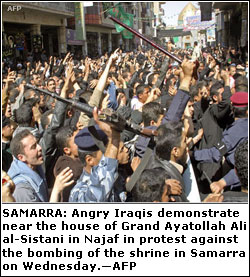 SAMARRA, Feb 22: A bomb attack on Wednesday destroyed the dome of a major holy Shia shrine in the Iraqi town, prompting reprisal attacks against 27 mosques in Baghdad that left six dead.
Two explosions brought down the gilded dome of the 1,000-year-old Imam Ali al-Hadi mausoleum, fanning fears of a sectarian war between Iraq’s two major sects.
The attack against the shrine, where Shias believe their 12th Imam disappeared in the ninth century AD, triggered violence that was unprecedented in scope since US forces ousted Saddam Hussein in April 2003.
In Baghdad, mobs killed three clerics and three worshippers in assaults on 27 mosques, an Iraqi security officer told AFP.
Crowds machine-gunned numerous religious sanctuaries and torched at least one, the officer added.
In the south, a crowd stormed the Basra offices of the Islamic Party, killing two people and wounding 14 others, police said, giving no further details.
A mob wounded a guard in an attack on the Islamic Party offices in Nassariyah, police said.
“We ask the Marjaiya (Shia grand ayatollahs) to intervene before it is too late,” the Islamic Party’s chief Tareq al-Hashimi told journalists.
The mobs nationwide ignored a public appeal by Iraq’s top religious authority, Grand Ayatollah Ali al-Sistani, who urged his community to remain calm and to refrain from seeking vengeance.
“Ayatollah Sistani is appealing for calm and against attacks on Sunni mosques and places of worship,” one of his aides told AFP. The office of Prime Minister Ibrahim Jaafari, who proclaimed three days of national mourning, later announced that three suspects had been arrested in connection with the Samarra bombing — news that was flashed on local television broadcasts in an apparent bid to ease tensions.
Waving green flags and the national Iraqi colours, thousands of people had earlier taken to the streets of Samarra, 125 kilometres north of Baghdad, vowing to punish those responsible for the attack.
Shops closed and muezzins recited prayers from the loudspeakers of nearby mosques and blamed the United States for the turmoil, saying “God is Great, death to America which brought us terrorism.”
A few hours later, tens of thousands rallied in several areas of Baghdad and in the cities of Karbala and Najaf, in southern Iraq.
Mr Jaafari called on Iraqis to denounce sectarian attacks and “close the road to those who want to undermine national unity”.
The latest bloodshed came as political representatives of two sects bicker over the formation of a national unity government, amid anxiety that further delay in setting up a cabinet could lead the country into chaos.
The head of one of the most powerful parties in Iraq, Abdel Aziz Hakim, attributed partial blame for the bombing to US Ambassador Zalmay Khalilzad, two days after the US diplomat offered a veiled rebuke to Shia parties in public.
“These statements …… gave the green light to terrorist groups. Certainly he is partly responsible for what happened,” Mr Hakim told journalists in Baghdad.
However, Mr Khalilzad, who enraged Mr Hakim on Monday with his warning the United States would curtail funds if Iraq was run on a sectarian basis, condemned the bombing and pledged US assistance.
The supreme leader of neighbouring Iran, Ayatollah Ali Khomeini, also blamed Washington. But he too called on Iraqi Shias not to seek revenge.
The Samarra bombing, carried out by men dressed in police commando uniforms, bore the hallmarks of extremist Abu Musab al-Zarqawi’s Al-Qaeda organization in Iraq.
US President George W. Bush called on Iraqis to act with restraint.
“Violence will only contribute to what the terrorists sought to achieve,” he said in a statement.
The head of the Sunni religious endowment organisation, Ahmad Abdel Ghaffur al-Samarrai, also condemned the attack, terming it “a criminal act”.
Reflecting the broader regional interests involved, Iran’s Supreme Leader, Ayatollah Ali Khamenei, urged people to show restraint and not to take revenge on Sunnis and blamed the attack on US and Israel’s local agents.
“This is a political crime and its origins should be found in the intelligence organizations of the occupiers of Iraq and the Zionists,” Ayatollah Khamenei said in a statement read out on state television.
“The dominating powers ... have ominous plans such as aggravating the insecurity and creating religious disputes ... Today’s crime in Samarra added another page to the list of misdeeds by Iraq’s occupiers,” he added.
Announcing a week-long period of mourning in Iran, Ayatollah Khamenei urged all Muslims to avoid fanning the flames of sectarian rivalry.
“There are definitely some plots to force Shias to attack the mosques and other properties respected by the Sunnis,” he said. “Any measure to contribute to that direction is helping the enemies of Islam and is forbidden by Shariat,” he added.
Foreign Ministry spokesman Hamid Reza Asefi also said US-led forces in Iraq were ultimately responsible for the blast.
“This inhumane act, committed by terrorists when Iraq is insecure, is due to the presence of the (foreign) occupiers there,” said Foreign Ministry spokesman Hamid Reza Asefi.
“It aims to insult religious sanctities, trigger turmoil, launch religious war, and create rifts among the Iraqi people,” he added.—Reuters/AFP



























