Denying funds to Hamas
ISRAEL has taken yet another measure that will rule out the chances of a resumption of the peace process. By denying $50 million in revenue receipts to the Palestinian Authority, the government headed by acting Prime Minister Ehud Olmert seems determined to sabotage the democratic process in Palestine. Gaza is already one big slum with a high crime and unemployment rate. The PA is Gaza’s biggest employer, and if state employees fail to get their salaries, popular discontent could explode into violence and lead to anarchy. This perhaps is what Tel Aviv wants, without realizing that it can deal with a Hamas that is in power in a much better way than it can with Hamas as a guerrilla movement. Hamas has not yet formed the government, though President Mahmoud Abbas has invited it to do so, because it has captured a majority of seats in elections to the PA legislature held last month. As a majority party, it has every right to govern its people and be responsible for its action to parliament. To refuse to deal with a Hamas government thus means a refusal to honour the results of democratic elections.
The denial of money by Israel may create short-term problems for the PA, but it is doubtful it will lead to a collapse of the Hamas government. Last year, the Arab League agreed to fund the PA, and the AL foreign ministers are due to work out the modalities of giving $50 million to the PA every month. Iran is also likely to join the Arab move, and this should enable the PA government to continue to function. The most unfortunate aspect of the situation is America’s total support to Israel’s boycott of the Hamas government. While Washington has indicated it will continue humanitarian assistance to the PA, Secretary of Sate Condoleezza Rice has reacted negatively to an Iranian-Arab financial bail-out for the PA, saying the donors must consider the consequences of their action. What America should consider is the consequence of Israeli actions instead of worrying about the consequences of the Arab-Iranian financial help to the PA.
A guerrilla movement that managed to survive for decades and withstood Israel’s persecution and “targeted assassinations” is not going to call it a day because Tel Aviv or the US have decided to starve it of funds. The real tragedy will be the lack of progress on the peace front. The roadmap crafted by the five — the US, Russia, the EU, and the UN — is dead. Originally, it provided for the emergence of a Palestinian state “by 2005”. However, on a visit to Washington, Mr Ariel Sharon prevailed upon President George Bush to let Israel retain some lands in the West Bank. Later, President Bush said that 2005 was an unrealistic date for a Palestinian state to come into being. Since then the peace process has been in limbo. Instead of backing Tel Aviv in its bid to throttle the Hamas-led PA, the US should have adopted a positive attitude towards Hamas and asked Israel to enter into negotiations with the latter. Hamas would then have adopted a positive attitude and sought a realistic solution to the Arab-Israeli conflict instead of sticking to the unrealistic goal of destroying Israel.
All but whitewashed
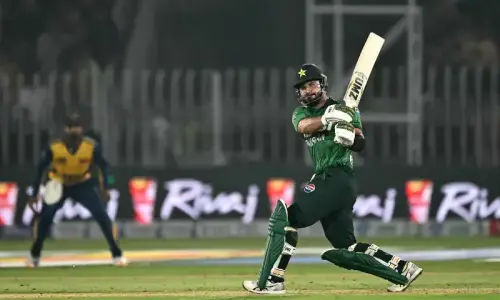
BY beating Pakistan in Karachi on Sunday, the Indians took the one-day series 4-1. It was a near-reversal of the ODI series in India last year which was clinched by Pakistan by four successive victories after having been 0-2 down. Euphoric after winning the Test series, Pakistan perhaps took things lightly with the result that they were outplayed in departments of the game, especially in fielding. Indeed, but for the application of the Duckworth-Lewis formula in Peshawar, the Indians might have made a clean sweep of it. Their last three wins were masterminded by Yuvraj Singh, a rising superstar, and Mahendra Singh Dhoni, who bids fair to challenge Australia’s Adam Gilchrist as the world’s best wicket keeper-batsman. In Karachi, while Yuvraj Singh found the gap on either side of the wicket with surgical precision, Dhoni, blazed his way to an incredible 77 in no time. Yuvraj himself made an unbeaten 100 but was left to praise his irrepressible partner towards the closing stages of the game.
Surprisingly, it was India’s pace attack which played a decisive role in the series. Irfan Pathan, R P Singh, Ajit Agarkar and Sreesanth, all claimed crucial wickets and denied Pakistan the chance to build any meaningful partnership throughout the series. Shoaib Malik, batting at number three, did what he could to serve his side but the others disappointed. Skipper Inzamam himself was sadly out of form with the bat while his bowlers and fielders let him down again and again. India’s performances against Sri Lanka and now Pakistan enhance their chances in the World Cup in the Caribbean next year, because on current form, they appear to be second only to Australia in the one-day format of the game. Bleak as Pakistan’s pitiful showing was, there was a silver lining in the cloud down-south in Colombo where our Under-19 lads retained the Junior World Cup by defeating India in the final. Bowled out for 109, they sent the Indians packing for 71 in a spirited display of pace bowling which reduced their rivals at one stage to six down for just nine runs. Perhaps some of the teenagers will don the national colours in the not too distant future. And, as they say, we must catch them young.
Attack on churches
GIVEN the religious frenzy and violence sweeping across the country over the cartoon controversy, it should come as no surprise that two churches in Sukkur were burnt on Sunday over an alleged act of desecration of the Holy Quran. In such cases, it has always been difficult to ascertain the veracity of a blasphemy charge but that has never stopped mobs from being whipped into action and going on a rampage. This was witnessed last year at Sangla Hill when angry mobs attacked churches over an allegation of the Quran’s desecration. In Sunday’s incident, police were investigating the case between two Christian men who reportedly were engaged in a property dispute but began charging each other with blasphemy when news spread of the alleged act of desecration, thus inflaming the passions of a section of the youth. To vent their fury, they took to the streets attacking the churches, a Christian school and even a police station. They were dispersed only when the Rangers were called in.
Although several people have been arrested, it is likely that they will not really pay for their crimes — as inevitably happens when protesters are first rounded up and soon released only for them to go repeat the performance elsewhere. It is time that those who disrupt law and order, whether by attacking public property or by inciting others to do so, were seriously dealt with. Leaders need to play a responsible role and calm their communities rather than goad them into violence. No matter how hurt a community’s sentiments are, the law must be allowed to take its own course. As has been said before, everyone has the right to protest provided it is done in a peaceful and orderly manner.
Street violence is not the answer
IT is ironic that in the middle of the cartoon crisis, Abu Hamza al Masri, a London-based Muslim leader, should be convicted by a British judge for delivering sermons that “created a real danger to the lives of innocent people in different parts of the world.” The verdict creates a dilemma for the supporters of the Dane editor who published derogatory cartoons of the Prophet (PBUH) in the name of free speech.
The caricatures published by the Danish newspaper did a lot more damage than “create danger to lives of innocent people.” They actually led to the deaths of nine people in different parts of the world, and the death toll threatens to rise further. Would someone take the editor responsible for the violence and deaths to a western court of law? The British judge who convicted al Masri admitted that he had no idea whether anybody ever acted on his violent sermons. In the case of the Danish editor, his act of publishing the cartoons has directly led to the deaths of several people. What would the British judge say if the case of the editor was brought before him?
Britain’s attorney-general, Lord Peter Goldsmith, who prosecuted al Masri, stated that, “Free speech is important in our democratic and multi-faith society, but encouraging murder and inciting hatred against others because of their race will never be tolerated.” Well, the Danish newspaper has done just that.
And lest any one should think that the cartoons were published without the knowledge about their potential to create havoc, the editor of Jyllands-Posten said that he was actually testing what would happen if he published the offensive cartoons. He decided to go ahead with this “project”, when an author complained to him that no cartoonist or artist was willing to draw similar cartoons and pictures for a book he wanted to publish. The fact is that the cartoons were published in Denmark and later on in other newspapers with the full knowledge that they would incite Muslims.
And that is exactly what Muslims going wild in their protests need to realize. The West is sending a clear message across the dividing line and it is: “we no longer care about your sensitivities and we are not afraid of you so let’s see what your warnings are worth, once and for all.” British author Salman Rushdie who offended Muslim sensibilities by publishing Satanic Verses was forced into hiding for several years because of the threat to his life. The British government had to protect him round the clock. Tasleema Nasreen of Bangladesh tried to propound her own family interpretation of the Holy Quran and had to flee for her life. The West had to literally adopt her for years to save her from the wrath of angered Muslims of the world. No one dared print a word that had the potential of inciting Muslims.
But that was before 9/11 and the war on terrorism (and Muslims) had not yet started. After four years of “smokin’ em out” from Iraq to Indonesia and Mindanao to Waziristan, the West is no more inclined to tolerate death threats and fatwas. The western world is ready to take on the Muslims.
When the editor of Jyllands-Posten said he wanted to test and see what would happen if he published the cartoons, he was, knowingly or unknowingly, representing the entire western world. That the West is solidly behind the “test” was affirmed as soon as the western media and leadership learned that the Dane editor was in trouble for challenging the Muslims. Leading European newspapers published the offending cartoons, knowing fully well that they had provoked Muslim anger and would add fuel to
fire.
Even American newspapers are beginning to reproduce the cartoons, “as a matter of policy”, according to them as they are becoming “more newsworthy” with the increase in violence.
President Bush picked up the telephone and assured the Danish prime minister of US support. The Danish prime minister had earlier refused to even meet a delegation of Danish imams who wanted to brief him on Muslim sensitivities about the cartoons. German and US foreign ministers, instead of condemning the publication of the offending material, have blamed Iran and the Arab countries for exploiting the cartoons to incite unrest.
This is not to say that the cartoons were published as part of some grand international conspiracy against the world’s Muslims. What is happening is that the lines that were drawn between Muslims and the rest of the world 1,500 years ago are once again transforming into battle lines.
Two civilizations are clashing once again. It was only about 956 years ago, in 1050 A.D. when Pope Urban I called upon the Christians of Europe to unite and fight a crusade against the Muslims. Of course, that was not the first clash between the two civilizations. An earlier one had occurred around 636 A.D. when Muslims had begun to reach the heart of Europe. Seen from this perspective of the last two millenniums of history and the consequent rise and fall of great empires, it is not too far-fetched to see the events of the last few years as a renewal of the age old clash between the two civilizations.
However, while it is useful to understand the bigger historical phenomenon behind the events like the attempt to incite feelings through cartoons, the refusal by the French government to allow veils at schools, the attack on the Twin Towers, wars on Iraq and Afghanistan, the emergence of extremist organizations like Al Qaeda and Hamas, Muslim unrest in several countries it would be wise to remember that this is not the age when Tariq bin Ziad burned his boats after landing on European soil or when Saladin marched to take back Jerusalem from the crusaders.
Times have changed, if human nature has not. Conventional war is not an option for any Muslim nation of the world, but it took Saddam Hussein and Mullah Omar’s foolhardy behaviour and the resultant loss of life before Muslims learned this simple fact.
As a matter of fact, conventional war and the conquest of weaker countries is not an advisable course of action even for super powers as America has learned to its horror in Iraq and Afghanistan. Unable to bridge the technology gap, weaker people now employ innovative methods to fight stronger enemies. Guerrilla warfare in hills and jungles, sniping in urban areas, explosions and suicide bombing are some of the new weapons of the have-nots.
Angered by the West’s provocations and frustrated by the knowledge that they are helpless to retaliate, Muslims are taking to the streets. They are attacking European embassies and burning flags. In their desperation they are doing exactly what the provocateurs want them to do. They are providing them proof that Muslims are emotional, irrational, vulnerable to provocation and therefore dangerous commodities that need to be eliminated. They are supplying material to justify the war against terrorism.
The main reason for street violence by the Muslims is the abysmal lack of proper response at the official level. Unfortunately, most of the ruling regimes in Muslim countries are held hostage by western powers. Kings and dictators owe their existence and continuity to material support from American and European countries because they have no moral or legal basis to rule their countries. The divine right to rule is neither recognized by the West nor permitted in Islam.
The military dictators claim power through military firepower, for which they are fully dependent upon advanced western nations, especially the United States. It is obvious, therefore, that the ruling clique in most Muslim countries is unwilling to take a strong united stand that would annoy the West.
Muslims of the world need to realize that as long as they allow themselves to be ruled by regimes that owe their own existence to the opposing civilization they are destined to live as losers. It is pathetic that while the rest of the world moves towards democratic dispensations, the gulf between the governments and people in Muslim countries should be widening.
If Muslim countries had representative governments they could have forced the western governments to stop ridiculing Muslim sentiments by confronting them with several peaceful yet firm steps: lodging official protests, arranging peaceful demonstrations and picketing, recalling ambassadors, reducing diplomatic staff, closing down embassies, threatening to ban all imports from offending countries, and last but not least, threatening an oil embargo.
None of that happened for several months even though Danish imams, who had been rudely rebuffed by their government, showed the offensive material to the rulers of several Muslim countries.
If governments of Muslim countries had responded swiftly to send a firm message across the divide, the violence and killing could have been avoided. But kings and dictators cannot be expected to understand what the masses want. And even if they understand, they usually have other agendas to follow. The primary task before Muslims, therefore, is to work towards establishing real and true democracies in their own countries, so that their rulers are sensitive to the needs and wishes of their own people rather than those of the clashing civilization.