0
0

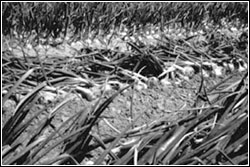 WITHIN weeks of an acute shortage of onions in Maharashtra – the leading producer in India – when prices soared to record levels, and India had to resort to imports from Pakistan, the situation has changed dramatically.
Farmers in the state have reported a bumper crop this season, and the markets are flooded with onions. While consumers might rejoice over the fact that prices have crashed sharply – from an unbelievable Rs150 a kilo just three months ago, to a measly Rs3 – farmers are weeping.
One onion grower, who was deep in debt, even committed suicide last week. Hundreds of cotton farmers have killed themselves over the past one-year in Maharashtra, especially in the drought-prone Vidarbha region. But this is the first time that a farmer has had to resort to such a drastic step in northern Maharashtra, which has an abundance of water.
The state government, however, has taken a pragmatic decision of encouraging farmers to export their produce. It now offers an export subsidy, and has decided to issue licences to 22 exporters. Farmers can get a subsidy ranging from Rs10,000 to Rs50,000, for exports of 10 to 20 quintals of onions.
According to Harshvardhan Patil, a cabinet minister, nearly half a million tons of onions would be exported over the coming weeks to the Middle East and South East Asia. However, prices have plunged even in the international markets, especially following a bumper crop in India.
Onion prices in the Gulf were ruling at around $250 a ton in September, but have declined to around $175 now, according to the National Agricultural Cooperative Marketing Federation of India (Nafed).
The government also wants to fix a minimum support price for onions, which could be much higher than the current market price. This would, of course, lead to problems later, and the cash-strapped government would not be able to bear the burden.
Farmers are forced to dump their produce at markets like Lasalgaon and Pimplegaon near Nashik at rock-bottom prices as there are no storage facilities in the state. Many farmers have been selling onions at 50 paise a kilo, which does not even cover basic costs. Maharashtra accounts for a third of the country’s total onion output, and about 80 per cent of its exports of onions.
AN energy crisis is looming over Maharashtra, once India’s most industrialised state, but the government appears clueless about how to tackle it. Much of Maharashtra’s electricity woes can be attributed to energy pricing.
Ironically, the only saviour for Maharashtra today is the controversial, Enron-promoted Dabhol Power Corporation – now renamed Ratnagiri Gas and Power Pvt Ltd (RGPPL) – which is finally being revived to help the state tide over the crisis.
Maharashtra is facing a massive shortage of 4,500 mw, even before the scorching summer months have set in. Most rural parts of the state face an unbearable 12 hours of power cut daily, while a majority of the urban areas (except Mumbai, the state capital) experience two to four hour cuts.
A growing number of industries in the interiors of the state are shutting down their operations and relocating to other states because of the power problems, while entrepreneurs are reluctant to invest in new industries, adding to the state’s problems of joblessness and economic stagnation.
The state government boasts about attracting high-tech industries, including information technology and bio-technology, but international businessmen ridicule the government during visits here, citing its inability to provide such a basic resource as electricity.
Fortunately, thanks to the efforts of the federal government, the Enron-promoted project will once again start production from May 15. Federal power secretary R.V. Shahi says that the $3 billion Dabhol project (which ultimately will have a capacity of 2,184 mw of power) would, however, operate for a mere three hours daily for a few months.
The first phase of the project – which was generating 744 mw of power – was shut down in 2001, after some leftist allies brought pressure on the government, claiming the power was expensive. Politicians in Maharashtra have been reluctant to charge users the actual rates for power, wanting to subsidise electricity.
In fact, former chief minister Sushil Kumar Shinde – who was strangely inducted into to the federal cabinet earlier this month, and amazingly made power minister – a populist politician if ever there was one, added to the looming energy crisis in 2004, by promising free power to farmers, as an election-eve gimmick.
The government is even now paying a heavy price for this populist move, as rich farmers continue to misuse pumps to water fields on which they grow crops like sugarcane, which guzzles water.
Even last week, Shinde shocked energy officials and bureaucrats, both from Delhi and Mumbai, by claiming that the revived plant at Dabhol would sell power to the state government at Rs1.5 a unit. There is no way that the new promoters of the plant – state-owned gas giant, GAIL, and energy major National Thermal Power Corporation – would agree for such rates and sustain losses on power generated at the Dabhol plant.
In fact, the contentious issue of pricing continues to dog the project. The plant had to be shut down in 2001, after the state power utility refused to pay for the electricity it had bought from the company – the first major independent power producer in India – claiming that the price was too high.
The Dabhol power plant uses naphtha and gas to generate power, and both are far more expensive fuels, as compared to coal. Even at this stage, the Maharashtra government estimates the price at around Rs3 a unit, though chief minister Vilasrao Deshmukh bluntly admits it could be as high as Rs10 a unit.
The naphtha stock at RGPPL is expected to last for less than three months. It will then have to depend on liquefied natural gas (LNG), but India has still not been able to source adequate supplies from abroad. Naphtha costs almost double than gas, and Maharashtra’s bankrupt government – which has run up a total debt of over a trillion rupees – would be unable to afford it.
India will have to firm up gas supplies by November, when RGPPL’s second phase – of 1,444 MW – is expected to be ready. By then the LNG terminal should also be in place to receive the imported gas, a difficult task. For the 100-million residents of Maharashtra, it promises to be a sweltering and uncomfortable summer this year.
INDIA’S third-largest pharmaceutical firm, Dr Reddy’s Laboratories Ltd, last week announced one of the biggest-ever Indian takeovers of a foreign company. Dr Reddy’s said it was acquiring Germany’s fourth largest generics pharmaceutical firm, Betapharm Arzneimittel GmbH for a whopping $570 million.
Indian pharmaceutical giants, including Dr Reddy’s and Ranbaxy Laboratories, are on an aggressive overseas expansion spree, especially of generic drug-makers. With healthcare costs soaring in the US and Europe, many governments are seeking to slash drugs costs and are looking at generic products.
Most of the leading Indian pharmaceutical firms have already acquired, or are in the process of acquiring, international companies, both in the US and Europe. Last year, a relatively small firm like Matrix Laboratories Ltd, acquired Docpharma, a Belgian company for about $265 million.
Other Indian pharmaceutical companies that acquired foreign firms included Torrent Pharmaceuticals, Wockhardt Ltd, Shasun Chemicals and Jubilant Organosys. Anji Reddy, chairman, Dr Reddy’s, notes that the acquisition of the German firm was part of “a key strategic initiative toward becoming a mid-size global pharmaceutical company.”
India’s largest pharmaceutical firm is Ranbaxy, with global sales of $1.2 billion (which makes it a pygmy when compared to other international drug giants). Ranbaxy, however, aims to emerge as a $5 billion company over the next five years. Dr Reddy’s – which is also listed on the New York Stock Exchange – has a turnover of about $450 million.
According to G.V. Prasad, chief executive officer, Dr Reddy’s Lab, the acquisition will help the company establish a strong position in the German market. The company is also looking at opportunities in France, Spain, Italy and the US.
Dr Reddy’s – which has acquired a 100 per cent stake in the company – bought 80 per cent equity from UK-based 3i, which acquired the German firm last year. Others who were learnt to be eager to acquire control of Betapharm included Ranbaxy, France’s Sanofi-Aventis, and Israel’s Teva.