



 0
0

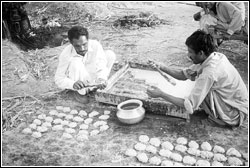 THE imposition of 15 per cent sales tax on gur seems to be another effort by the government to prevent sugarcane growers in the NWFP from gur production.
The growers see this tax as official arm-twisting to force them to sell their produce at the fixed price and on terms favourable to the sugar mills.
There is no rationale in imposing the sales tax as an increasingly part of the surplus crop is diverted towards gur production. A big part is exported to Afghanistan, Central Asia, and Iran.
Knowing the ground realities, it is not difficult to establish that mill owners are responsible for influencing the government’s policy on gur. In Pakistan, hardly any economic policy is framed in the interest of people or the country. Instead, organized special interests always dictate these policies. The imposition of tax on gur is another example of the same government-corporate-nexus. This does not augur well, either for cane growers of the NWFP or the country and the low income groups.
Diverting sugarcane for gur production is not without reasons. Since the last 10 years, the growers stepped up production of gur as it not only fetches more profit but also protects them from the malpractices of mill owners and managers. Delay in payments, under-weighing of produce, and unnecessary procedures have compelled many cane growers to shun the crop altogether or switch over to gur production.
In the districts of Charsadda, Mardan and Peshawar - even when sugar prices are rising fast - the prices offered by the mills for 40kg are not enough to bring reasonable returns to growers. Last year, the mills offered a mere Rs40 for the same quantity i.e., 40kg cane.
The present sugar crisis has brought the price of one kg sugar to Rs42. Two main factors are behind the price spiral, the indirect protectionist policy of the government, and the mill owners’ exploitation of growers.The farmer is losing interest in growing the labour-intensive crop that brings them no profit. The diversion of crop to gur production is the panacea found by some growers.
On the contrary, the imposition of sales tax on gur would result in losing the markets of Afghanistan, the CARs, and Iran. The government instead should encourage gur export. Value addition of the product could increase the exports not only to traditional markets but also to countries like India and Africa. Gur is a delicious sweetener and the high quality produced in the NWFP if introduced, internationally can earn huge foreign exchange.
The growers switching over to gur production have right to do what suits their interests best. They have every right to earn legitimately and as much as possible through hard work. To discourage them would be counter productive.
It is the grower and his land on which hinges the production of sugarcane or any other crop. A grower would stop producing or would switch over to other crop if he is not satisfied with the return of his toil and inputs. This exactly is the situation with the cane producers of the NWFP since last many years.
Mill owners have their own interests. But they do not have the right to exploit growers. Perhaps, it is because of the political connections that the mill owners are able to influence the government policy.
They have pleaded that the gur producers do no pay any sales tax, and apparently due to this the government has imposed 15 per cent sales tax. But how can one expect to tax grower without the latter getting any facility, let alone incentive from the government. The government has banned electricity connection to gur making installation called ‘ghani’ in Pashto. The growers instead have to buy heavy-cost generators to operate their installations.
As cane growers of this province sow alternate crops, mostly wheat, therefore, due to a delay in purchasing and the subsequent payments by the mills make it hard for a grower to sow wheat in time. The unavailability of land and the shortage of cash to buy inputs for alternate crop is another hurdle facing the growers. The federal government last year imposed a ban on gur export that has cost dearly to growers along with large-scale unemployment of the agriculture workers.
Sugar mills in the NWFP, in connivance with the federal government authorities in tribal areas are smuggling sugar to Afghanistan. If the purpose of the government to ban export and levy sales tax was to avoid scarcity then its policy has failed, just because of the mill owners, not due to the gur producers.
Interestingly, the NWFP Assembly had condemned the imposition of ban on gur export by passing a resolution. The growers have been vituperating the banning of export and imposition of sales tax on gur, but to no avail.





























