0
0

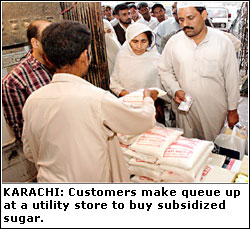 KARACHI, FEB 17: Despite increase in sugar quota for the Utility Stores Corporation (USC) from 11,000 tons to 22,000 tons per month by the government, people still have to wait for hours to get the sweetener at the controlled rate.
Many people return empty-handed after a long wait when the store’s officials close the sale window on the pretext that the stock for the day is finished.
The main reason for the rush at utility stores is the price difference of Rs 12.50 per kg of sugar. The sugar is currently selling at the utility stores at Rs27.50 per kg as against Rs38-40 per kg in the open market.
In case the price of sugar in the market fails to stabilize in future, the situation outside the utility stores may become even more troublesome for the common people trying to get the commodity at cheaper price. Market sources think that the consumers’ rush at utility stores indicates that they expect a further increase in price.
In the current situation, ugly scenes have become a regular feature at stores in different areas. In one such incident last week, angry customers pulled down the iron grill of a store at Saadat Colony in Shah Faisal Colony, when some people tried to bust the line to reach the sales counter. The unruly mob ransacked the store and looted commodities worth several thousands rupees before the Police reached the store. In many areas, people have beaten utility stores’ staff.
During a random visit to a utility store in Gizri people were found desperate not only buy sugar but also wheat flour (atta), which was also about Rs30 cheaper at the USC than the market and was selling at Rs115 for a 10 kg bag.
A well-off person created a scene at the Gizri store when the store staff denied him delivery of six bags of atta. The store officials were not letting anyone to buy more than two bags at a time.
At the same store, a person was seen carrying three bags of atta of 10kg each on his bicycle. He said he teaches in a Madressa and has a family of 16. He also bought only two kg bag of sugar for his big family.
A lady with three kids, who had already bought two kg bag of sugar, was seen demanding the store officials to give extra two kg bags to each of her kids too.
The UTC has reduced the sugar quantity to two kg packets from the previous five kg bag.
It has been noticed that many people come at the utility stores with two to three friends or family members so that they could buy more sugar bags.
The management of utility stores has been demanding the customers to purchase some items other than sugar from the store in order to prove that they are genuine buyers and not shopkeepers and traders.
A customer outside the store said that in case some one desires to have more than two bags of two kg sugar, the store officials advise him to purchase items worth Rs 1,000 first from the store. He said he wants to purchase two bags because of a large family.
Utility stores have no way to check the double or triple buying of sugar by a single person as he can easily make big purchases and pile up stocks by taking a round of various stores, especially in the district Central. There are also reports that some shopkeepers have hired volunteers, who make several rounds of various stores to build up stocks and then sell these to shopkeepers at the commission or rate feasible to both the sellers and buyers.
In many cases, it was seen that a truck, carrying sugar, arrived at the store and in a few minutes, the entire lot had been sold out, especially in the district Central where caterers are also active in buying from USCs.
Zonal Manager, Utility Stores Corporation (USC), Masood Alam Niazi, who looks after Sindh and Balochistan Zone, said that the big difference in price of sugar at utility stores and open market is drawing huge crowds at the utility stores.
He claimed that the steps taken by USC have discouraged the market players and now only genuine customers are coming up at the stores.
However, he said that the rush of sugar hunters and long queues at the stores still exist because of big disparity in price at stores and the open market.
To a query about the quality of sugar at utility stores, he said the corporation procures it from the Trading Corporation of Pakistan (TCP) which purchases it from the local millers. He added that now the TCP has asked the USC that it will make available to the USC both the imported and the locally produced sugar.
To control the double purchasing and extra buying by the consumers, he said Rations cards, which were in use earlier, needs to be re-introduced in which the number of family members must be mentioned. The stores should have some registration or record of buyers’ purchasing. Besides, in case ration cards are not possible some other type of cards or measures should be introduced to check extra buying by the consumers.
He said 40,000-50,000 packets of two kgs each are being released daily in the Karachi region. In Quetta region, 30,000 packets are being released, while 30,000-35,000 packets are being released in Sukkur region. Around 35,000-40,000 packets are being released in Hyderabad region.
As many as 40 outlets are in operation in Karachi as compared to 30 stores a year back. Besides, there are five temporary special stores which mainly sell sugar and atta and six mobile stores. One mobile store covers two points each day by selling atta, sugar and other items.
Hyderabad has 21 stores with five special stores selling only sugar and atta, while Sukkur has 20 stores with five special stores for two hot selling commodities and five mobile stores. Quetta has 22 stores with five special stores and mobile stores each.
There were 900 utility stores all over the country in 1996 to 1998, which have now reduced to 665 including 100 special stores selling only sugar and atta and 100 mobile stores.
Niazi reckoned that the number of utility stores is not enough to cater to the huge population and there is a need for opening more stores. However, he dispelled the impression that the utility stores cater only to five to 10 per cent people out of total population.
“Around 30 per cent of the population purchase goods from the utility stores,” he claimed.
He said that prices of goods in the stores are cheaper by five to 10 per cent as compared to open market rates as well as mega and super departmental stores. Perhaps the absence of credit card facility is the negative point in our stores but the USC is holding talks with some banks for commencing this facility very soon.
Despite hardships and problems - each store records a sale of Rstwo million to four million per month depending on the size and capacity of the store, he added.