



 0
0

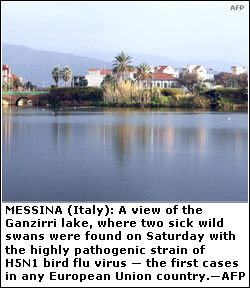 ROME, Feb 11: Greece and Italy said on Saturday they had found swans with the H5N1 bird flu virus — the first known cases in the European Union of wild birds with the deadly strain of the disease.
As the slow creep of the virus around the globe continued, Romania said more infections were suspected in birds in the Danube delta and Bulgaria said the lethal strain had been confirmed among swans in wetlands close to the Romanian border. The region is a haven and transit point for migrating birds.
Nigeria started testing people who have fallen ill close to where the virus has been found among birds, in the first outbreak in Africa of a disease that has spread seemingly inexorably across the Eurasian landmass from China and Vietnam.
Finance ministers of the Group of Eight (G8), meeting in Moscow, discussed the risk of a worldwide pandemic and issued a new call for wealthy countries to help poor ones fight bird flu.
“We acknowledge the risk of a possible avian flu pandemic and its potential economic and financial impacts,” they said.
Italy said five wild swans found in the southern island of Sicily and on the southern mainland had tested positive for the highly pathogenic version of the H5N1 strain.
“It is certain that the virus has arrived in Italy,” Health Minister Francesco Storace said.
Transport of animals susceptible to the virus would be banned in the three regions, Storace added. No bird flu had been found in farm or domestic birds and there was no need to fear a risk to human health.
“I don’t think we in Italy are in the habit of cooking swans and eating them,” he said.
MIGRATION FROM RUSSIA: A regional health official in Sicily said the swans were believed to have migrated from Russia.
A spokesman for the Rome-based Food and Agriculture Organisation (FAO) said it was confident Italy was ready to deal with the outbreak.
“In most of western Europe there are very effective veterinary services and the poultry industry is of an advanced sort, not the ‘backyard’ sort, so the likelihood of there being a danger to the human population is very much less than, say, in Africa,” he said.
Three swans found around the Thermaikos Gulf and sent by Greece to the EU lab in Britain tested positive for the deadly strain. A sample from a wild goose on Skyros island in the Aegean has also been sent to Britain.
“This is the deadly, the aggressive strain of the virus,” Deputy Agriculture Minister Alexandros Kontos told Reuters. “The swans were probably flying to Africa because of the cold snap in central Europe.”
Preventive measures include isolating poultry and keeping flocks indoors, banning hunting, disinfecting farms and a ban on meat or eggs from the areas.
The new Bulgarian infections, too, were among wild swans. Angel Kunchev, head of the health ministry’s epidemic control unit, said he expected samples from other swans found dead around the country since Jan. 31 to also test positive.
MUTATION: There are fears that the virus could mutate into a form where it can spread from human to human, exploding into a global pandemic in which millions could die.
David Nabarro, who heads the UN drive to contain the virus, said this week there was no evidence it had done so, but added: “It’s not far away.”
A senior scientist at the WHO offered a glimmer of hope, saying on Friday that a limited number of migratory birds appeared to be spreading only a single sub-strain of the virus.
“It could reduce the mutation level ... you are less likely to have widespread mutation than if you had 20 strains hop-scotching across Asia,” said Michael Perdue, an epidemiologist in WHO’s global influenza programme.
Genetic sequencing of the virus found in chickens in northern Nigeria, completed late on Friday, showed it also closely matched that in poultry outbreaks in Turkey and China.
Nigeria was trying on Saturday to discover whether people who had fallen ill in the area had caught the disease, and farmers culled thousands more chickens.
Angola, Mali and Guinea joined other African nations in banning poultry and egg imports from Nigeria.
“Surveillance and response of H5N1 in both animals and humans needs to be strengthened in all regions bordering countries where outbreaks have been identified,” a WHO spokesman said on Saturday. —Reuters



























