0
0

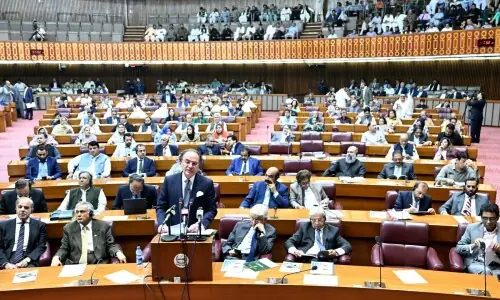
ISLAMABAD, Feb 10: The opposition and treasury members in the Senate on Friday called upon the government to provide details about measures taken by it to control sugar prices and cope with the present shortage of the commodity.
The senators said that sugar-cane production had declined and growers had suffered on account of the government’s sugar policy.
They asked Prime Minister Shaukat Aziz to appear before the house and provide them with details of actions taken by the government to control sugar prices and steer the country out of crisis.
These observations were made by lawmakers during question hour when Senate chairman Muhammadmian Soomro deferred a question in an attempt to shield Minister of State Muhammad Ali Malkani from a barrage of questions about the decline in sugar-cane production.
Dr Khalid Ranjha attributed the crisis to the government’s apathy towards the grower and said that farmers had not been adequately and promptly paid for their sugar cane crop.
Dr Ranjha said that there was a law in vogue which recommended action against sugar mills that delay payments beyond a certain period (a fortnight), but it had not been invoked despite delays of more than a year.
Mr Malkani said the sugar price hike had mainly occurred due to fluctuation in the international market and sugar-cane production had declined due to costly inputs. Last December, he said, a committee had been set up to work out ways to ease the crisis.
Enver Baig of PPP Parliamentarians said that while the per kilogramme price of sugar had touched Rs42, the adviser to the prime minister on finance, Salman Shah, had ruled out the possibility of providing sugar at subsidised rates.
“If they have sufficient money to purchase a new plane for the prime minister and luxury cars for ministers, why can’t they provide subsidy to the common man on an essential commodity?” he asked.
He alleged that more than 70 percent of the country’s sugar mills were owned by ministers whose actions could not be checked by any authority and whose stocks could not be raided.
The minister of state defended ministers who own sugar mills and gave the example of former ministers who also had stakes in businesses, mentioning the name of Asif Zardari in this connection.
Naeem Hussain Chattha, a treasury member, pointed out that until four years ago the country used to export its surplus sugar.
“So why did the government not forestall the problem? And why did it not take steps to pre-empt the crisis and prevent the situation through which poor Pakistanis are now facing?”
Mr Malkani failed to elaborate on specific steps that the high-level meeting chaired by the prime minister had taken to offset negative affects of sugar price hike.
“Why did the government not anticipate the looming crisis and purchase sugar when it was sold at $200 which has now risen to $500 per bag ton now?” asked Dr Safdar Abbasi of PPP Parliamentarians.
Leader of the house Wasim Sajjad assured members that the prime minister would attend the current session and would explain the government’s sugar policy and brief them about steps to overcome the situation.
Another treasury member Dr Nighat Agha said the commerce minister should also be called in to inform the house about steps taken to meet WTO challenges in the wake of such a serious crisis.
At times the Senate chairman justified the government’s stance on the grounds that former cabinet ministers also owned sugar mills.
Sanaullah Baloch raised the question of the oath which ministers take at the time of assuming public office in which they pledge not to give precedence to personal interest over national interest and asked whether the minister’s owning mills do not exploit national interests to gain personal interests.
Asif Jatoi accused sugar mills of exploiting the interests of growers and called for steps to ease the crisis.
In a written reply to a question, the house was informed that sugar-cane production, which stood at 48,041 tons in 2001-200, had declined to 45,880 tons in 2005.