0
0

Violent protest
IT is time all those hurt by the publication of the blasphemous cartoons in a Danish newspaper paid heed to the joint call by the Organization of Islamic Conference, the European Union and the UN. The statement by the representatives of the three organizations, while recognizing “deep hurt and widespread indignation” in the Muslim world over the publication of the “offensive caricatures”, pleaded for “restraint and calm”. The statement goes to the heart of the problem when it says that freedom of speech entails “responsibility and discretion” and that one must show respect and sensitivity for other faiths even if one does not believe in the faith in question. The reaction of all Muslims has understandably been strong, and Muslim governments have expressed their concern to the Danish and other European governments. But in many places the protests turned violent, especially in Beirut and Damascus where some foreign missions were burnt. This is regrettable, because violence in any form cannot be condoned. Those who torched the embassies could have registered their protest peacefully and in a dignified manner. What they have done instead is to hurt their own just cause.
The issue is of special relevance to Pakistan. So far protests against the sacrilege have been peaceful, and let us hope that the rally planned for March 5 will be equally non-violent. It is confined to Karachi, and one hopes the organizers of the rally as well as the provincial government will take all measures to ensure a peaceful mode of protest. But going by what has happened in the past, especially in Karachi, one must keep one’s fingers crossed. Often, demonstrators have damaged public and private property and attacked individuals and targets that had nothing to do with a given incident. After the murder of a religious divine in Karachi, the organization to which he belonged gave a call for a “wheel jam” strike, but on the strike’s eve public and private property was attacked, vehicles were burnt and the offices of a newspaper vandalized and put to the torch. Some political parties have behaved no differently and closed shops by force and burnt buses and cars to enforce their strikes. In 2004, a bomb blast in a mosque led to the burning of a fast-food shop whose owners and workers — six of whom were killed — had nothing to do with the act of terrorism in the mosque.
The printing of the cartoons was a highly provocative act by the Danish newspaper, which later apologized to the Muslims, while the Danish government expressed its “distress”. Some other European dailies have not helped the cause of sanity or contributed to a lessening of the tension by reproducing the cartoons. In fact, as a separate OIC statement points out, the cartoons’ reproduction “aggravated” the situation. But let us note that the sins committed by some newspapers cannot be heaped on all the world’s Christians. Many “Christian” governments have deplored the cartoons’ publication, and the Pope has come out strongly against the act. At the same time, the European media should note the vast demographic change that has occurred in almost all European countries. In its reporting and comments, the western media should take into account the multi-ethnic nature of their societies and refrain from comments that may not enlighten their public about a given issue but alienate minorities who are now in Europe’s mainstream. Muslim groups in Europe could also consider approaching the European Court of Human Rights.
Hangu bombing
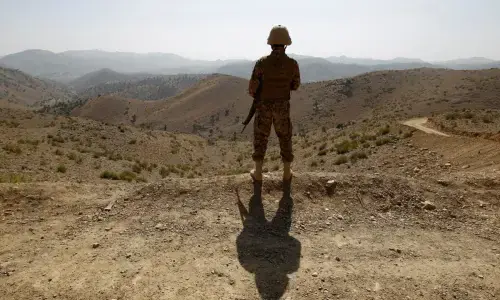
THE suicide bomb attack in Hangu on the town’s Ashura procession and the ensuing violence on Thursday and Friday are a grim reminder of the sectarian divide in the country and of the role played by extremists on either side. A curfew has now been imposed on the NWFP town — which in the past has experienced sectarian disturbances — and the army is said to be patrolling. Residents of one village outside Hangu saw over 100 rockets rain down on their homes. According to the interior minister on Friday, troops had been sent to the surrounding mountains to flush out and disarm militants who were firing rockets into the villages down below. Such measures may bring about temporary calm or an uneasy peace, but cannot be a substitute for a more assertive approach to tackling the monster of sectarianism in the country.
This means going beyond the cosmetic and addressing the root cause of the malaise. Statements are made at the advent of every Muharram by government functionaries and religious leaders with everyone pledging to abide by a code of conduct and to respect the beliefs and convictions of all sects. Other than taking up newspaper space from time to time, such inanities do not achieve much. While it may seem very difficult to rid Pakistani society of the intolerance and sectarianism that seeped into it during the Zia years, a concerted effort has to be made to promote tolerance and brotherhood. This includes cracking down on extremist outfits and sectarian organizations that call members of the opposite sect heretics and attack and bomb their places of worship. It also means clamping down on the printing and sale of hate material, monitoring the sermons delivered during Friday prayers for inflammatory tone and content, bringing madressahs into the mainstream and creating a curriculum that promotes harmony. The problem is that much is said on each of these aspects of countering sectarianism by our political leaders but there has been little in terms of tangible efforts on their part. Unless that happens, carnages like the one in Hangu may well happen again.
Poor polls in Nepal
GIVEN the opposition parties’ boycott of Wednesday’s municipal polls and the Maoist threat to disrupt the process, the low turnout at Nepal’s first local election since 1997 was to be expected. Only 20 per cent of registered voters took part as against 66 per cent in the 1999 parliamentary polls. Out of the 4,150 seats, more than half were without candidates, while several candidates were elected unopposed as their rivals withdrew their nominations. For King Gyanendra, who assumed absolute power a year ago, the polls had the opposite effect of what he had intended. Far from being seen as evidence of his popularity and as a step towards the restoration of democracy, the polls earned him flak from around the world. The US said that the king’s was a “hollow attempt to legitimize power”, while India, which wields enormous clout in Nepal’s internal affairs, held that the election lacked credibility.
The king has promised to hold general elections in April next year. But considering his political actions that have brought the shutters down on Nepal’s hard-won democracy since 2001, there is a strong possibility that the April polls will be held in conditions worse than the ones witnessed during the recent elections. The Maoist threat is growing and so far nearly 13,000 people have died in rebel-related violence in the past decade. Economic blockades are common and recent months have witnessed fierce clashes between Nepalese troops and the rebels who control much of the hinterland. The king does not have the support of the political parties which now find themselves more in agreement with the Maoist demand for redrafting the constitution. Unless he takes positive steps to form an equation with the main political parties and refrains from jailing political dissidents and putting curbs on the media, he will find himself increasingly isolated within the country and exposed to mounting criticism from the international community.