



 0
0

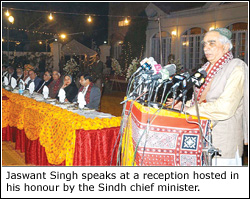 KARACHI, Feb 5: Jaswant Singh, leader of the opposition in Rajya Sabha (upper house of the Indian parliament), has expressed his optimism about a peaceful solution to all issues, including Kashmir, between India and Pakistan, through dialogue.
Mr Singh, a former foreign minister, called for bilateral talks on Jammu and Kashmir between the two countries and finding its solution as the future of the people of both countries lies in peace as there was no other way.
Speaking at the dinner hosted by Sindh Chief Minister Dr Arbab Ghulam Rahim in honour of the Indian delegation on Saturday, Mr Singh recalled that it was the BJP government, led by Mr A. B. Vajpayee, that had initiated the peace process between the two countries. He appreciated that the process was being carried forward by the successive government.
Mr Singh reiterated that visa restriction should be relaxed to facilitate easy travel between the two countries. He was of the view that the two governments should either do away with the visa restriction or introduce the ‘on-arrival’ visa.
He expressed his happiness that the Thar Express on Khokhrapar-Monabao route was set to start on Feb 18, and called for a ferry service between Mumbai and Karachi, saying that this would greatly help boost the bilateral trade.
“Now when the two countries have opened their doors to each other after more than five decades, we must ensure they are not closed again,” he stressed.
Referring to the centuries-old relations between the peoples of Sindh and Rajhestan, he noted that the people of Punjab on either side of the border had also improved relations.
He expressed his gratitude to the people and government of Pakistan for the warm welcome and hospitality extended to him and his delegation.
Earlier, welcoming Mr Jaswant Singh and members of his delegation, Chief Minister Dr Arbab Ghulam Rahim said that the people of Sindh had appreciated his decision to adopt the route of Sindh to visit Pakistan for the pilgrimage to Hinglaj Mata temple in Uthal (Balochistan).
The chief minister made mention of the deep-rooted cultural and social relationship between the peoples of Sindh and Gujrat, and said that after several decades, millions of people across the border would be able to share the moments of happiness and grief with each other. The Thar Express would provide the opportunity of reunion to the separated families, he said, adding that the opening of this route would also contribute greatly to the improvement in relations between Pakistan and India.
“The credit goes to President Pervez Musharraf,” he remarked, describing the launch of the train service as ‘success of the president’s diplomacy for peace’.
Acknowledging that Pakistan-India relations were improving, he said that friendly relations were not possible with resolving the Kashmir issue, which had resulted in wars between the two countries. He, however, expressed his optimism that the Kashmir issue, as well as other outstanding ones, would be resolved through peaceful means under the leadership of Gen Pervez Musharraf.
Dr Arbab noted that while the Wahga border had led to an improved relationship between the people of east and west Punjab, the Khokhrapar-Monabao route would play a vital role in bringing the peoples of Sindh and Rajhestan closer to each other.





























