0
0

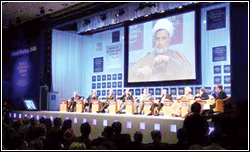 AN informal mini-ministerial conference of trade ministers of key WTO members held last week at Davos on the sidelines of the World Economic Forum — the first such discourse after the Hong Kong ministerial — gave some hope of an early breakthrough in the stalled negotiations as most of the participants insisted they saw an improvement in “the tenor of the talks”.
The ministers from 18 countries and the EU who attended the meeting have, meanwhile, agreed on a deadline for resolving the outstanding issues in the troubled agriculture talks. WTO director-general Pascal Lamy circulated a “Doha Work Programme — Timelines for 2006” to the ministers present there. The agreement on the detailed timeframe is of little significance but is relevant to the extent that the negotiations have to be concluded by the end of this year.
The meeting set an April 30 deadline for agreement on modalities — specific details and timeframes — for further negotiations, officially known as the Doha Development Agenda and previously the Doha Development Round. The deadline needs to be formally approved by the broader WTO ministerial forum. While the resolution of farm issues has to be completed by April 30, the deadline for non-farm issues is July 31.
US Trade Representative Robert Portman was quite optimistic and said the Davos conference has created a sense that trade liberalization talks must advance in all areas for the negotiations to succeed. He and other ministers from the rich West were of the view that the coming rounds of hectic negotiations got “a psychological lift” at Davos and that there was “a new willingness” to narrow the deep differences.
Pascal Lamy, director-general of the WTO, said during a briefing after the session: “They all realize they have to stop digging their tactical, defensive holes ...It’s a change in mindset.” Similarly, European Union’s trade commissioner, Peter Mandelson, who had expressed pessimism about the likelihood of a deal only a fortnight ago, said there was now “better mood music.” There is a consensus that “a new dynamic” has emerged in the multilateral trade talks
Such a turn to optimism is strange because some of the leading WTO member states have been seen as embittered in their attacks during meetings or in their statements in the recent past. Europe and the United States now publicly clash with each other over the issue of farm subsidies. It is interesting to note that the US now takes side of the Third World on the question of agricultural subsidies and accuses the EU of creating hurdles in reaching an agreement on Doha round. And a day before the Davos meeting, Mandelson remarked that it was an “alliance” between the United States and Brazil on agriculture that has led to a stalemate in the WTO talks.
Although the ministers from the rich West were generally optimistic — as they often are at such informal mini- ministerials — there were signs that the euphoria generated at Davos will be short-lived. Toward the end of the January 28 panel discussion, Mandelson accused Portman of being obsessed with agriculture although it accounts for only three per cent of world trade.
There were unpleasant exchanges between the participants, particularly between Mandelson and Brazil’s foreign minister Celso Amorim at the Davos get-together. Amorim had argued that the Doha round must boost development and the best and fastest way to achieve that was through liberalization of agricultural trade — a view also supported by Portman.
But Mandelson refused to accord a central role to agriculture and said that an agriculture-based development model can only benefit the developed and large emerging economies such as Brazil. The poor nations’ economies, he claimed, will be “wiped out” by an agreement on elimination of agricultural subsidies. Amorim said these subsidies were like nuclear weapons; Mandelson argued that removing them would hurt developing countries, because their farmers were not competitive enough.
Mandelson holds the view that a slower, more gradual approach to farm trade liberalization would work better, noting that it took several decades for industrial tariffs to be reduced significantly. This view was rejected by Amorim.
Meanwhile, Britain is becoming impatient with Mandelson’s hard-line approach and believes it is time Brussels and Washington took steps to move the negotiations forward.
Gordon Brown, in a statement a day before the Davos meeting, said that Brazil and India have shown a willingness to compromise at a meeting of G-7 finance ministers held in London shortly before the Hong Kong talks. Now Europe and America will have to make more concessions to get the talks off the ground.
Brown believes the negotiations launched in Doha have become so bogged down in technical details that it will require extraordinary steps on the part of the leaders to break the logjam. For the purpose, Tony Blair is discussing a possible agenda and time with George Bush for a summit of key WTO member states possibly in late March or early April. Mr Lamy has so far been lukewarm towards the idea.
Meanwhile, a report titled “Under the Influence”, launched by ActionAid, an NGO, on the first day of the World Economic Forum reveals a worldwide explosion of corporate lobbying, contributing to unfair trade rules. It calls on the EU, US and WTO secretariat to curb corporate influence and stop the profits of multinationals being put above the interests of poor people in the current trade talks.
The fact that the informal WTO meeting took place in the midst of some of the world’s most powerful business leaders showed who has been pushing the agenda of trade talks to date. Increasingly, big business is using its economic might to dictate government policies. In World Trade Organization (WTO) negotiations this comes at the expense of poor people, whose concerns are left out in the cold.
The cosy relationship between corporations and decision makers recently came into spotlight by the Jack Abramoff scandal in the US. Abramoff used his position as a corporate lobbyist to buy favours in Congress. From 1998 to 2004, US companies and lobby groups spent nearly $13 billion on influencing Congress members.
ActionAid’s research shows that corporations in the EU have excessive influence over policy makers and are trying to get their way in the current trade talks. In 1998, Leon Brittan, the then EU trade commissioner, asked the chairman of Barclays Bank to form a lobby group for companies specifically to influence WTO negotiations on trade in services. As a result, the European Services Forum (ESF) was born.
The office of the current EU trade commissioner, Peter Mandelson, strongly denies that this group has privileged access to EU officials. However, in May 2005, Mandelson met with an ESF- led delegation of European business leaders. The group wanted the EU to “insist on services being liberalized” at the WTO.
Pharmaceutical companies are using WTO rules to safeguard their profits and hinder the fight against HIV and Aids. In 2003, senior officials of one of the world’s biggest drug companies negotiated directly with the WTO’s director-general and some member states to block a proposal that would allow poor countries to import cheaper copies of patented drugs during health emergencies. It was the result of the lobbying at the WTO that a change in rules was effected last year which made it harder for countries such as Brazil, India and Thailand to make cheaper copies of patented medicines.
Many observers see the fingerprints of corporations over the draft deal agreed at December’s WTO meeting in Hong Kong.