0
0

 INDIA’S most ambitious civil aviation reforms initiative unveiled last week – the privatization and modernization of the nation’s two busiest airports, Mumbai and Delhi – hit an air pocket even before it could take-off.
The 25,000-odd well-entrenched employees of state-owned (and many would say, over-staffed) Airports Authority of India (AAI) went on the warpath, worried that the move would result in many of them losing their jobs in due course.
The new owners of these two airports – the Mumbai airport is to be managed by a consortium comprising Indian and South African partners, and the Delhi aerodrome by a German and Indian one – would undoubtedly want to transform them into leaner, lucrative and more efficient organizations.
AAI employees launched an indefinite strike last week, inconveniencing thousands of passengers across the country. Their move was backed by the left parties, who control most of the unions in the sector. But the United Progressive Alliance (UPA) government, and especially Civil Aviation Minister Praful Patel, has decided to push ahead with the privatization plan and not succumb to the pressures from the unions and the left parties.
India’s civil aviation sector is booming, with new airlines taking to the skies, offering attractive fares and drawing in millions of new passengers. But there have been virtually no changes on the ground, and Mumbai and Delhi airports – which handle the bulk of the 25 million-odd passengers who fly every year – are relics from the 1960s.
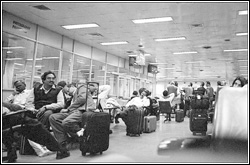
During the morning peak-hours, serpentine queues wind their way through the terminal buildings at Mumbai and Delhi, as impatient passengers try to check-in and get security clearances. Amenities at the airport are minimal, and passengers have often to hunt around for baggage trolleys.
International passengers are pestered by touts – who refuse to provide them the trolleys if they are not paid in dollars – and even some airport employees who badger airport users for tips near toilets and other public places.
Outside the terminal buildings, the AAI’s performance over the years has been disastrous. In Mumbai, for instance, thanks to its carelessness, much of airport property has been taken over by the land mafia, apparently in league with a few crooked employees. Over the years these gangsters have built up slum townships, renting the ramshackle huts to hapless migrants from other parts of the country.
Mumbai airport’s expansion plans have been grounded because of the mushrooming slum colonies, which also attract stray dogs, birds and other creatures that freely move across the runways, endangering aircraft movement. Birds have in the past got sucked into aircraft engines, resulting in millions of dollars of loss for airlines.
Sophisticated landing equipment has also been stolen by organized gangs that operate on the periphery of Mumbai airport. Many of these gangsters have become so powerful that they are able to get the backing of local politicians of all the major parties, and even bureaucrats and police officers are afraid of taking action against them.
Indian airports have had a terrible track record over the past several years. Many airports have failed to even safeguard their own properties, have not been able to provide modern amenities to passengers and airlines, and have botched up on upgrading their terminals and other facilities.
Yet, opponents of the privatization of Mumbai and Delhi airports want the government to entrust the task of modernizing the two airports to the same authority, with its bloated work force, and a dismal past performance.
OF course, things are far from hunky dory for the federal Civil Aviation ministry, in its move to revamp the two major airports. While employees’ unions and left parties are putting pressure, some of the bidders – who failed to get the contract – have decided to drag the government to court.
One of the most vocal critics of last week’s deal is Reliance Airport Developers, a company controlled by Anil, the estranged sibling of the Ambani business family. The industrialist, besides controlling a telecommunications empire and a power distribution firm, is also a member of parliament, and a close friend of Samajwadi Party bosses Mulayam Singh Yadav (the chief minister of Uttar Pradesh) and Amar Singh.
The Anil Dhirubhai Ambani Enterprises (ADAE) group has challenged the entire process of awarding the contracts for the two airports. A consortium comprising Indian firm GMR, and Fraport, a German airports operator, got the contract for Delhi airport, while another comprising Indian group GVK and the South African Airports, won the Mumbai airport contract. The two consortiums are expected to invest about Rs50 billion over the next four years in the first phase of modernisation of the two airports.
Reliance Airports had tied up with Aeropuertos y Servicios Auxiliareas (ASA), a leading Mexican operator. In fact, the Mexican government was also eager that the consortium – which had emerged as the top financial bidder, and second-best in technical evaluation – win the contract for Delhi airport.
Reliance-ASA had earmarked 45.99 per cent of revenue-share to the AAI, while GMR-Fraport had earmarked just 43.64 per cent. Since the latter was the sole technically qualified bidder among the five bidders, GMR-Fraport was given the option of matching the top bidder, which it did.
The Anil Ambani controlled firm expressed its “utter shock and surprise” over the changes in the published tender conditions, barely two hours before the bids were opened. It dubbed the changes as “untenable and unconstitutional,” and has challenged the deal in the Delhi High Court.
The AAI officers’ association, which had failed to get a stay from a lower court, is also planning to approach the Supreme Court, seeking to halt privatization of the two airports. But the civil aviation ministry believes that the entire process has been transparent, and is confident of emerging a winner in the court battles.
INTERNATIONAL cement giant, Holcim of Switzerland, which last week acquired India’s leading cement firm, Gujarat Ambuja, is now the largest producer in the country, accounting for 35 million tons of cement.
Holcim has been on aggressive acquisition spree in India, buying over ACC (a former Tata group firm), Ambuja Cement, and now Gujarat Ambuja. It has spent about $2 billion for these investments, and is now an undisputed leader in India.
The other major cement producer in India is the Aditya Birla group, which controls Grasim and Ultratech, formerly the cement division of engineering giant Larsen & Toubro. Holcim and the Aditya Birla group, between the two of them, now account for over 50 per cent of India’s cement capacity.
Two other European firms, Lafarge and Italicement, are also on the prowl, looking for smaller units in India. But with the industry witnessing consolidation, there are not too many significant players to be acquired. There are a couple in south India, including India Cements and Madras Cement.
India is one of the fastest growing markets for cement, as billions of dollars are being invested in new infrastructure projects, including roads, highways and expressways, ports and airports, and sprawling residential townships, software parks, and commercial projects including shopping malls.
The cement industry has witnessed brisk growth in recent years. It has notched up compounded annual growth rate (CAGR) of 8.2 per cent over the past decade, making it one of the biggest markets for cement, and attracting international names. India’s cement industry has grown faster than even China’s.
Analysts expect the industry to continue growing at over seven per cent in the next five years, as demand for the commodity soars.
Holcim, which picked up a nearly 15 per cent stake in Gujarat Ambuja, paid the equivalent of over $200 a ton for the acquisition, one of the highest valuations for a cement firm in India. It paid the promoters of the company Rs105 a share. Holcim last week also came out with an open offer for an additional 20 per cent stake in Gujarat Ambuja, offering a little over Rs90 per share.
And just as it spun off the non-core operations of ACC last year after acquiring the firm, Holcim is expected to sell the non-cement businesses of Gujarat Ambuja over the coming months.