



 0
0

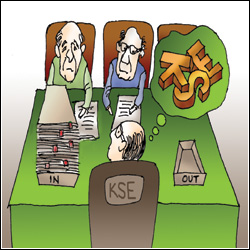 ONE month into his new job as the fourth managing director of the Karachi Stock Exchange, M.A. Lodhi is yet to be broken in. Employees are still wary, unsure what to make of him. Brokers are still neutral, most of them hopeful of cooperation. And the board of directors is still incomplete, awaiting the appointment of nominee directors. Lodhi himself, known for his easy going nature has his own share of acclimatization to do. So far, he’s judiciously avoided the media, made but a scant few public appearances and is said to be testing the internal environment at the exchange before he sets about making his plans for the next three years.
The hope is Lodhi’s soul searching reaches this if no other conclusion: That he now occupies one of the country’s most sensitive, volatile and stressful seats. The sooner he reaches this conclusion, the better his chances of survival. Even though he is known for shunning comparisons between himself and others, an analysis of how his three predecessors fared could help him.
Shahid Ghaffar, former SECP commissioner for securities markets was the first MD of the stock exchange. He was brought in at the time when resentment was at a peak and he had to battle tempers and protests routinely as he went about trying to implement reform and build capacity at the exchange. His cool-headed demeanour and in-depth technical expertise helped but his training in the bureaucracy meant he just wasn’t aggressive enough. Ghaffar would later compensate for some of this when he became the commissioner of securities markets.
Then came Noman Ahmed, a young, unassuming sort who was entirely the wrong choice, unable to understand or cope with either the ways of the market or its participants. He was run over entirely by the broker community and eventually pushed out.
Moin Fudda came on as MD with great flourish. He was brought on by the brokers themselves, appreciated for his savvy public relations skills and his quiet, thoughtful manner. Yet he too faced resentment when he occupied what was formerly the KSE president’s chamber. Initially, he surprised the market with his stern operation cleanup in which the physical premises of the exchange were given a new look, a legacy that’s still holding up. He also made an effort at recruiting fresh blood into the exchange but this turned out to be a transient improvement. And in the end his inability to discern the best course of action and stand up to the variety of interfering forces overcame him.
Lodhi would do well to start out with the knowledge that his new assignment will bring him challenges his long career in hotel management and insurance have not prepared him for. Even the insight he would have gathered during his two stints on the board of the KSE will do him but little good. So, to start with, Lodhi must get his house in order. The KSE, as an institution may be chugging along with basic operations but stands debilitated and barren with almost every major department running without a head. Capacity building never really took place in any major way at the exchange but to worsen problems, several employees have recently left the bourse, angered by the way they were treated. The KSE will never be able to put in place visionary plans of development until it is equipped with a solid team of top managers who are able to develop their departments along modern lines.
The new MD must prioritize the hiring of young professionals at or indeed above market salaries to head each department, give them independence and then concurrently develop a three year plan for the exchange. Lodhi’s track record here is reassuring. At the National Insurance Company which he headed for six years, he focused on adding qualified young professionals to the ranks of an aging institution and he ranked human resource achievements at the top of his list in his farewell newsletter at the organization in January this year.
In addition to hiring new professionals, Lodhi will also have to get aggressive about smartening up existing workers. A comprehensive and ongoing training programme will have to be developed to pull KSE employees out of their still bureaucratic, old-style of operation and equip them to survive in a competitive workplace. The training programme should also be expanded to induct a host of fresh business graduates who should be groomed through the system. The KSE should be made as choice a place for new graduates as the multinationals and major banks are.
Part of Lodhi’s internal reorganization plan must be to create a world class research team. For this, he will face the tough challenge of picking from an already scanty group of research professionals heading the equity research divisions of brokerage firms. However, establishing a formidable research division will be critical if he is to implement any developmental measures at the exchange. His research team will have to be capable of not just publishing informative reports on a regular basis but be able to study the way planned measures have been implemented in other markets and also make a variety of market information available to the media, the broker community and investors.
The same team should also be responsible for spreading awareness among brokers about modern ways at stock exchanges. For example, when the concept of demutualization was first introduced, the majority of brokers were unable to even define the term. A concerted effort by the exchange to educate stakeholders on issues like this is essential. Another challenge for Lodhi will be developing a marketing wing at the KSE. While former MD Fudda did attempt to do this, he failed to nurture the department. Unless the KSE is able to get aggressive about marketing, image enhancement and outreach, it will continue to remain the domain of the limited. As it is, the base of real investors continues to be severely limited.
Then, the new KSE chief should prepare for the introduction of new products such as index futures, options and derivatives. Plans to do this have consistently failed in the past largely because of the incapacity of the institution to support developmental plans. Once capacity is built up, Lodhi should forge ahead with new introductions to help modernize and diversify risk and provide investors with an attractive array of options. Another challenge for the new chief will be working towards a more clear demarcation of roles between the management, the board of the exchange and the general body of members.
He will have to carefully and stringently apply the rules of the exchange to ensure the general body of brokers are brought into the picture only when a matter is required to be referred to them. At the same time, he will be incapacitated without the expertise only the broker community can provide and striking the right balance will be a tricky task. He will also have to clearly understand the role of the board of directors as policy makers and fight for—indeed battle for—the independence that management must have in the day-to-day running of the exchange. Lodhi’s friendly and open nature will be helpful but could hurt him when in critical times brokers resort to their old habits of breaking down doors.
Equally challenging for the KSE chief will be handling a relationship with the Securities & Exchange Commission. This is always difficult but especially so now when the apex regulator has lost several employees, is confronted with low morale, has a new chairman and faces a great loss of credibility for the way in which the previous chairman was removed. Lodhi will have to find a way to be effective enough so the SECP has no cause to intervene in the management of the exchange and independent and tough enough to ensure the apex regulator does not resort to micromanagement and interference as it often does.
In the end, the brokers, the SECP and the government also have critical roles to play to ensure their choice for KSE MD is successful at what he has been brought in for. Brokers will have to accept that the MD has a role to play that necessitates independence. They will also have to learn to accept the boundaries that establishes and restrain from throwing their weight around in the interest of their institution. The SECP will have to learn that their role does not overlap with the role of the exchange and that unless they give the new MD the independence to operate, they will be defeating the very purpose of independent management.
And most importantly, the government will have to learn that to create truly independent institutions, a lot more than simple enactment is needed. It is all very well to boast abroad of an independent SEC and independent management of the stock exchange but if the ministry of finance, the prime minister and the President’s secretariat continue to give audience to beleaguered brokers every time there is a problem, they are themselves undermining the entire reform process. Now that the government has created institutions of independence, it’s about time they let them do their job.






























