0
0

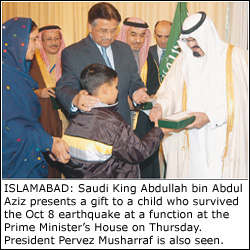 ISLAMABAD, Feb 2: Pakistan and Saudi Arabia on Thursday agreed to expand cooperation, particularly in the economic sphere, and stressed the need for early and peaceful settlement of outstanding conflicts in South Asia, including the Kashmir dispute.
A joint statement issued at the end of Saudi King Abdullah bin Abdul Aziz’s two-day visit to Pakistan said: “In the field of political cooperation, both sides exchanged views on regional and international developments and affirmed their adherence of maintaining international peace and stability. The two sides agreed to work together towards resolving outstanding conflicts in their region in accordance with the relevant principles.”
It said: “President Musharraf briefed the Custodian of the Two Holy Mosques on the ongoing dialogue between Pakistan and India.
The two leaders agreed on the necessity to reach early resolution of all outstanding issues between Pakistan and India, especially the issue of Kashmir, through negotiations.”
The two sides recognized the inter-linkage between the security and stability of the Arab region and South Asia, and their keen interest to preserve such security and stability. The statement committed the two countries to explore prospects of the strategic relations to ensure their continuous solidarity in the service of their peoples and the Ummah.
To enhance political cooperation, the two sides committed to convene frequent and regular meetings of their joint commission, which will be responsible for following up the implementation of what has been agreed upon during the visit.
They agreed to intensify cooperation to fight terrorism and other international crimes, such as money laundering, drug trafficking and arms smuggling, in a sustained and comprehensive manner.
“The two leaders emphasized that terrorism represents a palpable threat to all humanity, and that there is a need to intensity and coordinate bilateral, regional and international cooperation to combat terrorism and to eradicate its root causes,” the statement said.
The statement committed the two countries to make continuous efforts for an early realization of proposals to conclude a Comprehensive Convention on International Terrorism, which is before the United Nations General Assembly.
They agreed to the setting up of an International Counter-Terrorism Centre as called for by the International Conference on Counter-Terrorism held in Riyadh in February 2005 and proposed by the Saudi king.
The two leaders expressed satisfaction at the growing cooperation between the two countries and renewed their commitment to reinforce bilateral cooperation in trade and investments.
They welcomed the signing of the Memorandum of Understanding on Political Consultations, Agreement on Avoidance of Double Taxation, Agreement on Cooperation in Science and Technology, Cooperation Programme in Technical Education and Vocational Training and Programme of Educational and Scientific Cooperation.
The two sides agreed to exchange frequent visits at all levels to enhance mutual understanding and friendship, and deepen development of steady cooperation in economy, trade, education and investment. “They agreed to expand and facilitate investment and joint ventures, especially in energy and infrastructure. Both sides look forward to the upcoming joint investment conference which will be organized by the Saudi-Pakistani Investment Company during the first half of this year to explore new areas of joint investments,” the statement said.
On the issue of Palestine, both sides urged the acceptance of the results of the recent elections, as they reflected the free will of the Palestinian people, and called for a wise and objective dealing with the results and avoiding premature judgments and hasty conclusions, it said.
“The two sides expressed their hope that Hamas will form a government which preserves the legitimate rights of the Palestinians, safeguards their interests and works for progress in the peace process,” according to the statement.
“Both sides agreed that durable peace in the Middle East depends on an early resolution of the Israeli-Palestinian conflict. They emphasized the importance of the Beirut Peace Initiative and the ‘Road Map’. The complementarity between the two plans is seen by both sides as the best way to re-invigorate the peace process and pave the way for the establishment of an independent and viable Palestinian state living in peace, security and prosperity within secure borders side by side with Israel.”
They expressed their hope that the evolving political process would result in the establishment of a government capable of assuring Iraq’s unity, territorial integrity and prosperity without foreign interventions, it said.
The two leaders expressed satisfaction at the outcome of the Makkah Islamic Summit and reaffirmed their commitment to reform the Organization of Islamic Conference in order for it to become an effective forum to advance the collective interest of the Muslim world, and to cooperate in the implementation of the 10-year plan which was adopted by the conference.
During his visit, King Abdullah held in-depth discussions with President Pervez Musharraf and Prime Minister Shaukat Aziz covering a wide range of issues.
President Musharraf reiterated his deep gratitude for the prompt and continuous relief assistance that Saudi Arabia had provided to the earthquake victims. He expressed his gratitude for the Saudi pledge to assist in rebuilding the earthquake-hit areas through the Saudi Development Fund to finance housing, road, education and health projects.