0
0

 KARACHI, Jan 30: The two-day parliamentarians’ seminar on HIV/Aids Policy began here on Monday with legislators from within the country and abroad emphasizing the need for an effective strategy to contain the spread of the deadly disease in Pakistan before the situation gets out of control.
The participating parliamentarians and representatives of UN bodies also underlined need for pragmatic legislation and policies alongside mass awareness campaign for the purpose and for removal of misperceptions about Aids.
MPAs from the Senate, National Assembly and four provincial assemblies, as well as parliamentarians from Canada, Malaysia, Nepal, New Zealand, Sri Lanka and Thailand, are attending the seminar, organized by the Parliamentarians for Global Action, Sindh Assembly and Aga Khan University in collaboration with UNAIDS.
In her keynote address read out at the moot, Dr Nafis Sadik, Special Envoy of the UN Secretary-General to Pakistan for HIV/Aids, said that Pakistan, with an encouraging national policy to combat the disease, was yet to witness a change in the underlying conditions.
Dr Sadik, who could not attend the seminar due to her illness, expressed her concern over the surge in the cases of HIV/Aids, and observed that in the worst-affected countries, economies and the society itself were collapsing under the burden.
With regard to Pakistan, it was observed that effective treatment still reached only a small fraction of those infected and very few cases were reported.
“In addition, Sindh, like many parts of the Pakistan, shows high rates of poverty, illiteracy and gender inequality, low levels of service and information, and high proportions of young people whose behaviour could go well outside traditional norms.
“In these conditions, a general HIV/Aids outbreak here is not only possible, but highly expected,” she warned, reiterating that ‘low and slow’ epidemic is just wishful thinking.
The envoy also referred to other relevant facts, saying that all conditions were in place for a general HIV/Aids outbreak here, in the immediate future.
“The experience in Pakistan and elsewhere shows that there is a way to fight HIV/Aids successfully by strong leadership, early actions, focus on preventing infection, and reaching out to people who need protection most,” she said referring to womenfolk.
Dr Nafis Sadik also suggested the need for tackling the looming epidemic through a real multi-sectoral approach that had been emphasized by the UNGASS Declaration of Commitment and by the recent endorsement by the G-8 of scaling up through universal access by the year 2010.
She said that it was encouraging to know that the cost of HIV/Aids treatment was coming down, and that drug regimes were rapidly improving.
The UNAIDS Coordinator in Bangkok M. Ali Bhuiyan said Pakistan needed immediate measures to check the spread of HIV/Aids. Otherwise, he added, the number of people living with the virus might rise to 716,000 by the year 2015 against the present estimate of 3,000.
He said that the Aids-control programme must become part of the political agenda and national development plan. “If intervention is not made now, Pakistan may be forced to spend $35 million annually on account of controlling Aids after 10 years.”
Nimal Siripala, Sri Lankan Minister for Healthcare and Nutrition, said the people of the region, in general, should adopt a cautious but effective approach towards the problem.
“How to introduce public awareness about the aspect in accordance with our respective cultures and backgrounds is a major challenge,” he said, adding that his country had attempted to address this problem by linking it with the family planning programme.
He suggested that parliamentarians of South Asia must immediately focus on formulating a safe blood transfusion policy.
He pointed out that 1.5 million people were contracting the disease every year and 7.4 million people, including a considerable number of children, were already living with the scourge.
He proposed availability of ARV drugs free of cost to those suffering from the diseases.
Parliamentarians are also needed to realize that poverty, illiteracy and ignorance are aggravating the situation in countries like Sri Lanka, Pakistan and Maldives where Aids prevalence is as low yet risks are high.
Dr Aldo Landi, UNAIDS Country Representative, discussing the global situation of HIV/Aids, said that till December 2005, more than 40 million such cases had been registered.
Efforts like this exercise by parliamentarians can help develop linkages and formulate joint strategies with maximum level of commitment and strength.
Dr France Donnay, UNFPA Representative, mentioning that 75 per cent of HIV transmission appeared to be due to physical promiscuity, said that measures to improve reproductive health could have direct and positive bearing on efforts to protect women and children from contracting the disease.
She urged the parliamentarians to strengthen the policies and programmes concerning the family planning and maternal care.
Secretary Health Sindh Dr Naushad Sheikh said that only 1,123 HIV cases had been reported in Sindh till date, but for every diagnosed case, there remained 30 undiagnosed HIV carriers. It is imperative to discard the stigmatization attached with HIV.
MPA Fareeha Razzak Haroon said that out of the total population living below the poverty line, nearly 35 per cent was inhabited in South Asia, which increased the risk of the spread of HIV in the region.
The situation in Pakistan is not as critical as in the neighbouring countries, but it is gradually worsening, according to her. She observed that women sex workers was the second most vulnerable segment on HIV risk scale following the addicts using syringes.
Ms Shazia Marri urged parliamentarians to rise above their political affiliation in dealing with the problem.
Citing numerous bills not yet enacted into law by the Sindh Assembly due to disagreement among opposition and treasury benches, she said politics must not hinder the initiatives supposed to be taken in the greater interest of society.
She said her party, PPP, would submit a draft bill with the Sindh Assembly to provide legislative cover to the efforts towards controlling the HIV/Aids.
President of the Lawyers for Human Rights and Legal Aid Mr Zia Awan said that the people living with the disease, as well as their families, needed legal protection against discrimination. Amendments to the relevant public health laws were also needed, he added.
The speakers noted that illiteracy and backwardness was increasing the risk of the spread of HIV/Aids as due to the lack of awareness, people appeared reluctant to disclose that they might have been infected.
Blood screening of immigrants and tourists was not in vogue which, they said, was aggravating the situation.
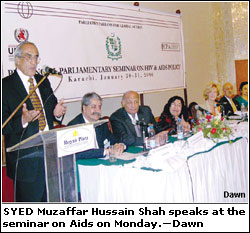
Speaker of the Sindh Assembly Muzaffar Hussain Shah, Dr Noor Jehan Panezai and President of the Aga Khan University Dr Shams Lakha were among others who spoke at the seminar.—PPI/APP