0
0

 The overall sale of petroleum products during July-December 2005 has declined by 11.6 per cent to 7.2 million tons from 8.2 million tons in the same period of 2004. The decline in overall sales of diesel, LDO, HOBC, kerosene etc is attributed to various reasons.
However, petrol sales, which fell by 10 per cent in the last six months, may again turn out to be the loser during January-June 2006 with the same percentage, in case prices go up further in future.
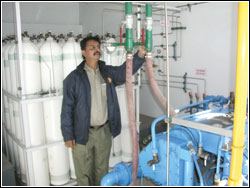
As the petrol consumption has decreased mainly due to its rising prices, gradual conversion of cars for CNG use is seen as a potential threat to the petrol consumption.
The government took a decision late last year to allow LPG consumption in automobile sector, lifting a ban imposed for many years. Currently, OGRA is framing safety rules for LPG use in vehicles.
LPG may emerge as another threat to petrol after CNG in case LPG demand rises after the go-ahead signal by the OGRA with safety standards.
CNG has already given a tough time to petrol and both CNG and LPG have emerged as alternatives to high petrol prices.
Over 870,000 vehicles have so far been converted to CNG compared to 500,000 one and a half year back and still many cars are in the pipeline. Consumers are making a long queue at the CNG filling stations to have CNG despite the fact that the price has surged to Rs31 from Rs29 per kg recently. But CNG is still cheaper by 45-50 per cent lower in consumption. As for LPG, its future price will determine its popularity among vehicle owners and it will be easy to do a complete cost-benefit vis-à-vis petrol and CNG. It will also depend on the quality standards to be introduced by the OGRA, without which LPG would turnout to be hazardous.
Petrol sales plunged by 10 per cent in July-December 2005 to 606,360 tons from 678,147 tons in the same period of 2004.
The demand for petrol should have risen sharply with the arrival of an average 12,000 cars per month on the country’s poor road networks besides rising import of used and new cars after the budget and trade policy measures. The import of old cars increased by 270 per cent to 10,524 units during July-December 2005 compared to 2,852 units the same period of the last year due to downward revision of duties and taxes.
The liberal import of used cars had a positive impact in the domestic market, resulting in decline in premium on prices. Car import during the whole fiscal is estimated to range 20,000 to 25,000 units.
And rising car production coupled with imports must have pushed up petrol consumption but it had not happened with the rolling out of over 50 per cent cars with factory fitted CNG kits by the local assemblers.
Country’s car sales have surged by 25 per cent during July-December 2005 to 71,027 units from 57,010 units in July-December 2004.
Motorcycle sales (Honda, Yamaha, Suzuki, Sohrab, Triwheeler, Qingqi (triwheeler) reached to 239,443 units in July-December 2005 as compared to 193,875 units in the same period of 2004.
Petrol price has surged to Rs56.29 from Rs33.78 per litre on January 1, 2004 owing to rising Light Arab Crude prices in the world markets. From July 1, 2001 till today – the price of petrol has gone up by 45 times as against decline by 23 times while it remained unchanged by 40 times during the period.
Car production is likely to cross over 150,000 units this fiscal compared to 126,817 units in 2004-2005 and 100,070 units in 2003-2004.
Motorcycle users are still dependent on the petrol as they do not have any option for CNG or LPG. Over 40 makes of cheap Chinese assembled with three Japanese bikes rolled out around 600,000 bikes a year as compared to 98,000 units two and a half years back when three Japanese bike makers had the monopoly in the market.
Sale of high speed diesel has fallen by 7.5 per cent to 3.66 million tons from 3.96 million tons due to lower economic demand in view of earthquake, reduced demand in the rural areas, change-over to electricity where possible and due delayed cane crushing by the sugar mills, reducing the movement of cane.
Transport movement after October 8 earthquake to November remained depressed with unexpected rains and snowfalls in many parts.
However sales picked up in December 2005. Since diesel prices have started climbing up – some people, having diesel cars and vehicles, have shifted towards CNG and LPG. From July 1, 2001 till today, diesel price has been increased by 42 times as against decrease by 23 times while it remained unchanged by 43 times.
Majority of commercial vehicles run on diesel except for some Suzuki models while a bus making company has introduced a locally assembled CNG bus.
Sale of light commercial vehicles (LCVs) rose to 14,549 units from 10,418 units in July-December 2004, while sale of trucks touched 1,916 units from 1,374 units. In contrast, sales of buses have fallen to 454 units from 684 units in July-December 2004.
Diesel outlook for January-December 2006 may improve with the onset of the main harvesting season March to May 2006. Sale of HOBC plunged by 14.3 per cent to 4,454 tons from 5,199 tons. Price hike could be attributed in its reduction coupled with consumers’ preference towards petrol rather than HOBC. Some consumers used to blend motor spirit and HOBC for higher octane. Presently, most of the country has availability of 90RON instead of 87RON at the same price of 87RON.
Kerosene sales fell by 6.2 per cent to 112,131 tons from 119,588 tons owing to persistent decreasing demand on the back of rising prices and gas alternatives in the form of LPG. Kerosene is now considered as a dying product as LPG has started replacing it.
Sale of furnace oil also plunged by 20.5 per cent to 1.9 million tons from 2.4 million tons. Fuel oil consumption is based on thermal power generation due to increased hydro-electricity and gas availability, the reliance on thermal was reduced, cutting fuel oil demand in the last six months.
For January-June 2006, fuel oil demand is based on the reliance on thermal electricity depending upon the availability of gas or hydro electricity.
Light diesel oil (LDO) sales dropped by 43 per cent to 60,015 tons from 105,548 tons. LDO is mostly used in small pumps for irrigation. With the increasing cost of LDO and diesel, consumers have switched to electricity due to its wider and regular availability and its cost-effective option as compared to diesel. However, this could be reversed, if prices of diesel go down.
Sale of jet fuel rose by 12 per cent to 302,549 tons from 270,216 tons due to increase in local demand from the PIA, private airlines, Hajj flights, earthquake relief operation and exports to Afghanistan.