



 0
0

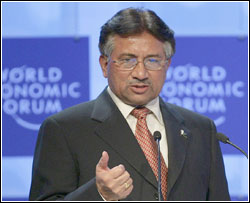 DAVOS (Switzerland), Jan 26: President Pervez Musharraf mounted a strong defence on Thursday on Pakistan’s plans for a natural gas pipeline with Iran.
With Washington openly hostile to Iran, Gen Musharraf said the pipeline, which also involves India, was a purely economic project that had nothing to do with the row over Tehran’s nuclear ambitions.
“It’s a totally economic deal,” he told reporters on the sidelines of the World Economic Forum in Davos, Switzerland. “It does not conflict at all with our stand on the nuclear issue.
“It has nothing to do with the nuclear programme of Iran.”
Tehran is reported to be close to an accord with India and Pakistan for the 2,600-kilometre (1,600-mile) pipeline costing over $7 billion.
The United States, however, said earlier this month that it was “absolutely opposed” to the project.
President Musharraf said many other countries had already imported energy from Iran, and there was no reason why Pakistan should not do the same.
“We need energy” to feed Pakistan’s surging economy, the president added. “We are looking at all sorts of energy.”
Gen Musharraf had said in a separate interview published on Thursday in the Britain’s Financial Timesthat he had no plans to ditch the deal.
“Our industrial growth, foreign direct investment, depends on availability of energy,” he said.
“We are proceeding with the pipeline. It is in our economic interest. If somebody wants to stop us they should compensate us ... But at the moment we are going ahead.”
KASHMIR ISSUE: Speaking about the issue of Kashmir, President Musharraf called on India to join Pakistan in working out a solution that could lead to self-governance and make the Line of Control “irrelevant.”
Gen Musharraf urged a step-by-step approach that would start with defining Kashmir’s borders and end with a joint cross-border administration.
“I am extremely flexible, and I am bold enough to go for an out-of-the-box solution,” he told reporters.
“But we cannot clap with one hand. I expect India to join.”
“Grasp these fleeting moments at this time,” he went on. “Fleeting moments come and go. It is incumbent on all leaders to grasp these moments, otherwise they are not leaders.”
Pakistani officials with Gen Musharraf at the annual gathering of political and business heavyweights in Davos, Switzerland, said that his comments on Thursday were his clearest to date.
He said that once Kashmir’s geographical status was defined, the whole province would be demilitarised.
It would then get a self-governing administration — short of independence but more than autonomy — and officials from Kashmir, India and Pakistan would jointly manage the area on both sides of the current Line of Control.
By doing that, he said, “we have made the Line of Control irrelevant”.
The Pakistani leader warned that if a solution did not come soon, political changes could make it impossible later.
“We need to move forward. If we do not do that, permanent peace cannot be guaranteed in the region. No leader is permanent.”
President Musharraf admitted that while the confidence-building side of the talks was progressing, dispute resolution focusing on Kashmir was lagging.
His proposed step-by-step solution, he said, would require compromise from all sides, adding that “Pakistan will not step back unilaterally”.
BAJAUR ATTACK: Islamabad had not given permission for a botched US air strike against Al Qaeda suspects that killed 18 civilians this month, nor was it asked to do so, President Musharraf said.
But while reiterating his condemnation of the Jan 13 strike as a violation of Pakistani sovereignty, he said the presence of Al Qaeda fighters in the region was as well.
“We were not asked and we did not give any permission,” he told a briefing for reporters on the sidelines of the annual World Economic Forum in Davos, Switzerland.
Musharraf’s comments were not an outright denial that Pakistan might have known of the strike in advance.
The Washington Post reported on Monday, citing US military and intelligence sources, that Islamabad had signed off on the attack beforehand and even assisted with pre-attack intelligence.
Moreover, Gen Musharraf underlined that US and Pakistani forces, while each operating on either side of the Pakistani-Afghan border, shared intelligence.
The strike on the village of Damadola was reportedly aimed at killing the Al Qaeda number two, Ayman al-Zawahiri, during a gathering of senior figures from the terror network there.
“We did not know” whether Zawahiri was actually there, Gen Musharraf said.
“While we condemn this attack, there are foreigners” in Pakistan, he said, using the authorities’ shorthand for Al Qaeda and Taliban militants thought to have sheltered in the tribal regions after the US-led invasion of Afghanistan in late 2001.
“Any interference in force by any country is violation of sovereignty, but so is the presence of foreigners on our soil.”
Gen Musharraf said Pakistan was fully involved in the fight against Al Qaeda. “We are attacking them in the mountains, we are occupying their sanctuaries.”
He said he did not know where Zawahiri or Al Qaeda founder Osama bin Laden were or whether they were still alive.—AFP




























