0
0

WASHINGTON, Jan 24: Prime Minister Shaukat Aziz has warned against an arms race in Asia and expressed concerns over nuclear ambitions of some neighbouring countries and the emergence of regional powers in South Asia.
He said Pakistan subscribes to the principle of minimum credible deterrence and opposes nuclear proliferation and an arms race in the region.
“As a nuclear weapons state, we adhere to the doctrine of minimum credible deterrence and are opposed to any nuclear proliferation as well as an arms race in the region,” he told a conservative think-tank in Washington.
Addressing a select gathering at the Heritage Foundation, Mr Aziz also brushed aside reported tensions with the United States and called America a close “friend and ally.”
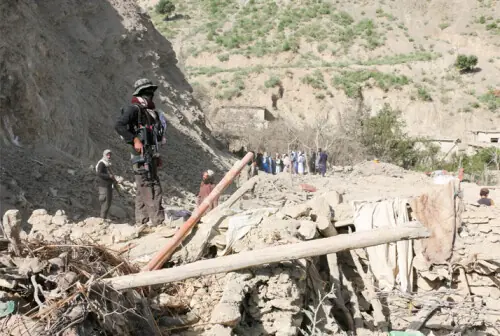
Mr Aziz’s trip to Washington came at a strained point in US-Pakistani relations, with many in Pakistan angered by the Jan. 13 air-strike in Bajaur that killed at least 13 people, including women and children.
But the prime minister played down these tensions and said “the stability of the region demands a ... constructive long-term relationship between our two countries.”
His speech came a day after he condemned the strike near the Afghan-Pakistan border, saying the United States had failed to notify Islamabad beforehand.
But Mr Aziz offered no comment when a reporter asked whether he would seek assurances from President Bush to prevent similar attacks in the future.
Referring to the sudden US withdrawal from Pakistan and Afghanistan after the Soviet Union pulled out its troops from Kabul in 1989, Mr Aziz said: “Whenever relations between the two countries have declined, both countries have paid a price.”
The prime minister said Pakistan had proposed a ‘strategic restraint regime’ to prevent an arms race and ensure that stability would be maintained in the region.
He justified his country’s response to India’s nuclear tests in 1998, saying the tests forced Pakistan “to respond in order to establish a credible nuclear deterrence.
“Failure to do so could have created a dangerous ambiguity about our capacity and could have led to possible miscalculations,” he said.
But he stressed that Pakistan wants to be an “anchor of peace and stability in the region”.
Mr Aziz did not speak of any new threats posed by India or other neighbours but in a veiled reference to India’s efforts to acquire anti-ballistic missile systems, he said the induction of such weapons could have a destabilizing impact on the region.
Talking about Pakistan’s relations with Iran at a time when Washington is seeking sanctions against Tehran, Mr Aziz said relations with the fellow Islamic nation were “guided by compulsions of geography and history”.
“We would like to work with Iran for peace and stability in the region and would welcome Iran’s role as a responsible player to this end,” he said.
Referring to the US-Iran dispute over Tehran’s nuclear policy, the prime minister said Pakistan had clearly stated its opposition to nuclear weapons proliferation “but we respect Iran’s right to develop peaceful uses of nuclear energy” under safeguards imposed by the IAEA.
Mr Aziz said Russia and China should play a ‘constructive’ role in resolving the current nuclear crisis involving Iran, adding that force should be avoided at all costs.
Allaying concerns over Pakistan’s nuclear capability, the prime minister said Islamabad was “committed to the prevention of nuclear proliferation”.
Mr Aziz also made a pitch for Pakistan’s peaceful use of nuclear energy, as the US and India were busy negotiating a firm agreement for American transfer of civilian nuclear technology to New Delhi.