



 0
0

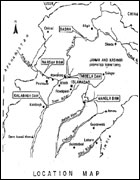 President General Pervez Musharraf had been campaigning for the construction of water reservoirs to meet the growing water needs of the country and to refurbish dwindling resources. In his address to the nation on January 17, he came up with concrete plans for the building of reservoirs. However, are solutions laid down by him the way out, the only way out or has he deferred the resolution of the issues?
Most experts consider the Kalabagh dam (KBD) the best option, the quickest vehicle for harnessing water resources and a project whose construction could be undertaken within about eight to 10 months because all basic documents stood finalized and all feasibility reports had been completed. Only international tendering needed to be done and once that hurdle was crossed, construction would commence.
But the very mention of the KBD triggers controversy. The President could not have been unaware of this aspect of the dam because the issue of its construction came up during the first short-lived government of Benazir Bhutto and then Nawaz Sharif committed himself to building the dam with as much determination as General Musharraf had started with. Both prime ministers had to back down because of the strong opposition.
The general has been forced to retreat like the prime ministers but he has accomplished the embarrassing somersault with uncanny political facility and officially deferred the KBD while deciding that the only option for meeting looming water needs was the construction of Bhasha dam. The Akhori dam is another project cited by the President but it belongs to distant future with the completion date about a decade and a half from now.
It is not that the Bhasha dam can be taken up without delay. A lot of documentation would need to be completed before the first brick can be laid for construction. The President has declared that it would be undertaken in the first week of February but that would be a symbolic act far apart from actual construction activity.
The incubation period for Bhasha dam is placed around a minimum of three years by experts. Detailed designs are required to be completed and finalization of tender documentation has to be carried out. That would take about two years and take us well into 2008. Floating of international tenders and their review would consume another two years. These essential inputs would be over by 2010 provided everything goes as envisaged. Even a minor slip, time wise, would be costly and add to the length of the construction period.
The earliest completion of the Bhasha dam provided all factors fall perfectly in place and every area of construction- financing, machinery, availability of inputs of all varieties, weather conditions, political situation, etc., can be expected around 2016. Needless to say this would be possible only if everything is done with clock work precision; one must, however, bear in mind that this kind of efficiency is not a national trait.
The Akhori dam was also mentioned by the President in his address but it would take much longer. According to experts, its construction cannot be taken up earlier than 2015; a construction period of about six years would be needed from then on. While it would add to water resources, its power generation capacity would be limited. In any case, it is not a project that can be taken up immediately.
The problem of water shortage would have become acute even if the KBD was taken up first. The President quoted some statistics about water shortage due to silting in dams. Mangla, and Tarbela dams and Chashma barrage would have lost their storage capacity by 6.3 million acre feet (MAF) by 2010. This is not to frighten the nation but a figure worked out by experts on the basis of accumulation of silt in these storages.
The process of desertification of many areas of Pakistan would be in play by that time. Water has already become a loose-loose case for Pakistan and there seems nothing on the horizon, presidential efforts to counter shortage notwithstanding, which can make a dent in this situation. One can only pray that weather provides respite to Pakistan in the years between shortage reaching frightening proportions and completion of Bhasha dam.
There is nothing to suggest that the President was not earnest when he discussed the water issue during his address. But the context of the address becomes somewhat incomprehensible when you realize that an important issue, the attack on Bajore where 18 deaths were scored by a missile hit from the other side of Pakistan-Afghan border, was altogether ignored by the head of Pakistan’s state. This, however, is a political issue and we need not dilate on it here. But the governmental policies for the agriculture sector are a subject of basic relevance for a discussion on water requirements of Pakistan.
What kind of support is the sector receiving from the state? One of the first pledges of General Musharraf, after taking over as the Chief Executive of Pakistan following the toppling of the Nawaz Sharif government, was for safeguarding the rights of peasants.
In the six years since that point, the conditions of the farming community of the country has gone from bad to worse. It wasn’t in a happy state prior to that stage; it is now in a pathetic condition.
Needless to say that we are talking of small farmers and not feudal elements that are always in alliance with rulers and are mostly a component of the regime in power, be it semi- democratic as was during the prime minister ship periods of Benazir Bhutto and Nawaz Sharif or essentially military rule with a fake democratic façade like the current dispensation. They were on the brink of poverty in 1999; by 2006 a majority of them had slithered down the poverty line and had become starkly poor.
What exactly has the government done for the farming sector and what measures have been adopted to boost produce, benefit farmers, make Pakistan largely if not wholly self-sufficient in food, generally augment the agriculture base of the national economy and substitute expensive imports with local crops? The answer on most counts is unfortunately in the negative and evidence of this conclusion is provided by the policies of the government.
The President was willing to accept professional advice at the start of his stint as Pakistan’s latest all powerful military ruler. The support price of wheat was raised by Rs35 per 40kg bag in 1999 and the result was there admittedly were many other favourable factors for the crop but the raised support price was the main key to higher produce, a bumper harvest. If the country has not sunk into deeper wheat shortage, it is essentially thanks to that crop.
The last raise in wheat’s support price was affected earlier this year; it was Rs15 per 40kg. The support price has since been capped because the government does not want to pay local farmers more than what imports cost. This argument is based on a misrepresentation of facts.
Meanwhile, the inputs for raising crops have become considerably more expensive and as a result, the farmer can no more make ends meet. This is true not merely of wheat but all other crops except cotton. Actually, cotton and livestock largely make the sector survive, cotton by offering some prophet to growers and livestock by providing fall back resources.
Available water resources were no hindrance in supporting the edible oil crops and cutting down imports. But there has been no attempt to take on the importers mafia. Cane crop has been messed by the lack of government intervention and intervention on behalf of the millers with the result that the price of the commodity is on an escalating streak for over two years and imports have been made when stocks were available with a government agency. A huge amount is spent on import of tea but tea cultivation is not promoted.
Fertilizer prices are allowed to be unofficially raised and its sale in the black market goes unchecked. The list of what the government can do to obtain maximum benefits from the existing water resources is quite long. On every count, the administration is ignoring potential of the sector and possibilities of enhancing the country’s food produce.
The emphasis on building reservoirs has been overdue but more overdue is the overhauling of policies governing the agriculture sector. That has little to do with water resources. And sharper focus on the sector can provide almost instant relief.





























