



 0
0

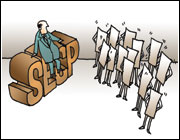 IN his first public address as newly appointed chairman of the Securities & Exchange Commission of Pakistan, Razi-ur-Rahman Khan made an unremarkable statement at a seminar last week. The SECP is to introduce codes of good governance in all sectors, he said, and is committed to evolving a strategy for corporate social responsibility.
Now that Khan’s taken charge of the critical post of chief corporate and market regulator as of last weekend, the hope is that his vision for the SECP will extend beyond this limited realm.
Khan’s appointment by the ministry of finance has surprised most in regulatory and financial circles even though the dismissal of former chairman Tariq Hasan was not unexpected since the handling of the March stock market crisis.
While the possible candidates for the job were few in number, Rahman’s primarily investment banking background is seen by many as inadequate to cope with the entirely contrary world of the regulator. It also remains to be seen whether he has the tough, decisive and independent personality coupled with the policy-making and implementation skills to get the job done.
But where did Hasan go wrong? And when and how did he lose favour with the government? He was clearly an accomplished and competent choice for the job, even if some thought him to be technically inadequate when it came to regulating the stock market.
One problem Hasan developed early in his stint as chairman was his inability to sell a favourable image. He was seen as undiplomatic, difficult to communicate with and closed to suggestions or advice. That, his colleagues and regulatees say, made him hard to work with. He was also seen to be indecisive and wavered frequently when planning further steps in the reform process. However, it is also more than evident that Hasan was well meaning and willing to make brave moves.
So, where will the SECP go from here? It is yet to be seen how well Khan can steer the institution but the appalling way in which Hasan was suddenly and unceremoniously dismissed means the government has burdened the SECP with a fresh set of problems. The fallout of this will become self-evident in the coming weeks and months as the SECP finds it difficult to recruit commissioners and other officers to its depleting ranks.
Top officials within the SECP confirm the low morale among employees and describe the institution as being at its lowest ebb since the SECP was set up in 1997. The unanswered question remains as to why the government chose a route quite so undignified, and more critically, what the real reason for the dismissal was.
If it was the share market crisis, why did the dismissal come a full 10 months after the stock market crisis? And if the reason is the recent conflict with the Karachi Stock Exchange over the appointment of a non-member chairman, then there are even more serious worries looming. At a time when the government should be looking to strengthen institutions, this was not a smart move. It smacks of a lack of transparency and accountability. So, can Khan lift the SECP out of this mire? He certainly has his work cut out for him.
To begin with Khan must assess with care the type of approach an independent regulator needs to take to achieve effective results. He can draw lessons here from the patience and technical expertise of the SEC’s first chairman Shamim Ahmed Khan, the hard headed decisiveness of second chairman Khalid Mirza and the clear intent to forge ahead of third chairman Tariq Hasan.
Perhaps more importantly, Khan should draw lessons from the SECP’s recent and sometimes repetitive failures. He will have to ensure a thorough and complete understanding of the issues at hand, use the collective wisdom of his colleagues, stakeholders and experts in the field to build an ambitious yet realistic plan and then use a delicate mix of diplomacy, consultation and aggression to push it through. He will also have to learn to accept unpopularity as part of the job.
Then, Khan will have to spend some time consolidating the achievements of the SECP thus far. A weakened institution risks undoing all that it has achieved so far. And Khan will have a major task at hand to preserve the gains of better corporate governance, progress with non-bank finance companies and the establishment of a direction for market improvements while artfully making way for further reform. This will mean buttressing the process of ongoing reform in all the areas where it remains in progress.
For example, the SECP group that has successfully pushed through the development of real estate investment trusts or REITs should be rewarded and supported. It will also mean going the extra mile to retain employees at the SECP and getting to work immediately recruiting new workers from the private sector.
Clearly, the bulk of Khan’s work will lie in the arena of capital markets, the reason why his predecessor lost his job. Here, Khan must tread with care. To start with, he would do well to focus on helping to build a strong front-line regulator. The SECP has repeatedly fallen to bad times on account of poor decision making on the part of the management of the stock exchange. This has meant the SECP has to repeatedly interfere in the KSE’s domain, compounding problems of communication.
If Khan can assist the KSE’s new management to build an effective system of regulatory control and then step back and allow them to do their job, he will help establish a working relationship between the exchange and the SECP which has still not been put in place.
Part of this effort will be ensuring that the independent directors on the board of the exchange have the technical skills, vision and independence to make an effective contribution. So far, with rare exceptions, this has not been the case. The majority of outside directors are either unable to understand the complexities of market issues or lack the independence to push through the right measures.
Khan will also have to beef up the SECP’s ability to produce world class research of international best practices and their relevance and applicability to local market conditions. The SECP should put together vision plans for each sector under its control which should outline in detail international practices, the problems other countries may have faced in implementation and incorporate suggestions from stakeholders as well. This will eliminate the lack of preparedness seen repeatedly on the part of the SECP.
The new chairman will also have to assess existing and long pending plans for second generation reform such as the demutualization process and develop fresh plans for amendments or implementation. This should be accompanied by a realistic schedule for implementation and an openness to debate, discussion and the flow of information.
Clearly, the SECP has so far not gained from its ambitious calendars of implementation and repeated delays. Khan should also ensure special care to the matter of timing when issuing directives and decisions. Both his predecessors suffered on account of poorly thought out timing.
Khalid Mirza’s otherwise solid performance was marred by a last minute decision to award a license for the establishment of an electronic communications network and Tariq Hasan’s directive on non-broker chairmen, albeit less dramatic, also led to trouble. It is far more transparent and far less damaging to plan ahead and give stakeholders sufficient time to digest the onset of changes.
It will help if the new chairman also develops a better system of communication with the media, creating an openness and access to information which will help in the process of creating awareness.
But Khan’s biggest challenge will be reigning in the influence of stock brokers. The message which has failed to go through is that the SECP is the apex regulator that should be fully alive to its responsibilities but which should be given the full authority by the government to function with independence.
An SECP chairman being dismissed simply on account of brokers aiming to get rid of him is a truly troubling sign, his own performance notwithstanding. If reform is to be successful and if issues like insider trading and market manipulation are really to be tackled, then the SECP will have to build itself into an institution of credibility, skill and independence.
And the government will have to allow it to reign supreme and ensure that powerful stock brokers are confined to the business of earning brokerage through the trading of shares.






























