0
0

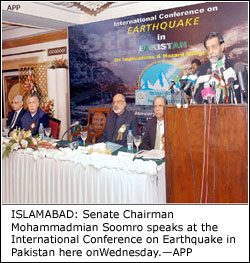 ISLAMABAD, Jan 18: Federal Minister for Natural Resources Amanullah Khan Jadoon has made it clear that the federal capital is not being shifted from Islamabad in the face of heightened risk of earthquakes.
“There is no such proposal under consideration,” he said when journalists referred to such rumours at the International Conference on Earthquake in Pakistan which opened here on Wednesday.
Implications and mitigation of hazards of earthquakes would be discussed at the two-day conference which emphasized on the first day that Pakistan needed to change from being a calamity- driven nation to a prevention-driven nation.
Mr Jadoon informed the conference that his ministry had been actively working with earth scientists, geologists to design “a robust and comprehensive Disaster Management Plan” to mitigate calamities in future.
He said the conference had been called to discuss important issues like chances of future shocks and quakes, vulnerability of major cities, dams and other strategic structures in Pakistan situated on active fault lines and patterns and relationship between aftershocks and main disastrous jolts.
Reliability of the existing seismic and building codes of Pakistan for designing of earthquake resistant buildings would also be examined, he said.
An indepth and comprehensive research and development programme would be initiated to improve public awareness of natural calamities, he announced.
The minister said the main focus of the research strategy would be on public-private partnership.
“Our politics revolves around people of Pakistan and the common man is the term of reference for us,” he remarked, assuring the safety and wellbeing of common man had been and would remain the top priority of the government.
Senate Chairman Mohammadmian Soomro called on the assembled scientists, seismologists and geotechnical engineers to develop “a foolproof and pragmatic mitigation strategy” to minimize the earthquake hazards and devastation.
He said the October 8 earthquake was a major devastating incident in which hundreds of thousands of people were killed or wounded or made homeless. By studying the past frequency of large earthquakes, probabilities could be tabulated with some degrees of certainty, he observed.
Pakistan, he said, needed to embark upon sound scientific research on structural geology, geo-tectonics and seismology “to study the patterns and aftershocks that may lead us to reasonable scientific guessing,” he said.
In his view preparedness was the most important factor in risk mitigation. A comprehensive action plan was required to minimize impact and degree of devastation and casualties in future.
Mohammadmian Soomro said the government had mobilized all available resources to develop a strategy to make this part of the world as safe as possible. He asked the scientists and geologists to formulate building code to avoid future damage.
He also appreciated the generosity of the world community and the role of Pakistan army, civil society and NGOs in providing relief and rehabilitation to the quake-affected people.
More than 40 earth scientists, seismologists and geotechnical engineers from the US, UK, Japan, Turkey and India are attending the two-day conference.