0
0

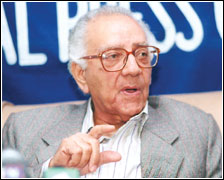 ISLAMABAD, Jan 17: Socio-economic conditions in Pakistan would continue to worsen until a mass movement is organized and rids the country of its entrenched feudal-military combine. This was the crux of a dialogue on the dilemma of present day Pakistan delivered by renowned lawyer and National Workers Party president, Abid Hassan Minto, at the National Press Club here on Monday.
A stirring for change existed in the smaller provinces but it needed awakening and support of the masses of the Punjab to bring about the change, the leftist leader said.
However he saw only gloom as he said the feudal mindset ruling the country had been merrily pursuing policies dictated by international powers and financial institutions — though the same had proved ruinous in many Latin American countries.
He held the military-led ruling class responsible for the increasing unemployment, poverty, social degradation and disharmony.
Mr Minto said the Kalabagh dam, the military operations in Waziristan and Balochistan and the constitutional crises were political issues and should be resolved politically and through the parliament.
That the Kalabagh dam was a political issue was evident from the fact that President Musharraf had been addressing public meetings all over the country to win support for the controversial project, he said, contesting the president’s authority to decide vital national issues unilaterally.
“If Pakistan could take its objections to India’s Baglihar and Kishan Ganga dams to the World Bank for arbitration, why can’t the people of Sindh and other provinces have the right to debate water management and distribution of resources in national forums, the parliament and the Council of Common Interest,” he asked.
Though various technical committees and the assemblies of three provinces had rejected the Kalabagh dam, Gen Musharraf was adamant to go ahead with it because, Mr Minto alleged, “he wanted to remain in power beyond 2007”.
Mr Minto said the concentration of powers in one man and making the constitution and the parliament subservient to him would prove disastrous for the country.
Military rulers, he charged, had made Pakistan’s sovereignty subservient to global imperialist forces. “Foreign forces feel free to target Pakistani civilians and territory in the garb of fighting terrorism. The government itself hands over Pakistani citizens to America without fulfilling any legal process”.
He alleged that the military had monopolized the earthquake rehabilitation and rebuilding work “to capitalise on the national tragedy to perpetuate its rule”.
He also questioned Gen Musharraf’s sincerity in eliminating the Sardars in Balochistan. “It is the same president who has gathered landlords, feudals and Sardars under the umbrella of the ruling Muslim League. Musharraf wants to eliminate only those feudal lords who are against him. Otherwise, he has not spoken even a word on land reforms”, Mr Minto said.
He said the military establishment has developed a vested interest in keeping the feudal structure intact as it has itself acquired large land holdings and military farms.
Majority of the population is living in rural areas and still living in abject poverty.
“The land reforms introduced by Gen Ayub Khan in 1959 and Mr Z.A. Bhutto in 1972 were ineffective”, he observed asking for mobilization of the masses on the lines of the recent wave of changes taken place in some Latin American countries.
He said our government is claiming of economic turnaround by following the IMF and WB prescriptions which have proved a total failure in Latin American countries.
He warned Pakistan of continuous economic crisis if it still followed the prescriptions of the World Bank and IMF.
Mr Minto said he was very much clear about the inability of the capitalism to solve the basic problems of the people and an ongoing resentment in the Third World against this system. He urged the working class, peasants, intellectuals, lawyers, doctors, journalists to get united and launch a democratic movement against the ruling clique and military dictators and for establishing an egalitarian society.