



 0
0

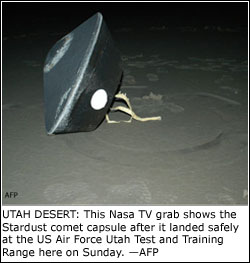 WASHINGTON, Jan 15: The US space probe “Stardust” returned to Earth on Sunday carrying precious samples of dust from stars and comets, which scientists believe could offer vital clues about the origins of our solar system, Nasa television showed. After a seven-year journey, a capsule weighing 46 kilograms and carrying a teaspoonful of space dust landed in the Utah desert at 1010 GMT after flying 4.63 billion kilometres in space, or 10,000 times more than the distance separating Earth from the Moon.
“All stations, we have touchdown,” a jubilant mission control announcer said as the capsule made its touchdown, 13 minutes after entering the Earth’s atmosphere.
Nasa described the capsule’s entry speed — at 46,444 kilometres per hour as the fastest ever of any human-made object, topping the record set in May 1969 by the returning Apollo 10 command module.
The samples were collected during the first attempt to gather, beyond the Moon, space particles that date back to before our solar system was born, or about 4.5 billion years ago.
A helicopter crew found the capsule at about 1054 GMT, Nasa said. Two more choppers then headed to the recovery scene to package it up before flying it to the US Army Dugway Proving Ground, Utah.
At about 1200 GMT, the capsule arrived at the Dugway facility’s Michael Army Air Field for initial processing, Nasa television showed. Nasa will move it later to Johnson Space Centre in Houston, Texas, the network said.
Painstaking analysis could take scientists as long as 10 years. The work, according to one scientist, could be compared to finding 45 ants on a football field, or studying five square centimetres of earth at a time.
To help the researchers, the University of California, Berkeley, has launched a drive to recruit 30,000 volunteer students, who will have access to a powerful microscope via the Internet.
The Stardust probe, weighing 385 kilograms, was launched in 1999, circled the Sun twice and then flew by comet Wild 2 in January 2004, which at the time was located next to Jupiter.
During its hazardous traverse, the spacecraft first deployed a shield to protect itself from gases and space dust contained in the halo of the comet.
It then flew within 240 kilometres of Wild 2, catching samples of comet particles and taking detailed pictures of Wild 2’s pockmarked surface.
The 72 pictures of Wild 2 taken by the probe show its rugged surface, including craters as well as about 20 “geysers” spewing gas and dust.
During 195 days of the flight, Nasa engineers used a collector to gather interstellar dust that will also allow scientists to study the make-up of stars.
The special collector contains aerogel, a unique substance that can trap the particles and store the precious cargo safely for the trip back to Earth. About four hours after releasing its return capsule Stardust entered Earth’s atmosphere.—AFP




























