



 0
0

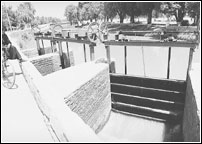 Probably, the first use of the term ‘water use efficiency’ was to mean the ratio of crop production to evapotranspiration. The term has since become widely used to describe the yield per unit of water evapotranspiration, or applied water. The irrigation engineering term ‘irrigation efficiency’ is the designate ratio of water required to grow a crop that include evapotranspiration, percolation and seepage, leaching for salinity control and land preparation to the water delivered.
Two pressing issues threatening the sustainable development of irrigated agriculture are water shortage and salinity. The two are linked in several ways. The irrigated agriculture concentrates salts because water is taken up by the crop and salts are left behind in the root zone.
Proper management ensures that the salt is concentrated outside the root zone, and away from future water supplies for irrigation, domestic or industrial use. Hence water is required to transport salt from the root zone, in addition to consumptive requirements of the crop, and also land is required to store the salt. Therefore, water shortage also prevents remedial action on land already affected by the salinity.
Each year, irrigation with good quality river water adds one to two tons of salt per hectares (ha). To prevent accumulation of salt in the soil profile, additional water is applied than the water taken up by the crops to leach the salts out of the root zone.
Unless there is an adequate drainage system, this practice leads to rising water tables and waterlogged conditions. High water tables actually increase the salt transport into the root zone because of capillary rise from the water table.
In Pakistan about 30 per cent (4.7 million ha) of the gross command area is water-logged and about 13 per cent is considered highly waterlogged.
Agriculture in Pakistan suffers from under-utilizing its potential resources, resulting in unnecessarily low yields per hectare and per unit of water consumed. At the time when water demand exceeds water availability, the only remedy is to achieve higher food and feed production per unit of water consumed.
A good part of Pakistan is classified as arid to semi-arid where rainfall is not sufficient to grow agricultural crops. About 68 per cent of the geographical area has annual rainfall of 250mm whereas about 24 per cent from 251 to 500mm. Supplemental water is required for profitable agricultural production in these areas, which is mainly possible through water harvesting.
About 15.8 million ha is presently served by the Indus River irrigation system, the largest integrated irrigation network in the world. It has three major reservoirs, 19 barrages, 12 inter-river link canals (mainly to supply the command areas of the eastern rivers from the western rivers), 43 independent irrigation canal commands and some 58.5 thousand-km of main canal.
In terms of equivalent annual depth of water for the 15.8 million ha gross command area, the total water supply is about 1,375mm (4.5 feet). On an average one crop with field duration of less than five months (e.g., wheat, potato and rice) can be raised successfully with half this amount.
Low water use efficiency (less than 40 per cent) plus the need to plan for irrigated agriculture on at least an 80 per cent water supply dependability level, contribute to low cropping intensity and poor performance of irrigated agriculture.
The productivity of water in Pakistan is among the lowest in the world. For wheat, for example, it is 0.5kg per m3 compared to 1onekg per m3 in India. Maize reveals even a factor nine between Pakistan where the productivity is 0.3kg per m3 and Argentina productivity of 2.7 kg per m3. This reveals that there is a substantial potential for increasing the productivity of water.
Yield gap between potential yield and national average is also fairly wide. The major crops like wheat, rice and maize require interventions to increase productivity, not only in incremental terms, but also in substantive one.
For this a shift in cropping pattern is necessary, and crop specific interventions are needed. The yield range for the wheat is in the range of 0.8 to 5.5 tones per ha. This clearly indicates that through improved management the gap can be reduced, and correspondingly substantial increase would be obtained in the production.
The current yield of rice is two tons per ha against expected yield of 2.56 tons per ha. Rice productivity can be increased through increasing plantation intensity, mechanized transplanting, reduce post harvesting losses, and by introduction of hybrid rice varieties.
The strategic option for the rice would be to increase the productivity of the crop, while keeping the same area under this crop due to its high water requirement.
While it is clear that water productivity will be low in crops beset by diseases, pests, or weeds, there are also more understated aspects of crop management or the behaviour of various cultivars that can have large effects on productivity.
There are many aspects of soil and stubble management that influence the water balance of the soil by affecting infiltration and water storage in the soil, and evaporative losses from the soil surface. These combined effects can substantially affect how much water is available to a crop. There are, as well, many other agronomic effects on water productivity. Timeliness of sowing, evenness of establishment, use of herbicides, management of nutrients, the role of previous crops, in fact, anything that improves the general vigour of a crop can strongly affect water productivity, usually for the better.
Sowing winter-growing crops early, when soil and air are still warm, leads to good canopy cover during late autumn and winter with consequently less evaporative losses from the soil surface. Changes in mechanized agriculture during the last 20 years have enabled farmers to sow their crops at more opportune times.
These changes include: using large and fast machinery that can sow large areas quickly; using general herbicides for killing emerged weeds just before or during sowing; and using specific herbicides for controlling weeds once the crop has established, or more powerful general herbicides, such as glyphosate with genetically modified crops resistant to such herbicides.
Such techniques greatly improve the timeliness of sowing and can thereby improve yields in water-limited environments. However the timing of availability of water is decisive factor.
Other issues that need attention are: soil erosion and degradation, inappropriate fertilizer and pesticide use, inadequate availability of quality seed and markets infrastructure; weakness of agricultural research and extension services.
Improved seed is one of the important factors in crop productivity enhancement. Unfortunately this category of seed coverage is within low range of 14-20 per cent for wheat and other major food crops. The productivity of the food crops can be substantially enhanced through increased use of quality seed.
Along with the promoting improved seed government should also focus on monitoring and quality control of seed production and distribution to the users end.
Proper use of organic and inorganic fertilizers is also critical for maintaining soil fertility to enhance agriculture productivity. Fertilizers should be used according to the site-specific requirements of crops. The current use of plant nutrients is not only imbalanced and inadequate, but inefficient as well. The use of organic and inorganic fertilizer needs to be encouraged in an integrated manner. Currently, there is indiscriminate use of pesticides for plant protection. Integrated Pest Management should be promoted for sustainable plant protection.
Although, a number of land reforms have been done in the last 50 years, they did not bring any significant changes in the land holdings. Therefore more emphasis should be made to facilitate easy access of the majority of small farmers to the land, water and other essential agriculture inputs. This will help in the overall agriculture growth.
Due to the financial limitations, the small farmers are largely dependent on credit to procure agriculture inputs. Most small farmers are unable to use the facility of cost free loans because of the cumbersome procedures for transacting a bank loan even if it is interest-free.
The cooperative banking system is still very weak in terms of its ability to extend loans to farmers, to recover these loans and manage its affairs efficiently. Consequently, the influential farmers tend to dominate the co-operative organizations at the apex level. There is an immediate need to simplify such procedures. The agriculture loan should be broad based, and flexible enough to provide credit for variety of agriculture related activities.
Good rural infrastructure and adequate institutional capacity are essential for the transition from a resource- based to a technology-based agriculture. Hence, investment in these areas should be part of the core elements of government strategy for sustainable development, food security and poverty alleviation.
Production has traditionally been constrained by problems of a technical, institutional and policy nature. Technical constraints are poor agronomic and harvest management practices, no availability and inappropriate use of physical inputs. Institutional constraints include capital availability for small farmers, inadequate research and extension, inefficient agricultural education and training, lack of statistics and information system, complex agriculture credit institutions and policy problems relate to input and output price distortions are the major constraints.
The imperative need, therefore, is to address these issues more forcefully in order to tap the considerable productivity potential of the agriculture sector.
At the time when country requires increased food production to meet the food needs of growing population, while less water resources are available for agriculture, this alarming situation can only be resolved if water is managed more efficiently, so that crop yield per unit of water consumption increases. Increasing the agriculture yield per unit area in our crop field by the best available agronomic means is also of vital importance.






























