



 0
0

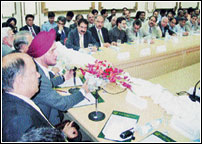 Indian businessmen are not only interested in larger and more stable trade but also in making sustainable investment in Pakistan. Indian entrepreneurs have been coming here as friends of local businessmen and making enquiries about the prospects of such investment. A group of chief executives of major Indian companies was to visit Pakistan in November, but the visit was postponed because of the preoccupation of Pakistani officials with the aftermath of the October 8th earthquake. They are to come here soon.
Prime Minister Shaukat Aziz has repeatedly said investment by India will have to wait for the settlement of political disputes between the two countries or for them to be on their way to a settlement, particularly Kashmir. He is reported to have directed the Investment Promotion Bureau not to entertain applications for making investment from India.
Pakistani businessmen with few exceptions are not in favour of such investment. They argue that Indian companies are very large and if they are allowed to set up companies here, they will dominate the market and put local businessmen out of trade. But the Indians argue they want to set up joint enterprises, which cannot become the monopoly of any single country.
The Indians say the products of such enterprises can also be exported to India and marketed by the Indian joint venture partners of such enterprises. The Indians are encouraged to seek such joint enterprises after the agreement between India and Pakistan on the $7 billion Iran-Pakistan-India gas pipeline, which they are pursuing avidly despite the US disapproval.
In addition, Shaukat Aziz has now spoken of a Turkmenistan-Pakistan-India gas pipeline, the details of which are yet to be settled. It is also recognized by both sides that after India and Pakistan became nuclear weapon powers, war between the two countries has to be ruled out. In a war, the loosing country will always threaten to use the nuclear weapons. So better trade than go to war, which is un-winnable.
India with its foreign exchange reserve of $136 billion is encouraging its entrepreneurs to undertake profitable foreign investment as a part of its foreign policy as well. But there is a distinct difference between trade and investment in this context. The former Soviet Union and the US traded with each other despite their ideological hostility and fierce cold war. China and the US too traded with each other despite their political antagonism, but neither of them tried to make investment in the other country across their ideological barriers.
So mutual investment comes at a later stage in India and Pakistan when there is greater stability in their relations. But there was a time when we preferred Indian investment in Pakistan to trading with India. That was a period in the early 1990’s when Riaz Khokhar was going out as the High Commissioner to India.
At a lunch for journalists in Karachi he was asked whether he would do anything to promote trade with India, “No, my briefing is to prefer Indian investment in Pakistan” he said.
A journalist asked if we would not buy a matchbox from India, how would you expect India to make large investment in Pakistan. Mr Khokhar shrugged his shoulders and said that was his briefing, surprising the journalists all together.
Those were the days of the supremacy of Mr.Ghulam Ishaq Khan in the economic field. And he possibly presumed that with large Indian investment in Pakistan, India would not be unreasonable with us. That was why he preferred investment by India to trading with India which could be suspended any moment.
When it comes to larger trade with India, some of the fears of the local businessmen are exaggerated. The fact is Pakistan is competing with India with its goods all over the world. Pakistani textiles, at least some of them, are competing with the similar Indian products all over the world including US, Japan and East Asia What matters is not the small size of the country, vis-a-vis India. Far more important is the quality of its exports products and the merit of its brands which should be improved and refined constantly.
Pakistan has to specialize in a few export products instead of frittering away its energy, talent on too many products thinly. Anyway, Pakistan’s relations with India are improving and more bridges of understanding are being built between the people with the assistance of the two governments. Pakistan is importing five basic vegetables in short supply here, along with live cattle for meat.
Pakistan has permitted the import of soft iron from India for construction purposes and India has resumed the sale of sugar to Pakistan. The number of items importable from each country has been increasing by the hundreds. Pakistan’s Commerce minister Humayun Akhtar has a thousand product target to promote.
Apart from the railway line and roads for buses and trucks connecting the North of Pakistan with India, the Khokhrapar-Monaboa is to open on February 1st and the reopening of the Indian consulate in Karachi and Pakistan consulate in Mumbai will follow soon after overcoming the logistic problems.
Pakistan and India have agreed on resuming the shipping service between Karachi and Mumbai and allow the ships to carry third country cargo as well. All this should ensure a larger volume of trade between the two countries. But when it comes to mutual investment, it has to wait and that could be for quite some time until India and Pakistan are on their way surely to find a solution for the Kashmir issue.
While dealing with India, Pakistani’s should feel far more confident as they can stand up to India in almost any field. Pakistan should now give greater importance to quality and that includes the quality of the public education as well and pride in their products through constant improvement and innovation.






























