



 0
0

 Political cloud have started casting shadows over the national economy with mounting business concerns over security situation in Balochistan. In a report on” key risks and challenges 2006,” a corporate brokerage house, Taurus Securities (TS) reckons that the militancy in Balochistan will have “detrimental impact on the reserves of natural resources and disrupt gas supplies.”
The situation , according to TS analysts is worsening due to military operation. They hope that resistance and criticism against it will lead to a dialogue. The military action has provided a common ground for the opposition parties to unite and provoked reactions from the other provinces.
The situation has implications for Pakistan’s image abroad and the proposed India-Pakistan-Iran gas pipeline to be routed through the province.
While the government claims it is dealing with the situation by using paramilitary force, the Baloch nationalists maintain that the authorities have over-reacted, the military action must be stopped and troops must be withdrawn. Federal ministers assert they would keep the security forces in the area.
Critics draw a parallel between the federal approach in solving the Baloch problems and that adopted in case of former East Pakistan-military action to back its efforts to integrate the provincial economy into the national and international markets, while according a very low priority to the issues of local household and provincial incomes. This denies the province a Balochistan-centred economic development which could benefit the majority of its population.
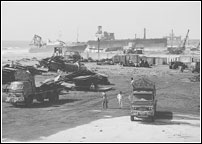
So far, the trickle down effect of economic growth strategy has not made much of a difference to the vast majority in the province, whether it be projects like Gadani Shipbreaking Yard, Hub Industrial Estate, Gawadar Port, the Sui gas supplies or Saindak copper mines.
In the case of the industrial estate, tax incentives were offered to develop a less developed region but its beneficiaries were investors and labour from elsewhere. The Baloch were the last to benefit from Sui gas and that too not adequately. The royalty on oil, gas and mineral resources is marginal. This has led to the demand for the Baloch control of resources in areas inhabited by them. Extremes of poverty and wealth are creating social tensions.
Balochistan needs massive investment in areas such fisheries, livestock and dairy farming, agriculture particularly orchards, in building small dams and drilling tube-wells, woollen carpet and handicrafts industry for the local people to prosper.
The country is paying a heavy price both in Balochistan and Waziristan for keeping the tribal areas politically, economically and culturally backward and for sustaining successive governments on tribal and feudal support. Once again, over-centralized authority is being challenged, impacting on political stability.
While there is a lot of rhetoric about improving governance and institutional building, the constitutional course for establishing rule of law and for resolution of political problems, has not been followed.
The 1973 Constitution has been defaced from time to time though it was framed unanimously by the representatives of the four federating units in the aftermath of a civil war in 1971. It reflected the national wisdom with Zulfiquar Ali Bhutto acting as the chief spokesman of the aspirations of the federation and its people.
The deviation from the constitutional path has created political instability in the shape of quick changes in governments and an upsurge of what has been described as “sub-nationalism” by some and “nationalism” by others among the people of the federating units.
The point missed is the latest trend of integration worldwide through networking on the basis of self-determination between and within nations. For example, in domestic politics, individuals, groups and political parties retain their individual identity and co-ordinate their efforts to achieve common objectives. The present coalition governments at the federal and provincial levels include parties with sharply divergent views.
The denial of autonomy to the federating units is the root cause of political instability. The unitary mode of governance transplanted over a federal constitutional structure is making solution of major federal problems like building of big dams, National Finance Commission Award more and more difficult to tackle.
The constitutional course for achieving consensus on building dams including at Kalabagh has not been adopted for decades at the cost of their non-implementation.
Similar is the fate of the National Finance Award which could not be announced for want of consensus among provinces and the federation in the constitutionally mandated period of previous five years.
All these issues are acting as a drag on economic and social development and need to resolved.
The Council of Common Interest has remained defunct but for a brief period since the promulgation of the 1973 Constitution. Now, after six long years, the government intends to revive it. Still worse, that the decision of the Council on water sharing (1991 accord) has not been fully honoured.
The ruling coalition is sharply divided on the dams issue. Three provincial assemblies are opposed to Kalabagh dam. The dam has not been approved by the Cabinet. All major decisions taken outside the parliament and the cabinet are being challenged in public, leaving one baffled about the fate of official commitment on institutional-building.
In the absence of a democratic process that inculcates tolerance, arbitrary decisions have sapped the spirit of give and take among the provinces and the political parties.
Yet all is not lost. Though politics suffers from stagnation, ground realities offer some hope of progress. The nature of military take-over in 1999 was a deviation from the conventional wisdom so far as it was not followed by declaration of Martial Law.
The elections were held within the promised three years’ time, the space required to manipulate a military-civilian coalition. The military’s strategic grip over political affairs had weakened because of their past performance, as pluralism gained strength in a developing market economy.
With the military-led coalition government having squandered away all its charms, the ideological sway of unitary system of governance has nearly collapsed and is paving the path of constitutional and civilian rule.
If major sensitive federal issues continue to occupy the central stage of national politics, the 2007 elections may bring in many surprises. It is not without reason that the financial analysts have started speculating whether the general elections scheduled for 2007, will not be postponed. The country would not escape this imperative without the over-centralized authority paying a heavy price.






























