



 0
0

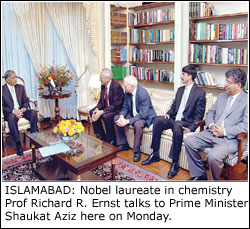 ISLAMABAD, Jan 9: Renowned scientist and a Nobel laureate Prof Richard Robert Ernest in his lecture here on Monday explored the fascinating factors of nature by Nuclear Magnetic Resonance (NMR) as he has discovered that the sensitivity of NMR techniques could be dramatically increased by replacing the slow, intense pulses.
This discovery enabled analysis of a great many more types of nuclei and smaller amounts of materials. He was of the view that this is the time that scientists should work for collective good and should contribute their responsibility for our future.
Prof Ernest said, “let us become path finders as science alone does not solve the problems of globe.” He ended his lecture by saying that optimism should be our duty as we are all jointly responsible for what will come in the future.
Earlier, introducing Prof Ernest for a lecture Dr. Attaur Rahman, Chairman Higher Education Commission and Adviser to the Prime Minister said that it was a great opportunity for the academic circles of Pakistan that a Nobel laureate Prof Ernest was visiting Pakistan to share his vast scientific experience and innovative knowledge with the scientists, academicians and men of letters of Pakistan.
Dr. Atta said that Prof Ernest won the Nobel prize for Chemistry for his development of techniques for high resolution Nuclear Magnetic Resonance (NMR) spectroscopy in 1991 and now is visiting Pakistan on his invitation to deliver lectures at HEJ Institute of Chemistry, University of Karachi and Pakistan Academy of Sciences, Islamabad.
The lecture of Prof. Ernest was listened by a great number of scientists, educationists, fellows of Academy of Sciences and students with full concentration, as the Auditorium of Pakistan Academy of Sciences was jam packed to listen to the lecture of the Nobel laureate.


























