0
0

 KARACHI, Jan 8: Leaders representing different parties at a seminar on Sunday urged the government to halt the military operation in Balochistan immediately and initiate talks with Baloch leaders to find a political solution to the problems in that province. They termed the military action a conspiracy to usurp the resources of that province.
They were of the view that the use of force in the past had always multiplied the problems and created hatred against the armed forces.
They held the civil-military Establishment responsible for the ‘multi-dimensional crisis’ in the country, saying that the country could not have reached the present stage had the Establishment recognized the sovereign rights of people to rule over the country.
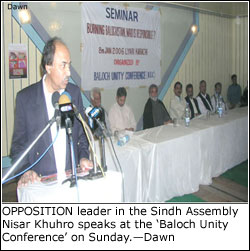
Entitled Burning Balochistan: Who Is Responsible?, the seminar was organized by the Karachi-based Baloch Unity Conference at the Abdul Khaliq Jumma Community Hall, Chakiwara, Lyari.
It was chaired by National Workers Party leader Yusuf Mastikhan and addressed by PPP leader Nisar Ahmed Khuhro, Jeay Sindh Qaumi Mahaz chairman Bashir Qureshi, Baloch National Movement chief Ghulam Mohammad Baloch, National Party leader Jan Mohammad Baloch, Awami National Party leader Amin Khattak, Jamhoori Watan Party leader Sher Mohammad Baloch, Mubashir Qaisarani and others.
Mr Khuhro, who is also leader of the opposition in the Sindh Assembly, condemned the military operation in Balochistan and said that military action had never been regarded an ideal solution to a political problem.
Mr Khuhro claimed that the civil-military bureaucracy had created anarchic conditions in the country and differences among its people, adding that it had become a regular practice that after every 10 years the country was put under the rule of armed forces and their civilian henchmen.
“Whenever elections are held under the army rule, people’s mandate is rejected and a so-called civilian government is installed. Subsequently, efforts are made to protect the government and force is used to crush the voice of dissent.” He said it was the considered opinion of his party that if the government under Gen Zia was bad, the government under Gen Musharraf was equally bad.
“We had already been deprived of employment, NFC Award and our language, and now the rulers are planning to completely destroy us economically by constructing the Kalabagh Dam.”
Mr Khuhro said Pakistan comprised four federating units and the rights of all these units should be respected, adding that neither Kalabagh Dam nor the Balochistan problem could be resolved through use of force.
“No party which is part of the present regime can absolve itself from its responsibilities,” he remarked, and urged all democratic forces of the country to exert pressure on the government in order to get the Kalabagh Dam project scrapped and the military operation in Balochistan stopped.
Bashir Qureshi of the JSQM slammed the government for launching the military operation and termed it ‘inhuman’. He declared that the Sindhi people, who were culturally, politically close to the people of Balochistan, fully supported their struggle for national rights.
ANP leader Amin Khattak said his party firmly believed that the Balochistan issue was a political one and could be resolved only through a dialogue.
He said his party had always opposed use of force to settle political issues, and in this context recalled that it had opposed military action in East Pakistan before the 1971 debacle.
Calling for an immediate halt to the military operation in Balochistan and Waziristan, he urged the rulers to stop the practice of calling their political opponents as ‘traitors’ and ‘miscreants’.
Jan Mohammad Baloch (MPA) of the National Party, giving statistics of the national economy said the country was overburdened with loans, and held the civil-military bureaucracy responsible for the economic mess.
He deplored that Balochistan was being denied its due share in federal services. Referring to the general conditions in Balochistan, he said that barring a few, all roads were in bad condition. Hardly 20 per cent of its population was being provided piped water, he added.
BNM chief Ghulam Mohammad Baloch said Balochistan issue was basically an issue of sovereign rights of a subjugated nation fighting for national integrity and its own nationhood.
He traced the history of Baloch National Movement, and said that it had started when Kalat states union was forcibly merged into Pakistan by the army in 1948. This was followed by three more military operations — in 1956, 1958 and 1973—, he said, adding that the current one was the fifth military operation.
The BNM leader opined that the problem could not be solved unless national rights of Baloch people were accepted.
National Workers Party leader Yusuf Mastikhan held the civilian-military bureaucracy responsible for creating a multi-dimensional crisis in the country.
He said it was due to their ill-advised policies that the eastern wing of Pakistan was separated, and now the country had once again plunged in a serious crisis.
He was of the view that the crisis could only be overcome if the army’s intervention in the country’s politics was stopped and the sovereign rights of all federating units were recognized.
He said military action had never resolved any issue, and suggested that not only the army should be pulled out from Balochistan, but militarization of all state institutions should also be stopped.
Earlier, Mubashir Qaisarani and Akhtar Hussain Longo spoke at the seminar.
At the end, the participants adopted several resolutions condemning the military operation in Balochistan and terming it ‘a pre-planned conspiracy’ in the name of development to usurp the resources of that province.
The seminar urged the government to stop the construction of cantonments in Dera Bugti, Kohlu and other areas of the province. It also called for release of all innocent people, including political workers detained during the operation.