



 0
0

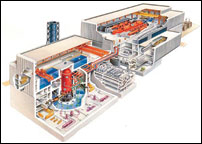 THE government is opting in a big way for increasing the output of nuclear power to ensure energy security and provide power to the consumers at competitive rates. The government is to acquire six to eight nuclear reactors from China at a cost of $7-10 billion within a decade.
As the ambitious nuclear programme is rolled out, Prime Minister Shaukat Aziz poured concrete last week for a new structure to mark the beginning of the work on Chashma II with the capacity of 300 MW, like Chashma I built by the Chinese with the same capacity.
But the new series of reactors to be provided by China is to have a capacity of 600 MW each and will increase nuclear power production by 3600 MW to 488 MW. Nuclear power says the prime minister is capital-intensive but cheap, reliable and environmental-friendly.
The new reactors will be under the International Atomic Energy’s safeguards, like the Chashma power plants and the KANUPP in Karachi. For all the large capital investment involved, the nuclear power at the end of the decade will be only eight per cent of the total power output.
The rest of the output will be hydro power produced by the old and three new dams proposed from renewable energy like solar power, wind power and from bio-mass. The coal reserves at Thar will also fully exploited. Efforts for obtaining power from Tajikistan, which had earlier agreed to supply 1,000 mega watts of power, would also be revived.
Gas from Iran via the Iran-Pakistan-India pipeline costing $7 billion, and from Turkmenistan via the Turkmenistan-Pakistan-India pipeline will also be sought with assiduity. Earlier we were told of gas coming from Qatar, but now the prime minister has spoken of gas from Oman.
The government is also to replace the use of petrol and diesel oil with CNG, LPG, and the import of LNG. If power from all such varied sources will be available and in plenty, the result can be abundant power and at cheap rates, particularly if enough power becomes available through the hydro output from the large new reservoirs proposed.
But will all the foreign investment in power and the energy sector come forth as expected? It is to be settled how much of the seven to $10 billion needed for the 6—8 nuclear reactors will come from China in any form of aid and how much will be contributed by Pakistan.
Meanwhile, the government has decided that no thermal power plant will be approved by the private power infrastructure board without the previous sanction of the government. This restriction is meant to reduce the consumption of the very costly furnace oil by the private power plants.
The government has also instructed the provincial government to phase out diesel vehicles from major cities by the end of the year 2007. The cabinet committee concerned with replacement of diesel with CNG is at work now. The vehicles, which have to opt forsuch conversion include buses, minibuses, wagons and two stroke rickshaws.
Trucks of various kinds are not mentioned in this directive. Does that mean they will continue to be driven on diesel oil?
Adequate nuclear fuel maybe a problem when we don’t have enough of it. India tried to get it from the US under its new nuclear cooperation understanding and at the moment it is to get the same from Russia. Maybe Pakistan will get its nuclear fuel from China if need be.
Work on the higher potency nuclear reactors are to start in 2015 and be completed by 2025. By that time the nuclear power target of 8800 MW would be achieved. Meanwhile the shortage of power on the basis of the current demand by the year 2007 will be 1300 MW.
Adequate and increasing electric power is essential to attract large foreign investment and make our own entrepreneurs invest far more. Foreign investors, for that matter Pakistanis too, should not be expected to invest and generate their own power, increasing the capital cost of their investment. Such a policy discourages investment as a return from the capital can decrease.
It is also essential to take adequate energy conservation measures. Energy conservation is talked about a great deal in official circles and conferences. But positive measures are not adopted and the best results obtained.
Energy wasters are essentially of two kinds. The first are those steel power massively like 40 per cent of the output of KESC. Earlier the theft and loss rate had gone up to 60 per cent of the KESC system.
Then there are the idle rich who waste money on power as much as on many other things. Officers of the KESC are provided with 999 units of power and they waste a great deal of that power simply because they don’t have to pay for it. It was one thing to provide such power free when the furnace oil prices were very low. But now when they are so high such gifts every month should not be permissible.
Those who pay night cricket and other games in the street at night also use power illegally and waste it. There has been more talk of alternate or renewable energy than positive efforts in that direction. And alternate energy board has also been set up without positive achievements to speak of. And now the prime minister talks of an interim policy on the development of renewable energy resources of the country that is in the offing and would be announced soon.
He chaired a meeting on development of strategy and policy framework for renewable energy and an alternate energy programme on Wednesday last. He directed the energy experts to expeditiously finalize the interim policy, which he said, must be realistic and be based on scientific assessment of the renewable energy resources.
Congestion on the roads because of overcrowding or chaotic driving also results in waste of a great deal of energy. And now the frequent VVIP traffic makes the congestion far more acute. Along with that the number of cars is increasing thanks to the liberal car leasing policy of the banks and more POL will be spent and far more wasted.
Shortage of gas has become a major problem in the country today. While arranging for more gas supply from outside the country and pumping more gas from within the country, there has been two other developments on the gas front. The price of gas has been raised by over 15 per cent for all except the minimal domestic consumers. And gas supply has been disconnected for several hundred factories, particularly the textile mills facing excess competition on the export front.
Now the economic coordination committee of the cabinet has appointed a 3-men committee, comprising the vice chairman of the Planning Commission, Secretary, ministry of petroleum and the chairman of the Central Board of Revenue to find a remedy for the textile mills. What kind of a solution will the committee find remains to be seen.
The complex situation with high price of energy on one side and shortages all round on the other demand a radical approach to energy conservation including by popularizing the use of public transport that has to be improved a great deal.
Such efforts are essential as the moves for exploring more oil and gas are not proving to be a great success. The latest oil discovery at Tando Alam will yield only 5000 barrels of oil per day plus some gas. Hence effective energy conservation measures are essential along with vigorously stepped up efforts to explore oil and gas including offshore operations.






























