



 0
0

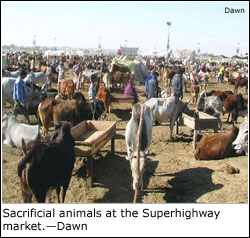 KARACHI, Jan 6: Like the last few years, a temporary market of sacrificial animals has been set up just a few kilometres away from the Sohrab Goth along the Superhighway. Sacrificial animals are brought from all over the country so the faithful could perform the sacrifice on the occasion of Eidul Azha.
Over 300,000 animals – including over 182,000 cows and bulls, over 135,000 sheep and goats, and over 1,000 camels and a few yaks from the Northern areas, etc – have already arrived at the cattle market, popularly called as Mawaishee Mandi set up on over an area of 1,000 acres on both sides of the highway.
On one side of the road, coming towards the city, is the cow and bulls market while on the other side, going towards Hyderabad, are markets for goats, sheep and camels. While bulk of the animals come from interior of Sindh, Balochistan and Punjab as well as the Northern areas including Baltistan, Gilgit, etc, some animals are also brought in from across the eastern border.
While water, electricity as well as the security cover are provided by the management of the market, however, many of the traders complained regarding the insufficient and irregular supply of water, and many of them had also made arrangements for the generators to get additional power supply in case of shortage or power failure. Water is also being sold on donkey carts carrying water tanks.
Though the weather has turned harsh over the past few days and it is cold particularly during nights with mercury dropping below 10°C, the enthusiasm of the customers remain high, and with the Eidul Azha approaching fast the rush is expected to increase further.
While the customers come all day long, a large number of customers come, after the office timings, in the evenings along with their families, and probably owing to the security cover provided by the large contingents of law enforcement agency personnel, people, accompanied by their families including women, children and the elderly, could be seen examining the animals, bargaining with the traders or just roaming around to witness the festivities in the market.
The Sohrab Goth crossroads, etc which already remains choked with traffic has been over burdened with the additional traffic – vehicles of the customers and visitors, as well as pick-up and mini trucks – delivering animals to their buyers.
A large number of other businesses such as hotels, veterinary hospitals, pan shops, fodder shops etc have also been established and are doing good business, though the customers complained that they were charging almost double the prices as compared to the prices of these commodities in the city.
Majority of the animals are priced slightly higher. The reason of the inflated price could not be understood, though the reason being given by the traders was that these animals had been raised specially for the purpose of sacrifice.
The prices of the cow and bulls ranged between Rs15,000 and Rs50,000, while a bull had been sold for over Rs1.4 million. One New Zealand species bull, born at a Lahore farm, was available for Rs350,000.
Prices of the goats or sheep ranged between Rs5,000 and Rs15,000 while one goat priced at Rs350,000 was also available. Price of a camel ranged between Rs20,000 and Rs50,000.
The yaks, which reside at very high altitudes and require very low temperature to survive, were also brought in from Baltistan and Gilgit. The yaks are priced between Rs50,000 and Rs150,000. The low temperature of the past few days must have been enjoyed by the yaks, who otherwise would have suffered a great deal owing to higher temperature.
The cantonment board is charging the traders Rs400 per cow, bull, camel and R170 per goat or sheep to bring in the animals to the market. Different plots have been created in the market for keeping the animals, setting up hotels, selling fodder and clinics for animals as well as human beings etc. The prices of these plots are ranged between Rs2,500 and Rs25,000.
Some of the plot owners have also further sold off their plots at a premium to the people who either could not get the plot earlier or did not know the procedure and had come to the market late. The cantonment board has also appointed contractors to do various jobs to facilitate the traders.
The pick-ups and mini truck operators are also having a good time and were seen charging high rates for transporting the animals to different localities of the city. The fare from the market ranged between Rs500 for nearer localities like Gulshan-i-Iqbal to Rs2,500 for far-off places like DHA, Korangi etc.
With the Eid approaching fast, the prices of the animals have also reached the peak and it is expected that in two to three days the prices would come down as the traders would get panicky to sell the animals, prices of which would nose-dive after the Eid.
One of the reasons of prices coming down after Eid is that the traders would not be willing to pay high charges for transporting the animals back to up country, so they would be at the mercy of the city butchers, who would also be aware of the shortcoming of the traders and would offer rock bottom prices for the animals.





























