Economic prospects in 2006
THE government in Pakistan faces the new year with a plate full of problems and overflowing. A few of the problems are of its own making or mismanaged by it, and some being the result of external developments like the domestic impact of high world oil prices.
The problem preoccupying the government now is the construction of the highly controversial Kalabagh dam. While President Musharraf is determined to build it on a top priority basis, the opposition to it from the political parties is mounting. The ruling Muslim League is not fully behind it. And the leaders are getting the people, the farmers of Sindh in particular, involved in the agitation against the dam project.
The president had earlier wanted the dam to be built on the basis of some kind of unanimity and then through a consensus, but the government is now talking of some kind of a “shared understanding”.
To win larger support for the dam, opposed by Sindh and the frontier province, the government has decided to revive the Council of Common interest, with eight members from the provinces, after a gap of eight years. The Council is expected to accord top priority to the Kalabagh dam on the basis of a simple majority. And since the principle of consensus or unanimity has been done away with in the CCI, the Sindhi leaders have rejected the revived body. It may be no more a unifying body of the country than the National Security Council which meets from time to time.
The Sindh chief minister Dr Arbab Ghulam Rahim wants work on the Basha dam to begin first and then the construction of Kalabagh dam. But President Musharraf gives top priority to Kalabagh among the three proposed dams to be built soon and that upset the supporters of the government in Sindh who want to retain both the support of the government and the baffled people of the province.
The case against the Kalabagh dam is strengthened by the views of many international experts against large dams. The World Commission on Dams after studying 45,000 dams around the world says the disadvantages of large dams far outweigh the benefits . The movement against large dams is by now an old and sustained one. The World Bank however wants Pakistan to take decision on the dams quick and has offered the initial funding.
Adding to the resistance to the Kalabagh dam is the disastrous fallout of the October 8 earthquake and the many aftershocks that followed. Pakistan is now believed to be in the earthquake zone and future tremors can threaten large dams located in its territory. Hence, the need for avoiding large dams in Pakistan beginning with the controversial Kalabagh dam.
It has been reported that a decision on building the Kalabagh dam and the award on the National Finance commission would be announced together. That may be adding one controversy to another instead of one lessening the impact of the other.
The provinces are still adamant that the NFC should allocate 50 per cent of the federally collected revenues to them, while the centre may retain the remaining 50 per cent. The federal government agrees to that in principle but that the provinces will get their 50 per cent share in five years, with the allocation increasing by 0.5 per cent every year from the next budget year. The provinces do not agree to such a marginal increase in their share of tax revenues each year and have left it to the president to take a fair decision.
The province’s needs for additional resources have been increasing. They need more funds for development, adequate infrastructure for combating the steadily worsening law and order situation, education, public health and environmental protection. The local governments’ financial needs are also increasing to have the right kind of environment.
How the president will satisfy all the provinces in respect of the Kalabagh dam project as well as the NFC award remains to be seen.
The Balochistan problem is getting more and more complex and far more difficult to solve. More development schemes and larger funds for development do not satisfy the sardars of the province. Some of the sardars are almost in a state of war with the government which does not want to yield to them eventually as the past governments had done. The centre, it is reported, wants to take on the sardars and settle the issue of whose writ prevails in the province.
Getting adequate funds for the earthquake victims’ rehabilitation may continue to be a problem. In almost three months after the October 8 earthquake only $305 million out of the $6.2 billion committed by the international donors has been received. Will all the amount pledged by the donors be delivered and in time? Negotiations for signing agreements for the loans of $3.8 billion are to begin after Eid. The donors will then outline their conditions for providing the aid and administering that. Meanwhile, the government has to spend its own money to make up for the delay in receiving the aid.
Most of the large donors say they will administer their aid themselves instead of leaving it to the government to spend that.
Meanwhile, the government says the rehabilitation and relief work will remain under military supervision and not left to the civilian control. But the political parties want civilian control of the entire work.
Another problem that confronts the government is the repatriation of foreign students in the Madressahs of the country. Interior minister Aftab Sherpao says that 65 per cent of the foreign students have already returned home voluntarily and 21 of them were arrested last week. Religious parties in the MMA are threatening an agitation against the forcible expulsion of foreign students and would court arrest. The issue should be solved more peacefully and tactfully.
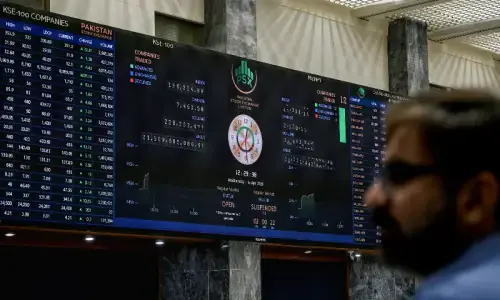
The government is proud of the performance of the Karachi Stock Exchange and considers it as one of the best performing exchanges of the world. But now it is involved in a conflict with KSE following the Securities and Exchange Commission of Pakistan’s decision that only a non-broker should be a president of the exchange instead of a broker with self-interest. The SECP argues major exchanges in the world have non-members as their chairman. The issue has now landed in the Sindh High Court. During the whole of 2005 the KSE-100 index set records and rose above 10,000 points. It crashed in mid-March and has now recovered to a level over 9700. The KSE is a speculators’ paradise and manipulators’ market, where real investors are often at a loss to know what he can do next.
On the economic front the growth rate can be affected by such contentious developments, tussle and tension. The State Bank of Pakistan says the economic growth rate this year will be between six to 6.6 per cent after having recorded the spectacular 8.4 per cent last year. A major problem the government will have to tackle in 2006 is inflation. Inflation rate is likely to get worse and be in the range of 7.5 to 8.5 per cent, says the State Bank. Coping with inflation can be very tough particularly when the market is not supported by enlightened efforts .
The Monopolies Commission is proposing to take action against some cement companies and sugar mills for violating the rules of the game. So far such threats have not been efficacious. Will it be any better now?
The government will face problems on the external front including the balance of trade and the balance of payments. The high world price of oil can make the situation far more difficult. The trade deficit for the July-October period has risen to $3.37 billion, and the current account deficit has risen to two billion dollars. The saving grace is the rise in home remittances, as in the last year.
The economic growth will also be hampered by the dearth of gas, which has resulted in the gas supply being cut off for hundreds of factories. By the last weekend gas connection to 118 factories was cut off inviting sharp protests from the industrialists, particularly of the textile group.
Imports can be cut to reduce the trade deficit. But that will result in a fall in the customs revenues and overall tax revenues. It can also result in lower economic activities, which would mean more unemployment.
A good deal of imports comes in the shape of cellular phone equipment the use of which has been expanding fast. The largest single item of imports is the automobiles financed by car loans of the banks.
The government is hence reluctant to reduce imports with its varied consequences, more so when it cannot reduce the huge oil import bill, which may rise to four billion dollars this year. The exports can increase. The Chinese government has earmarked $500 million for import of rice from Pakistan. But the rice exporters have protested against the export refinance rate of nine per cent which they say is too high. When the refinance rate was 4.5 per cent last year they exported rice worth a billion dollars against the target of $620 million. But now the higher rate stands in the way and has made Pakistani rice less competitive.
The Central Board of Revenue’s revenue collection performance continues to be relatively good. It collected Rs 302 billion in the first half of the year, which is 19.8 per cent more than what was collected in the same period last year. The good news is the discovery of oil and gas in Tando Alam yielding 5,000 barrels a day along with 300-mmcfd gas every day.
In spite of the doubts of the economists and the fears of the politicians the astrologers have predicted a good 2006 for Pakistan and they are unanimous.
Oil, gas & imperialism
YOU may have thought the age of empires was over, that in today’s globalizing world relations between states were governed by economics, market forces and free trade, rather than battles for political influence between the great powers. When it comes to the quest for, and control of, energy supplies, however, we still live in a partly 19th-century world.
Compared with the situation earlier this week, Russia’s attempt to more than quadruple the price of the gas it charges to Ukraine is no longer affecting other European countries as severely as it was. None the less Russia continues to seek to withhold gas from Ukraine, exerting a stranglehold on the nation that would appear to be motivated as much by politics as economics.
Smarting from Ukraine’s recent turn to the West, including Nato and the EU, Russia wishes to bring its once vassal state back into its sphere of influence. Russia has long offered subsidised energy to such states to help keep them within its fold. Threatening to hike Ukrainian gas prices to free market levels is in this respect the modern equivalent of a warning shot fired from the Russian imperial gunboat.
But Russia is not alone in treating energy security as the means of, or motive for, imperial-style endeavours. The quest for influence over oil and gas reserves underlies much recent western intervention in the Middle East and has driven high-profile political developments in Latin America, Central Asia and elsewhere. We need to recognize this energy imperialism as a fact of the modern world. For only by recognising it can we find ways to soften its nastier elements.
There are two forms of modern energy imperialism. The first, typified by Russia, involves producers using their leverage over supplies or energy transport systems to influence political outcomes. Most memorably, Opec, the Middle East-dominated oil producers’ cartel, tried this by restricting oil supplies in the 1970s, aimed partly at shifting western policy towards the region.
Today two Latin American producer states are using energy as a tool in standing up to the “imperial” West. Venezuela’s Hugo Chavez has threatened to interrupt oil shipments to the US and is tapping the state’s burgeoning oil revenues to win political support. In Bolivia, Evo Morales recently swept to power on promises to take back control of gas reserves from multinationals.
The second form of this imperialism involves consumer states launching political or military manoeuvres to secure supplies. Whether or not the US and Britain invaded Iraq with a sincere belief in weapons of mass destruction, no one doubts that fears over oil security played a part in strategic calculations - particularly after September 11 had so shaken the west’s trust in Saudi Arabia.
Now, with oil prices so high, and many western oilfields in decline, western firms and governments are working together (peacefully this time) to stake out new territories to reduce dependence on the Middle East. Around the Caspian, western political interests have again conflicted with Russia’s: the path of a new BP-operated pipeline from Azerbaijan to Turkey, for example, was the subject of a major geopolitical tussle between the West and the East. Japan and China are also arguing over pipeline routes from Russia’s far-east energy reserves, while China’s oil corporations are busy seeking alliances with Middle East and African governments.
If Britain opts to build more nuclear power stations this will be partly due to fears of reliance on foreign (Russian) energy. With our transport system still dependent on oil, however, reviving nuclear will hardly remove this problem.
One reason energy helps to revive the imperial urge for consumer nations is that, for all the growth of free markets and trade, energy security is paradoxically too important to the smooth running of capitalist economies to leave entirely to market forces. Our economic systems comprise a huge investment in infrastructure (including roads, cars, buildings and power stations) dependent on fossil fuels.
The imperial temptation for producers is related: the political levers it creates can be too powerful to resist. The issue here is not just geographic concentration of fossil-fuel supplies but the fixed and monopolistic nature of energy infrastructure: pipelines supplying entire nations can be flicked on or off on a political whim.
The inevitability of modern energy imperialism needs to be recognized. For consuming countries, securing energy supplies must be achieved in a way that better serves the long term interests of producing countries, rather than taking the form of western support for compliant but corrupt regimes or ill-conceived invasions that provoke further violence.
And producing countries should be encouraged to understand that their long term interest is often better served by working with consumer states, rather than imposing ultimatums upon them. Russia’s hard-ball tactics with Ukraine have damaged its credibility as a secure supplier with big European customers. Eventually oil and gas may be replaced by renewables but, for the time being, energy imperialism is here to stay, and efforts should focus on making it a more benign force. —Dawn/Guardian Service
Next three years matter
FROM 9/11 until the start of 2005, President George Bush succeeded in setting the political agenda for America and the world almost without effective challenge. At home and abroad he defined himself, and was widely seen, as the war president.
In America, he was also at key stages the tax cutting president, the oil industry president and the religious conservative president. It all brought him unprecedented unpopularity around the globe, but extraordinary political success at home. Thirteen months ago, Mr Bush was narrowly but decisively re-elected for a second term after a ruthless and crude campaign, while his Republican party consolidated its position in control of both houses of Congress. His Democratic party opponents were in disarray. The Republicans ruled America and America ruled the world.
Today, those political triumphs seem rather more deceptive. The Bush ascendancy of November 2004 has collapsed with remarkable speed. The year that has ended has been a seamless calendar of difficulties. Despite occasional bursts of optimism, the news from Iraq has been consistently worse and bloodier than anticipated.
Mr Bush’s dire mishandling of the aftermath of Hurricane Katrina dealt his reputation a particularly lethal blow. His clumsy attempts to fill long-awaited supreme court vacancies dismayed his supporters and alienated his enemies. The centrepiece of his domestic programme, privatisation of the social security pension system, failed. Conservative Republicans over-reached themselves in the Terri Schiavo right-to-die case. Key allies — Scooter Libby from the White House and Tom DeLay in the Congress — were indicted in connection with abuses of power.
In November, Republican candidates were defeated in high-profile governorship elections in Virginia and New Jersey. That month, Mr Bush’s approval ratings hit a new low of 36%, though they have since recovered somewhat, after an upbeat December on the stock market and an apparently successful Iraq election.
Nevertheless, there is now a very real sense in which America and the world are starting to treat Mr Bush as already a lame duck president. Commentators speculate that the president has run out of ideas. “When I watch Mr. Bush these days,” the normally sympathetic commentator Thomas Friedman wrote recently, “he looks to me like a man who wishes that we had a 28th amendment to the constitution - called ‘Can I Go Now?’
—The Guardian, London
For a ‘community of interests’
WHY are shareholders, the only stakeholders in enterprises, entitled to sit on the board of directors of a company? Executives and professionals, labourers and lenders, vendors, distributors and others make very valuable contributions but none is entitled by the universally recognized principles of corporate law and governance to sit on the board to determine policy and oversee the working of management.
The reason is embedded in human nature. Whenever two or more entities come together in a common enterprise where the flow of benefits is sequential, ‘agency problems’ will arise among people who are rational, self-interested, and value-maximizing individuals. This holds as true for members of a family as it does for strangers.
In the sequential list of beneficiaries, the shareholders are the residual recipients and at the bottom of the list. They will receive any benefits only after everyone else — executives, labourers, lenders, vendors and others — are paid. It is for the purpose of harmonizing otherwise contradictory traits that the entire discipline of law and economics has been constructed which has made possible the growth and development of large enterprises around the world and has also devised governance systems to keep negative traits in check.
Corporate law puts the most vulnerable and the last recipient among stakeholders — the shareholders — on the board of directors to hold the management of the company accountable to them as the best way of ensuring that a fair share of benefits is received by them as well and not eaten up by executives along the way.
That is also the reason why the most vulnerable end recipients of the political world, the citizen-voters, are the only ones entitled by law to hold accountable presidents, ministers, officials and all others who have direct control over benefits and decision-making — first through their representatives in parliament and ultimately through elections.
In corporate as well as political governance, the universally accepted and best management practices are built upon this framework necessary for creating large corporate and political units and yet ensuring equitable distribution of benefits amongst all stakeholders by elimination of misuse of power — the agency problems — that otherwise undermine the working of any large enterprise. This law of equitable management applies to all instances of human enterprise where the flow of benefits among stakeholders is sequential and gives rise to potential agency problems. It also applies to the issue currently raising tensions throughout the country as the nation discusses the equitable distribution of water resources.
Despite its controversial nature since it was first mooted in the early 1980s and withdrawn, the issue of the Kalabagh dam has suddenly cropped up again and is dividing the nation. Hence, any search for solutions must first begin with the question: why has Wapda — the principal agency responsible for development of water resources of the country and power generation capacity — not used these 25 long years in preparing several non-controversial options for developing national water resources?
For nearly the same time period, Wapda has been a prime example of an organization working in disregard of the recognized law of equitable governance of common resources. For years, it has not felt itself accountable even to the controlling ministry of water and power, much less to the concerns of other federal agencies or provincial governments including the people who are the residual recipients of water. The huge deficit of trust whose burden the entire nation is being asked to carry is essentially the product of poor governance practices by one organization — Wapda.
Any search for solutions must respond to the concerns of those who genuinely fail to understand why there has been nothing for the nation to discuss except the KBD. Similarly, any search for consensus must also explain the logic of sleeping over the subject of water resource development for three decades and then suddenly acting impatient.
True, our population growth would press for increasing food production in the country. But while consensus-building is going on, food production could also be enhanced through an improved package of inputs which in three years — at an estimated cost of Rs 10 billion per year — could every year add Rs 60 billion worth of increased food production to our GDP. Let us also not forget the fact that all over the world, two-thirds of the increase in food production is driven by the application of efficient technologies and management practices.
In several discussions over KBD the true nature of the project is often missed out. Apart from research projects, no project including KBD with a price tag of $10 billion to $12 billion is merely a technical issue. It is a public investment project and should accordingly be evaluated for its comparative cost-benefits.
In any rational system of resource allocation decisions, the technical feasibility of a project is a preliminary prerequisite and a necessary though not a sufficient condition for decision-making. Along with technical feasibility, reports on the social and economic feasibility of various options are also important inputs for decision-making. In their absence, it is not possible for anyone to state with clarity how and where costs and benefits would be falling and which would be the best option for the nation to take. It is, therefore, premature to make a rational and well thought-out investment decision incurring debt liabilities running into billions of dollars.
Let us now discuss consensus-building efforts by first acknowledging that a consensus exists on the need for the development of water resources of the country. This consensus is very precious; it should neither be belittled nor vitiated by hasty counter-productive measures.
Consensus is the output of the fine art of negotiations and is best evolved through its own mechanisms. There has been some grumbling about the difficulties of consensus-building with certain people taking the extreme position of going ahead with the KBD without waiting for any consensus. But, as we shall see, this is factually incorrect.
Public statements and media discussions are important in opening the debate and airing different perspectives on the issues. But consensus is not built through public posturing or media statements. It is essentially built upon two foundations consisting firstly of a range of options so that a ‘community of interests’ is evolved through give and take in negotiations. But we have already seen that no options have been developed by Wapda in over 25 years to provide the nation with this first foundation for consensus-building.
Secondly, consensus-building requires the existence of institutions under whose umbrella the fine art of negotiations can be conducted. But if water development projects like KBD causing inter-provincial frictions have not been taken to the mandated institutions — the Inter-Provincial Coordination (IPC) and the Council of Common Interest (CCI) — where the federation and provinces work under the same umbrella, how can we, in all fairness, show impatience with the people for failing to reach a consensus?
Food production is certainly enhanced by turning barren lands into fertile ones. But it is also curtailed by turning fertile lands into barren ones. There is enough evidence of increasing barrenness of the once fertile lands downstream of Kotri barrage which needs to be redressed and the fears of the “residual recipients” about the future are not unwarranted.
Lastly, any activity that raises persistent concerns of “empowerment” of some and of the “disempowerment” of others cannot be qualified as “development” which is meant to be inclusive and is best nurtured by the promotion of common interest. Our search for consensus would have increased chances for success if it were guided by the law of equitable management of common resources including the well recognized “no-harm doctrine” and pursued through peaceful and cooperative means.
Email: smshah@alum.mit.edu