



 0
0

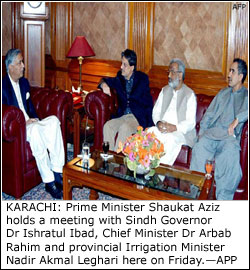 KARACHI, Dec 16: The ruling coalition in Sindh has signalled its unwillingness to mount a consensus building campaign on Kalabagh dam in the face of strong opposition to the project but at the same time offered to back other options to overcome water shortages, sources said.
According to the sources, coalition members passed on this message to the prime minister on Friday when he met the provincial governor, chief minister and irrigation minister in a “significant” meeting here at the Governor’s House.
The prime minister was informed that even the ruling party MPAs had threatened to quit over the issue. But they said they had no objection if the federal government launched an initiative on its own.
Despite brief sabre-rattling over the Kalabagh dam issue and its opposition even from within the ruling coalition in Sindh, the federal government has refused to relent on the issue of building more reservoirs for the country’s water needs.
It may be pointed out that the ruling party of Sindh had told the federal government earlier that Bhasha dam was a better proposition because of the huge trust gap that existed between Sindh and Punjab on account of what Sindh said was “non-implementation of the 1991 water accord and over the NFC award”.
Prime Minister Aziz was officially quoted as saying that all decisions regarding construction of more water reservoirs, including Kalabagh dam, would be made in consultation with all the stakeholders and in supreme national interest.
The meeting was attended by Sindh Governor Dr Ishratul Ibad, Chief Minister Dr Arbab Ghulam Rahim and provincial Irrigation Minister Nadir Akmal Leghari in which the overall political situation, law and order, development programmes of the province and the issue of water reservoirs was deliberated upon.
The meeting was seen as an important move towards open discussion on serious national issues for building a national consensus through dialogue. “The focus of the meeting was not Kalabagh but the shortage of water as a whole by the year 2020,” said a source.
The prime minister, according to official sources, informed the meeting that the government had already initiated a process of dialogue and discussion on the water storage issue.
He was of the view that there was an urgent need to increase the water storage capacity and build more water reservoirs, as this was critical for agricultural development, food security and would ensure a better future for the country.
NO LINK CANALS: On Friday, Dr Arbab Ghulam Rahim said that he was not against the construction of dams over River Indus as these would ensure “continued and even supply of water” to Sindh.
“Sindh wants dams to be built without link canals,” Dr Rahim told reporters after inaugurating a symposium.
He said the people of Sindh had certain reservations on the selection of sites for dams on the Indus and he was trying to express those reservations at all possible forums.
He said that dams were aimed at ensuring continued supply of water to different areas and he understood that the reservoirs built over Indus would be a source of supply of water and help avoid fluctuations caused by shortage of rain or inadequate melting of snow in the mountains.



























