Restive Balochistan
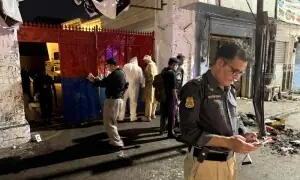
WHOSOEVER fired those rockets at Kohlu on Wednesday most certainly had a news sense. The four missiles caused no damage, but the attack attracted media attention, because it coincided with President Pervez Musharraf’s four-hour visit to that small town in Balochistan. The incident follows several other acts of terrorism in Balochistan and outside, including the car-bombing close to the PPL offices in Karachi on Sept 22, killing nine people. Two phenomena now seem to be running parallel: some ‘mega’ projects are underway in Balochistan; at the same time, Baloch restlessness seems to be increasing. Even though the situation is not at all as grim as it was in February this year — when there was an eyeball-to-eyeball confrontation between the security forces and some militants in the Sui area — the situation is far from normal politically. An indication of the Baloch view of the situation was the general council meeting of the Pakistan Oppressed Nations’ Movement in Karachi last week. Present there were some leading Baloch figures, including Sardar Ataullah Mangal and Mr Mahmood Khan Achakazai. The meeting rejected the Kalabagh dam — even though Balochistan is only marginally affected by it — but the tone and tenor of the meeting showed frustration in a sizable section of Baloch leaders.
The relevant point is why no progress has been made so far on the recommendations made by the Mushahid Hussain committee report. Drafted after consultations with all sections of Baloch leaders, the committee came up with some useful suggestions, including more state funding for the social sector, especially in the Gwadar area, greater safeguards for the Baloch in federal and provincial jobs, and broadening the participation of Baloch people on the boards of governors of oil and gas corporations. The Mushahid committee was concerned largely with the political situation, but the one headed by Senator Wasim Sajjad, which is to look into the constitutional aspect of Balochistan’s grievances, may turn out to be of greater import. This report is eagerly awaited, because the quantum of provincial autonomy has been a major issue with all the three small provinces.
There are basically two facets to the autonomy question: one is the absence of autonomy to the extent that some Baloch leaders want; the other is the infringement of Balochistan’s provincial rights as guaranteed by the Constitution. The latter issue takes the autonomy question out of the confines of Balochistan, because Sindh and the Frontier too have their own view of it. The 1973 Constitution is, of course, federal in character, but in operation Pakistan is a highly centralized state — even when there is a political government. However, when the army is in power — as it is now — the three small provinces feel deprived of even such autonomy as the Constitution guarantees. The feeling is strongest in Balochistan, because it is the country’s biggest province territorially but economically the most backward. It has large reserves of oil, gas, copper, gold and other minerals, besides fisheries, but it feels its own people do not benefit from the exploitation of these resources. These injustices should be rectified — and in a manner that satisfies the Baloch people and gives them a sense of participation in the political process. While the Mushahid committee’s 92-page report containing 17 points should be implemented, one would expect the other committee to come up with its recommendations and throw it open to the public for debate, because changes in provincial autonomy cannot be Balochistan-specific and must relate to all units of the federation.
Ecnec-approved projects
THE Executive Committee of the National Economic Council (Ecnec) has approved 29 development projects worth some Rs 183.6 billion. Hopefully, the funds will be properly utilized and accounted for. A sum of Rs 157.3 billion has been set aside for 24 new projects, focusing mainly on the transport and communications sector, railways, irrigation, and for constructing government offices and providing housing for government employees. Also on the approval list are five old projects carrying a cost of Rs 26.3 billion, which is Rs 2.4 billion higher than their original cost of Rs 23.9 billion. Had Ecnec approved of these projects when they were first prepared, the difference of Rs 2.4 billion — which is the result of cost escalation — could have been avoided. Two projects, to provide housing for Rangers in Sindh and to build an office in Islamabad for the National Accountability Bureau, seem extravagant given their total cost of Rs 1.76 billion. Labelling such schemes as ‘development’ projects is misleading because they cannot possibly have any conceivable impact on Pakistan’s socio-economic development, other than providing jobs during the construction phrase.
However, there are some projects that should lead to an improvement in the lives of ordinary citizens. Money has been set aside to improve Balochistan’s road network, to augment Karachi’s water supply and to compensate those displaced by the Lyari Expressway being built in the city. A large chunk of Rs 33.4 billion has been allocated for railways to buy locomotives, coaches and to revamp the rail track network. The government needs to be reminded that its responsibilities go beyond drawing up a project and providing financing for it to ensuring that such funds are judiciously used and that the projects in question are completed in time. For this the government needs to strengthen its system of monitoring of such projects to prevent unscrupulous officials in charge of implementing the schemes from abusing their position to embezzle or divert funds for personal gain.
Facing up to AIDS
SO long as Pakistani society refuses to face up to the worsening AIDS situation in the country, little progress can be made on curbing the spread of the incurable disease that has extracted a heavy toll of lives in the world. The disease may not yet have assumed the alarming proportions it has in neighbouring India, but recent figures showing the number of HIV and AIDS sufferers in Pakistan at 100,000 — up from 74,000 two years ago — point to the difficulties in keeping the situation under control. Already, there are justifiable fears that the actual number of HIV/AIDS cases is more than estimated at present, especially since cultural norms prevent an open debate on the subject and many cases go unreported. No doubt there are several preventive steps that health authorities could take, like putting in place a system of screening migrant workers (a high-risk group) returning home and ensuring that blood meant for transfusion is thoroughly checked for deadly pathogens. However, these will not have the desired effect unless accompanied by an effective and sustained drive to create awareness among the people about the cause of the disease and its implications.
For the past few years, Pakistan, along with other countries, has been observing World AIDS Day. But other than that, there are few activities or programmes on radio and television to inform people about the risks associated with deviant sexual behaviour, the use of shared needles (common among drug addicts) and contaminated blood transfusions, all of which contribute to the spread of HIV/AIDS. Only by engaging people actively on the subject can health authorities hope to bring about a change in attitudes and overcome social taboos. Otherwise, several years down the road, the situation in Pakistan might even come to resemble that in sub-Saharan Africa where the average HIV rate is more than seven per cent of the adult population.
As Bangladesh works out its destiny
TIME, they say, is the best of healers. This certainly seems to be the case between Pakistan and Bangladesh as the two countries have, to a large extent, moved on from the bitter memories of the civil war of 1971. Celebrated as Victory Day in Bangladesh, December 16 in Pakistan is known as the day on which Dhaka fell to the advancing Indian forces aided by local guerillas called Mukti Bahini.
More than three decades later, today, we should have the grace to admit that the day also heralded the breaking away of the then majority province, East Pakistan, from the stranglehold of West Pakistan’s political and economic hegemony.
Much has been written on the significance of this day which many in this country see as a day for reflection — and for good reasons — for those at the helm of Pakistan’s polity. The purpose of this comment is not to repeat what has been said over and over again in the political context, but to evaluate the post-1971 context in which Bangladesh as an independent nation has made some big strides in improving its socio-economic and political standing in the world toady. This, perhaps, can also help us achieve for our people what has eluded them since our own independence from colonial rule 58 years ago.
There are positive indicators that reflect the successes Bangladesh has achieved on many fronts between 1971 and now. These include, above all, self-sufficiency in food, a significant drop in child mortality rates, rise in female literacy rates, increased and sustained primary school enrolments and lower birth rates. Statistics available with the UN and other independent agencies vouch for the claims of progress made in these areas.
Bangladesh’s successes in the socio-economic sector have been possible through the streamlining of the health-care system, granting of loans for setting up small and medium-sized enterprises in rural and urban areas, including those focusing on the provision of mechanized farming tools and techniques, empowerment of women at the grassroots level, facilitating access to literacy for the girl child and implementation of wide-reach immunization and family planning programmes.
Another area in which Bangladesh has achieved remarkable success is that of managing natural disasters. The country is perennially cyclone-prone, with torrential rains and floods ravaging its vast and densely populated low-lying tracts at least twice a year, seriously affecting millions by the forces of nature. A national disaster management programme, which was put in place some five years ago, has significantly reduced the damage traditionally caused to lives and property.
An emergency evacuation plan, readiness of the national health-care units and relief agencies to deal with a disaster and the setting up of a communication network that facilitates logistics, are achievements that have made Bangladesh a model country in South Asia in disaster management.
Despite all these achievements, December 16 or the Victory Day, it seems, has become a national day of reflection in Bangladesh today. Newspapers give little space to eulogizing the heroics of the struggle for independence from Pakistani rule or to the bitter events of March-December 1971 that led to the creation of their country. Instead, more space is reserved for intellectual soul-searching aimed at evaluating what the young nation has achieved after independence and where it has failed. A glance at last year’s Victory Day editions of leading Bangladeshi papers reveals just that.
Some of the failures listed and dwelt on at great length included the immaturity of the democratic process, the overall law and order situation, the growing threat of religious fanaticism, lack of access to justice, slow pace of the poverty alleviation programme and what the press called a lop-sided urban development, where land-grabbers seemed to have been the sole beneficiaries of the progress made in the construction sector in recent years.
In aid of its criticism on these counts, the press fully endorses the understanding foreign donors, analysts and NGOs have shown of the problems faced by Bangladesh today. The English press even goes a step further to assert that these views should not be taken as a negative appraisal of their country but as truthful facts that must be confronted, for unless Bangladeshis are cognizant of the problems affecting their society today, they would not be able to do much about addressing these.
A caption commenting on a picture depicting two impoverished girls that had appeared in Dhaka’s The Daily Star on V-Day last year read: “Promises not kept... The Victory Day means little to these scavenging girls walking past the National Memorial at Savar yesterday, whose emancipation was one of the prime goals of the independence war.”
In its editorial comment the same day the paper did not even name Pakistan as the country from which Bangladesh had won its independence. Instead, it focused on what still needed to be achieved, as envisioned by those who worked towards that goal: “They dreamt of peace and prosperity, but we are still steeped in chaos and poverty. They aspired [for] after an egalitarian society which remains a far cry. Political independence can only have a fuller meaning when we come out victorious in our battle against social injustice of every kind.”
The press in Bangladesh is equally cognizant of the corruption that has long assumed alarming proportions across the developing world. The existing economic disparity, inflation and rights abuses, as reported by international watchdog agencies, also got their fair share of space in the Bangladeshi press V-Day last year. To think that all these ills should get such a projection on the country’s independence day is unthinkable in Pakistan, and therein, party, lies the difference between our two respective geniuses as peoples.
Bangladesh has had its fair share of tub-thumping and sloganeering in pandering to nationalist sentiments that often turn attention away from realities of life — a common phenomenon in most developing countries. But how the Bengali genius, like an infant who needs to be suckled only for so long and no further, seems to have weaned itself away from eulogizing national heroes and their deeds in the years after 1971 has been astonishing. Instead of mouthing empty rhetoric aimed at self-assurance, Bangladeshi intelligentsia is concentrating its energies on how to do better in the years ahead.
The explanation for this informed attitude towards nationalism lies, perhaps, as much in the Bengali ethos, which does not lend itself to pomposity, as it does in the absence of a dominant feudal mindset and the relative homogeneity of the Bangladeshi people as a nation. The lack of the last aspect has continued to foster a sense of political deprivation in Pakistan and even in India, while the omnipresence of a feudal mindset has been the biggest hurdle in the way of Pakistan’s socio-economic and political progress.
The growing middle class in Bangladesh today is saddled by a steady 10 per cent growth rate that the country’s economy has maintained in recent years. More important, perhaps, the middle class is much more conscious of its needs today and in the years ahead. No doubt, problems of governance remain, but the democratic process in Bangladesh seems to be better hedged against extra-constitutional interventions than it is in this country, for instance.
There is no room for reinventing the political wheel, no imminent danger of derailment of the democratic process, even though a rising tide of religious fanaticism and political polarization between the government and the opposition have been challenging enough in recent months. But, then, which nascent democracy does not have teething problems? The democratic process entails learning by trial and error while keeping the pluralistic fabric of the polity intact.
The Islamic resurgence in Bangladesh is part of that pluralism and finds its expression in the right-wing, non-violent Islamic parties participating in the mainstream political process; the rest is terrorism fanned by fanaticism, which does not have any roots either among the people or in the political moorings of an independent, democratic Bangladesh. This distinction must be made between two parallel streaks of Islamist politics to avoid confusion and oversimplification of what is happening on that front.
The army in Bangladesh is not a power broker anymore; it does not abet in perking up political pressure groups — Islamist or ethnocentric parties — with an aim to exert pressure on an elected government that it may not like. That inheritance from the East Pakistan days has been confined to a past from which Bangladeshis have moved on with grace.
Today, there is no dichotomy between the faith and the popular culture in Bangladesh; there is room for both to coexist without coming into confrontation.
That the polity has remained basically secular and faith a matter of one’s personal equation with the Divine is no small feat. This, at a time when obsession with going back to religious ideals has made the proponents of Hindutva a key political player in neighbouring India and distorted laws in Pakistan beyond recognition, to the detriment of religious minorities and women, especially.
Bangladesh today personifies the ‘soft face’ of Islam — a face that Pakistan willingly discarded in 1971. The Bengalis’ very existence as part of this nation was seen to be incompatible with the emerging Islamic republic’s values, which were to be steeped further into tribal-feudal traditions, aided by a garrison-state mentality of the rulers.
| © DAWN Group of Newspapers, 2005 |