ISLAMABAD, Dec 12: US Ambassador Mr Ryan C. Crocker suspects that Osama bin Laden and his second–in-command Ayman Al-Zawahiri are no more in operational command of Al Qaeda.
“Security concerns seemed to have forced Al Qaeda leaders so far away into hiding that it is now logistically impossible for them to command and conduct operations personally, the ambassador told a group of senior journalists on Monday. “He has perhaps gone into a hole like Saddam did before he was arrested,” the ambassador added.
But the envoy said he would not take a guess on who was providing the operational leadership to Al Qaeda now.
Discussing the ongoing debate on democracy in Pakistan, Mr Crocker said that a democratic Pakistan with sustainable institutions alone could guarantee the sustainability of Pakistan-US bilateral and strategic relations.
He said Pakistan’s progress, prosperity and stability also depended crucially on a sustainable democratic system.
Though the envoy said he was in no position to guarantee that fair, free and impartial elections would be held in 2007, he assured that his country and others would closely monitor the conduct of these polls.
When told that despite similar assurances from the US Assistant Secretary of State Christina Rocca, this year’s local government elections were marred by massive rigging, Ambassador Crocker implied that these polls were not monitored with due seriousness by the US as, according to him, American officials found it too complex to understand.
When asked for his opinion on the current democratization process in Pakistan, he said it was difficult for him to make a judgement one way or the other. But he thought the process had certainly advanced and by way of example he referred to what he called the independent media which he said was very robust.
When told that whatever extent of freedom he observed in the Pakistani media today was no gift from President Musharraf but was the manifestation of the long drawn out struggle of the media persons against military and civilian dictators and asked to point out a single sustainable democratic institution that the president had established in the last six years of his rule, the ambassador preferred to remain noncommittal.
On the suggestion that President Musharraf appeared to be drawing his domestic political strength from his friendship with US President George Bush, the ambassador said that good personal understanding between the leaders of the two countries did help in an important way in bringing them closer. But he stressed that at the end of the day it is relations between the two countries and their people, which counted. In reply to a question, he said that President Musharraf had outlined the vision of a sustainable, stable and true democracy in Pakistan and said “I believe him”.
He said Ayub Khan had been an effective leader but he had failed to establish democratic institutions and that was why all his good work vanished with his departure.
Discussing the US contribution to earthquake effort, the ambassador said that there was a deadline for the US troops engaged in relief work to leave Pakistan. “They will remain here as long as they are needed and the government feels they are needed,” he said.
When questioned on transparency and accountability of the earthquake relief and reconstruction work in the context of the ongoing debate for a parliamentary oversight body, the ambassador implied that donors had pledged nearly $6 billion at last month’s conference only after the government of Pakistan had fully satisfied them that every penny would be accounted for and would be spent in a transparent manner.
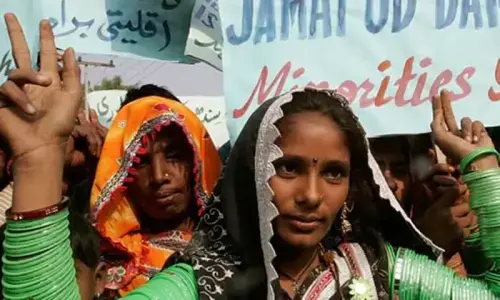
He appeared to be in total disagreement with President Musharraf’s contention that if Jammatud Dawa, an organization synonymous with the banned Lshkar-i-Taybba, was performing effective relief and rehabilitation work in the affected areas, no one should begrudge it or stop it from working.
According to Ambassador Crocker, allowing such organizations to work in the affected region would only create a space for them to promote and propagate their militant ideas,” which we cannot permit.
He was not sure if Hamza Rabia, allegedly the chief of Al Qaeda operations in Pakistan had been killed, but said “if President Musharraf is 200 per cent sure that he has been killed, I have no reason not to believe him.”
When his attention was drawn to the ongoing turmoil in Waziristan, he said, it was necessary for the government to establish its writ across the entire country from one border to the other.