0
0

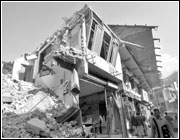 THE unprecedented devastating earthquake has brought out much that is good (and bad) within us. But distinct from individual cases of philanthropy, generosity and sacrifice that must be appreciated, one thing that lies exposed is the government’s failure to plan and act on the right lines—a reflection of its lopsided priorities all these years.
Apart from this, the jolt has also starkly revealed the ruling mindset: a sort of fatalism that pervades entire society. The earthquake has unearthed and made common knowledge what was previously known to only a few.
Though the disaster was beyond our control, its consequences, and those of the inefficiencies and iniquities of the system that it brought to surface, had to be borne by us mortals. Decades of negligence and/or wrong priorities in devising and implementing policies augment, through human failings, the physical and political damage of natural disasters.
One very important reason for massive damage was substandard construction of government buildings and in the formal sector, and the fact that the majority of dwellings were made of brittle material like mud, stone and un-reinforced masonry.
It also transpired that the authorities never gave priority even to collection of information about earthquakes and its effects, what to talk of preparation to face one, even though it is no secret that the region falls in a highly active seismic zone!
Widespread deforestation clearly resulted in many more landslides than might have been the case. A significant portion of the civil society looked upon the earthquake as a kind of divine retribution and concentrated on the moral dimension rather than pondering over what can be done now and in the future to minimize damage.
Nature does respond adversely sometimes to man’s actions that result in, say, environmental degradation, but so far there is no evidence that the morality or immorality of his private actions spurs natural disasters that sweep all in their path! Yet, a fatalist attitude seems to have become institutionalized in both our government and society.
Many TV channels, sensitive called in religious preachers instead of geologists to comment on the earthquake!
The main refrain running through official statements has been that problems of logistics complicated and delayed rescue operations. Several questions arise here: why did the armed forces possess so few helicopters, in a country with a sizeable mountainous terrain and roads liable to be blocked in times of heavy rain, snow and landslides, even without an earthquake?
It is astounding also because we are ostensibly engaged in ‘war against terror’ in mountainous terrain and have one of the largest defence budgets for an economy of our size! Likewise, there was very little heavy earth moving equipment and perhaps even less trained manpower available to take part in relief operations.
Adequate number of rescue personnel should be trained in normal times from the civilian departments as well as the military and paramilitary forces. Disaster and relief management should be an ongoing exercise, not a reaction to emergencies to be forgotten later. This is a serious lapse in a country, most of which is earthquake-prone. Once upon a time we had a civil defence organization that trained volunteers. We hardly hear of it now. Rescuers can be useful even in other disasters like floods, or man made emergencies such as fires, accidents and incidents of terrorism.
Still, what we lacked in equipment could be made up in manpower—and animal power. If ordinary people could be so highly motivated to help the victims as to go all the way to the stricken areas with relief supplies, what prevented the well-organized armed forces, which have hardy soldiers capable of fighting in the most difficult terrain?
The question arises whether we should depend on foreign aid alone, or on the capability of the government and people to regenerate the losses in due course? The response of the outside world takes time in coming, though some valuable help did arrive immediately, especially in relief efforts and medical assistance. They had to hold a ‘donors’ conference’ in Islamabad to induce the outsiders to donate for the earthquake victims.
But as often happens in such cases, only a small fraction of promised assistance is ultimately realized. In this case, about 70 per cent of the promised $5.8 billion are loans. We must have alternate plans to face the eventuality if offers of foreign aid do not fully materialize.
Aid cannot possibly cover all the losses after a catastrophe of this magnitude. This never happens. The resilience, vitality, political will and resources of the government and people must be counted on to re-build the lost infrastructure.
There is great room for improvement in the field of construction, or rather regulation of construction activity. The collapse of the 10-story ‘Margalla Towers’ in Islamabad has been attributed to sub-standard construction. Many adjoining buildings withstood the shock. If the CDA does not already legally require buildings constructed in its jurisdiction to conform to appropriate seismic codes, it is astonishing indeed, considering that Islamabad lies in a zone of moderate to severe earthquakes.
Judging from the orders now given (belatedly) to development authorities to develop seismic regulations and building codes, it appears no city in the northern region has such regulations in existence! Strict enforcement of whatever regulations exist is not there either. No building can be made completely earthquake proof, but experience shows that where buildings are designed and detailed according to the requirements of seismic design, outright collapse in an earthquake is rare and damage is greatly reduced.
The earthquake has exposed the many mafias that hold sway. It is common knowledge that unscrupulous builders, contractors and conniving government officials compromise on design and construction requirements for their (illegitimate) pecuniary gain, but it is not widely known how deep run the roots of these mafias and their networks among the elite in power for support and sustenance.
In Muzaffarabad, the overwhelming majority of government buildings collapsed or was damaged. Over 7000 schools and over 200,000 dwellings were totally destroyed and an equal number damaged badly, displacing over 3.5 million people. This was partly because the houses were built mostly of brittle materials, many were constructed on sloping ground, or other unsuitable sites and succumbed to frequent landslides.
Reinforced concrete government buildings collapsed in such large numbers because of poor construction, the earthquake’s high magnitude notwithstanding. It came as a shock that communications and transport infrastructure in this politically most sensitive region turned out to be flimsy and hopelessly inadequate, and the local administration so powerless! It was apparent that the country’s parliament was largely kept out of deliberations.
True to their working style, the government spokesmen have been making unrealistic claims of ‘building entire cities’ of modern earthquake resistant housing, and carrying out infrastructure projects costing $12 billion over the next few years. Their entire concern seems to be focused as usual on high profile statements, and eyes fixed on mega-projects that could go to enrich a few at the expense of the many.
No reappraisal or rethinking of priorities away from unneeded projects, or curtailing unproductive expenditure seems to be on the cards. The holy cow of military expenditure will not be touched. Surely, purchase of F16s has been put on hold, but for the wrong reason—(“it will send a wrong signal to the international community.”) and the SAAB surveillance planes deal with Sweden has gone ahead after the earthquake.
They say that the growth rate will not be affected. How can it be ? Earthquake might in fact increase it, because of the reconstruction that will come. What no government spokesman is talking about is that what would be virtual rather than real growth after damages to assets worth billions of dollars by the earthquake! At most, it would amount to transfer of resources from the poor to the rich! For now, there ought to be more of substance and less of rhetoric and jugglery of figures!
In the wake of the devastating earthquake (death toll already over 80,000 and rising), the builders and regulating government agencies have been fiercely accused of wrongdoing. The need for action was never as great as it is today.
Unfortunately, what could be learnt through wisdom and foresight has to be learnt from bitter experience! Some officials are still defending Kalabagh dam whose site lies in an active seismic region underlain by salt mines.
We do not even have fully equipped and manned seismic stations, facilities for monitoring of movements along known geological faults, do not carry out systematic study and research of earthquakes in the region, or update historical data.
According to Geological Survey of Pakistan experts, a number of seismic stations are needed in Karachi alone, to accurately establish the location and source of recent tremors that turned out to be localized in particular parts of the city.
They say these tremors appear to be non-tectonic and may arise from many causes ranging from mining and drilling activities to drainage and disturbance in soil overburden in specific areas.
Serious research on the known phenomenon of abnormal animal behaviour a few hours or days before an earthquake should be made available and made use of. At Kobe, Japan, dolphins in the zoo were seen to behave erratically twenty-four hours before the quake struck, and evacuation of many buildings greatly reduced the death toll.