



 0
0

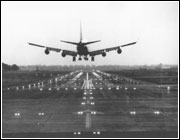 VISITORS to India’s financial and commercial capital get the first taste of delays and traffic congestion much before landing at the airport. During peak hours, flights have to hover over the airspace in Mumbai for up to an hour, as the airport – built way back in the 1950s, and expanded arbitrarily over the years – is unable to handle the load of incoming and outgoing aircraft.
Airlines have to unnecessarily burn up millions of dollars worth of fuel, as the narrow air corridor is choc-a-block with aircraft wanting to land. Once the aircraft lands, international passengers have to stand in long queues outside the immigration counter, then hunt for a trolley to collect their baggage (which itself takes substantial time to reach the conveyor belts from the aircraft), and finally negotiate the customs section.
Of course, it is an altogether different story that the 25-km drive to the city centre – through treacherous by-lanes and narrow roads – takes up to two hours, depending on what time of the day or night one is travelling.
Successive governments in India have had one strategy to tackle the problems relating to Mumbai and Delhi airports, the two busiest in the country – dilly-dally for years and maintain ambiguity about their future status. The current strategy includes talk of privatisation, modernisation and even expansion of the existing facilities.
The latest plan was announced recently by Ajay Prasad, the federal civil aviation secretary, who declared that Mumbai would have a green-field international airport. The Maharashtra government has been pushing for such a project for many years, but in the absence of a grand strategy, the central government chose to maintain a silence on the issue.
Prasad now says that the new airport – to be located most likely across the harbour in New Bombay – should be able to handle almost 50 million passengers annually, nearly five times the present capacity of the airport. Of course, the privatisation of the existing airport is expected to push ahead, as the government finalises the bids that it has received.
A green-field airport project that is coming up in Bangalore has been snared in controversies for years, so the new project is Mumbai is unlikely to take-off soon.
Air travel in India is growing at a rapid pace of over 25 per cent annually. Domestic air traffic grew by a hefty 21 per cent during the first half of this fiscal, even as a dozen new low-cost airlines have taken to the air.
But the tottering infrastructure on the ground is unable to meet the burgeoning growth in the aviation sector. Congestion in the air and at airports is likely to worsen, as millions more take to the skies. It has been estimated that the industry needs a whopping investment of over $35 billion over the next few years to ensure smoother operations.
About 650 new aircraft are needed by domestic airlines to meet the growing demand for seats, up from the existing fleet strength of a little over 200. The new airlines poach on the staff – including pilots – of existing airlines, resulting in a ‘wage-war,’ with airlines offering hefty hikes to woo employees from rival companies.
At least 3,000 new pilots would be required to fly the machines that are being deployed by the airlines. Many flights are now being operated by foreign pilots, as the score of aviation schools are unable to churn out enough fliers to meet the demand.
As part of its move to tackle this major problem, India’s largest private airline, Jet Airways recently signed a $15 million deal with Canadian simulator manufacturer CAE Inc, for a full-flight B737-800 simulator. The airline plans to induct a dozen new B737-800s over the next year, and would require at least 60 pilots to be trained on simulators.
Jet Airways plans to offer training facilities to pilots of other airlines, once the simulator is established. The airline had 10 years ago bought a similar simulator, which is being used to train its pilots, as well as those of other airlines.
Air India, which also uses the B737-800 simulator of Jet Airways, has two simulators (for B747-400 and A310), and plans to add two more (for B737-800 and for B777).
STATE governments are naturally rushing in with offers to manufacturers and service providers from around the globe, who want to cater to the requirements of this rapidly expanding sector. Maharashtra Chief Minister Vilasrao Deshmukh is wooing the world’s two leading aircraft manufacturers, Boeing and Airbus, urging them to set up maintenance, repair and overhaul (MRO) facilities in Nagpur.
Deshmukh points out that his government is talking to both the aircraft giants, and is confident about the MRO being established in Nagpur. It is estimated to cost about Rs15 billion.
Other state governments also have similar plans. Kerala – which has the largest number of international airports in the country, thanks to the presence of a large number of Keralites living abroad – has already allotted land near its capital to Air India for setting up an aircraft maintenance base. The national carrier has a low-cost subsidiary, Air India Express, which operates flights to the Gulf from Kerala.
The private, Cochin International Airport Ltd – set up in a partnership with Gulf-based residents of Kerala – is also toying with the idea of setting up an MRO. The government of another southern state, Karnataka (which nearly botched up the green-field airport at its capital, Bangalore) is eager to establish a University for Aerospace Technology. The Society of Indian Aerospace Technologies and Industries plans to set up such an institution in the state.
Many state governments are also eyeing for a juicy chunk of the $3 billion ‘offset’ cake that aircraft majors Boeing and Airbus are expected to invest in the country, as part of their deal with state-owned Air India and Indian Airlines. Both airlines are expected to buy over a hundred aircraft from the two companies – at an estimated cost of almost $10 billion – over the next few years.
The Indian government is going in for a compulsory offset clause, which would ensure that about 30 per cent of the cost is invested in India through purchases from the domestic industry.
And state-owned aircraft manufacturer, Hindustan Aeronautics Ltd (HAL) is itself planning a foray into the international civil aviation sector. The company is keen to acquire a 10 per cent stake (at a cost of around $100 million) in an international consortia led by Russia’s Sukhoi Design Bureau and America’s Boeing.
HAL has appointed SBI Capital Markets as a commercial consultant to advise it on the prospects of acquiring a stake in the consortium. The company also plans to float a joint venture with engineering giant Larsen & Toubro to make aircraft components. HAL has already floated a joint venture with Snecma, a French aero-engine maker, for manufacturing civilian aircraft engines.
Indian automobile component makers have established a reputation globally, and giants like HAL and L&T see tremendous potential in the aircraft components business as well. The Indian government has opened up defence production for private participation, and companies like L&T are expected to leverage their engineering strengths, by tying up with public sector majors like HAL.
There are an estimated 20,000 old and dilapidated buildings in Mumbai, and many of them crumble under the onslaught of the heavy south-west monsoons every year. Many of the tenants in these buildings pay rents that were frozen in the 1940s, so the landlords have no incentive to repair the structures.
The state government-owned repairs board executes shoddy jobs – and many buildings have collapsed immediately after the repairs – so both tenants and landlords are reluctant to hand over their structures to the board. Despite the pathetic performance of its repairs board and even of its housing board, the state government is still hopeful that its agencies would be able to tackle this problem.
There are an estimated 20,000 old and dilapidated buildings in Mumbai and many of them crumble under the onslaught of the heavy south-west monsoons every year. Many of the tenants in these buildings pay rents that were frozen in the 1940s, so the landlords have no incentive to repair the structures.
The state government-owned repairs board executes shoddy jobs-many buildings have collapsed immediately after the repairs- so that both the tenants and the landlords are reluctant to hand over their structures to the board. Despite the pathetic performance of its repairs board and even of its housing board, the state government is still hopeful that its agencies would be able to tackle this problem. Chief Minister Vilasrao Deshmukh last week announced that nearly a thousand of these tottering buildings would be pulled down and new high-rises would come up in their place, to house about 100,000 flats. All this at a whopping cost of Rs50 billion. The state government – which is already bankrupt and has run up debts of over rupees one trillion – will bear half the cost, the federal government another 35 per cent, and financial institutions are expected to provide the rest.
Deshmukh’s government has a track record of unveiling ambitious plans, but most of them simply fail to take-off. The government is still not able to execute a much-needed Western Island freeway, which has been delayed by more than a decade, and costs have escalated significantly.
Other major projects, including east-west flyovers and major roads, a trans-harbour freeway, and other important arteries connecting the airport to the city are still embroiled in controversies, or caught up in red tape. The cash-strapped government is unable to fund the Mumbai Metro or other rapid transit systems, nor is it able to produce the money to streamline the city’s suburban railway network.
Despite these massive failures on the infrastructure front, Deshmukh and his cabinet colleagues never tire of comparing Mumbai to Shanghai, and boast that the metropolis would soon emerge as the biggest financial hub between London and Tokyo.






























