0
0

ISLAMABAD, Nov 25: The government has directed officials to “mostly seek grants” out of the roughly $6 billion funds pledged by international donors and bilateral creditors with a view to avoiding piling up foreign debt.
Informed sources told Dawn here on Friday that although $1.9 billion had been pledged by donors as grant, the remaining over $4 billion, if not offered on concessional 0.5 per cent interest rate or a service charge, the debt sustainability, already vulnerable, could become a problem.
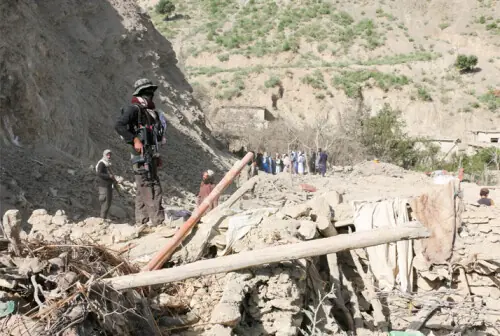
Officials of the Economic Affairs Division (EAD) are expected to start holding meetings with each donor from early December to discuss the rate of interest on financial assistance being offered for reconstruction and rehabilitation activities in Azad Kashmir and the NWFP.
“If we get the remaining $4 billion assistance at 0.5 per cent interest rate for 40 years with a 10-year grace period then this would be the best option. Otherwise we might get into a debt trap,” a source warned.
The government, he said, was not likely to accept $375 million loan offered by the IMF as it would not be without strings attached.
According to a latest official document made available to this correspondent, expanding market access and ensuring debt sustainability was an important indicator of global cooperation for Pakistan. However, enhanced levels of Official Development Assistance (ODA) on concessionary terms and their effective utilization “will no doubt speed up momentum” towards achieving the desired goals.
“Not only the terms of bilateral foreign aid to Pakistan are stringent, the grant element has also declined significantly over the years, thus impacting on the country’s capacity to service external debt,” the document notes. Most of the recent increase in foreign aid, it adds, did not necessarily provide a new source of financing for social services or poverty reduction, as it was a reverse flow for payment of principal and debt servicing of past loans.
Similarly, emergency and disaster relief, although much needed, did not address long-term development needs.
After reaching unsustainable levels in the 1990s, Pakistan’s external debt has stabilized and is approaching sustainable levels due to favourable external environment, rescheduling and re-profiling of debts and higher GDP growth, including exports and inflow of remittances.
Pakistan recorded a small deficit during the current financial year after witnessing current account surpluses during 2001-04. Due to higher exports, a large increase in the inflow of remittances, the receipt of grant assistance and inflow of foreign direct investment (FDI), foreign exchange reserves have risen to approximately $13 billion and the government has been able to pre-pay $1.7 billion of the expensive external debt.
These developments helped Pakistan enter into the capital market by issuing Eurobond as well as Islamic bond (Sukuk) worth $500 million and $600 million, respectively.
External debt and liabilities declined by $2.072 billion - from $37.92 billion in 1999 to $36.92 billion in mid 2004, the document noted.