0
0

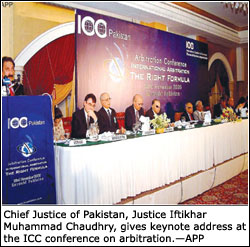 KARACHI, Nov 23: The courts in Pakistan are conscious of their role in improving the system of governance. This was stated by the Chief Justice of Pakistan, Justice Iftikhar Muhammad Chaudhry, while delivering the keynote address in the afternoon session of the ICC conference on arbitration on Wednesday. The conference was organized by the Pakistan National Committee of International Chamber of Commerce to promote the concept arbitration in Pakistan.
He said that the courts had a vital role to play in contributing their bit towards encouraging the local entrepreneurs and business community and attracting foreign investors to trade and invest in Pakistan.
Justice Iftikhar pointed out that the superior courts had persistently followed the policy of acknowledging and implementing international law in particular, customary rules commonly practised and treaty rules, ratified by the state.
He said that on the issue of applicability of rules of conciliation and arbitration of ICC, the Supreme Court rendered a landmark judgement in the case of Hitachi Limited, Rupali Polyester case and others (1998 SCMR-1618). The court observed that the rules of International Court of Arbitration should be recognized by the courts in Pakistan even though the same were not formally ratified or adopted by the state.
This, he added, was in line with similar other pronouncements of the Supreme Court to the effect that principles and rules of international law were applicable in Pakistan as far as they were not in conflict with the constitution or statutory law of the land.
About the theme of the moot, the chief justice said that deliberations on the subject would provide a source to the government for introducing modern procedure for arbitration.
He declared that Pakistan being an active and potent member of the comity of nations believed in providing better opportunity to the foreign investors to have a congenial environment for settling their business with the commitment to ensure expeditious resolution of disputes, if any, by adopting method of arbitration. Essentially, it was in our national interest to have a modern law and procedure for arbitration, he added.
The chief justice was of the view that the modern state was a welfare state. “A welfare state has to be economically developed and militarily strong. But, military prowess is also contingent upon economic power. Economic prosperity and development is, therefore, the goal of any and every state in the world today,” he added.
He said that in democracy, the existence of government was dependent upon economic growth and gradual rise in the per-capita income. Obviously, economic growth and development was based upon long-term planning, sound policies and incentives for trade and investment. He stated that the minimum requirements for development and progress were peace, safety, security and good governance. To achieve these objectives, he added, democratic society relied on reformed and modernized legal system and efficient system of administration of justice.
The chief justice said that an efficient system of administration of justice warranted the efficacious and expeditious resolution of disputes and quick dispensation of justice. “To do so, there are two methods - one is through regular judicial process and the other is out of court amicable settlement of disputes. Arbitration is one such old and time tested method. It is a recognized method both under the national as well as international law. For resolution of conflicts and settlements of disputes, arbitration is commonly practised medium,” he added.
He explained that the United Nations Commission on International Trade and Law in 1985 adopted the model law on International Commercial Arbitration. Later, the UN General Assembly recommended it for adoption to other member states. The assembly did so in view of the desirability of uniformity of arbitration law and procedure.
He maintained that the model law was aimed at making the arbitral procedure sufficient and adequate for meeting the needs of specific arbitration.
The federal minister for law, justice and human rights, Muhammad Wasi Zafar, said it was a matter of record that among the available dispute resolution methods, arbitration was by far the most commonly used internationally and the arbitral awards enjoyed much greater international recognition.
He said that in case of disputes the forums should be available of providing remedies and quick decisions and the centres for arbitration with suitable infrastructure could be one of the right steps towards that end.
Wasi Zafar said, “Holding of this conference was an excellent idea and I want to remove misapprehension in particular of lawyers that arbitration is not supplanting but is aimed at supplementing the existing system and their assistance would be very much required even in the arbitration process.”
Senior Adviser to Prime Minister, Syed Sharifuddin Pirzada, said that for capitulating foreign direct investment viable arbitration mechanism was needed to enforce the New York Convention-1958 on the reciprocal enforcement of foreign arbitration awards.
For Pakistan to realize the goal of becoming a cross road for trade and investment, it was necessary to ensure a legal and regulatory framework that was conducive to business interests by having in place a proper dispute resolution mechanism, he said, adding that it must be inexpensive, speedy, transparent and accessible to all. He said the government had drafted law on this very critical issue.
It was generally accepted that our judiciary was overburdened with litigation and, therefore, the government seriously emphasized and promoted the needs for alternate dispute resolution, he emphasized.
“I am particularly happy that mediation which is the first step for alternate dispute resolution is being promoted by the Government of Pakistan in collaboration with the International Finance Corporation,” he remarked.
He said Pakistan was also considering necessary amendments in various enactments to promote and facilitate mediation. Of course, if mediation was successful, the matter would end in a settlement which would be welcomed by all those concerned.
However, if there was no settlement, the next major step for alternate dispute resolution was arbitration.
Under the arbitration, the most interesting was privacy and confidentiality. It seemed extended to documents disclosed in the arbitration, but not to an arbitration award.
A settlement of the dispute in arbitration avoids the confrontational and adversarial position which was inevitable in litigation. Confidentiality and relative speed of resolution were thus achieved without being exposed to the delays, huge costs and vagaries of court litigation, he said.
The prime minister’s adviser said after promulgation of ordinance, more reforms in our arbitration laws particularly relating to domestic arbitration would soon follow.
The Attorney-General of Pakistan, Makhdoom Ali Khan, informed the conference that the draft law was lying with the national assembly for endorsement which would hopefully be promulgated soon.
Chairman ICC’s Pakistan National Committee Tariq Rangoonwala spoke of salient features of the draft law on arbitration and impact on national economy. —APP