0
0

ISLAMABAD, Nov 22: The Senate on Tuesday passed new contempt of court law before the opposition and the treasury benches engaged in another bout over how the state machinery handled last month’s earthquake disaster. 17-section bill, which categorises different kinds of contempt of court, was passed after a brief debate. After its passage by the National Assembly, it will become an act and repeal the 1976 Contempt of Court Act.
The bill, the first to be passed by the 100-seat upper house during its current session that began on November 11, categorises the offence as civil contempt, criminal contempt and contempt by scandalising the court. In the 1976 act all kinds of contempt were treated alike.
While former law minister Khalid Ranjha said from the government side that the new bill was necessitated by article 204 of the constitution that defined contempt of court and envisioned a law to regulate exercise of powers by courts, opposition members said real independence of judiciary, rather than mere laws, could enhance dignity of courts.
“The law relating to contempt of court is a means whereby the courts may act to prevent, or punish, conduct which tends to obstruct, prejudice or abuse administration of justice in relation to a particular case or generally,” said a statement of objects and reasons accompanying the bill.
It said such a law would operate in the interest of those taking part in litigation as judges, lawyers, parties, witnesses and the public at large.
“While the judicial system needs to be protected against improper attack, the courts operating in a democracy must be subject to fair comments and criticism,” the statement said.
The bill says a court may initiate proceedings for a civil contempt, suo moto or at the request of an aggrieved party. It prescribes up to three months of simple imprisonment or a fine up to Rs25,000, or both, for anybody convicted under this law.
The criminal contempt, arising from attempts to influence a witness, offers of improper inducement to a judge and subverting or hindering due process of a court, will be punishable with up to six months of simple imprisonment, or a fine up to Rs50,000, or both.
In a case of criminal contempt, a superior court may take action suo motu or at the initiative of the concerned judge or presiding officer or on an application from a law officer of a provincial or the federal government or by an aggrieved person.
The contempt by scandalising the court will be punishable with simple imprisonment of up to four months or with a fine up to Rs25,000, or both.
The bill says that publication of a “fairly accurate” account of legal proceedings of a court “shall not constitute contempt of court”. However, “a court may, for reasons to be recorded in writing, prohibit publication of any legal proceedings or a part thereof.”
“Comments in a temperate language on a judgment in a case which has been finally decided, without criticizing the integrity and impartiality of the judge in the said case, will not constitute contempt,” it said.
An amendment moved by Prof Ghafoor Ahmed of the Muttahida Majlis-i-Amal seeking to reduce the period of contempt proceedings to two months from the envisaged four months was rejected while the same member did not press another amendment of technical nature.
Opposition leader Raza Rabbani said the language of the bill was ambiguous and open to varying interpretations that could enlarge the gulf between the bar and the bench.
Farhatullah Babar of the People’s Party Parliamentarians (PPP) said dignity of courts depended on the quality of their judgments submission to accountability and that mere enactment of laws would not serve the purpose.
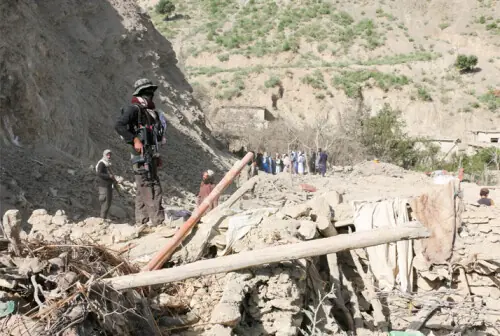
Education Minister Javed Ashraf came out with a strong defence of what he called a prompt response of the armed forces to save lives after the October 8 earthquake while he replied to opposition criticism during a brief debate over the situation over the disaster before the house was adjourned until 3:30pm on Wednesday.
He accused opposition members of trying to “throw mud on the army” and a malicious distortion of facts.
While Mr Raza Rabbani objected to the government’s offer for audit by foreign auditors of the earthquake relief and reconstruction funds “at the expense of parliament and Pakistani institutions”, his PPP colleagues Farhatullah Babar and Abdullah Riar called for cuts in defence spending to reduce dependence on foreign aid.
The government’s role was also defended by Minister of State for Overseas Pakistanis Senator Tariq Azeem and Minister of State for Petroleum and Natural Resources Mir Naseer Khan Mengal.
Mr Azeem also appealed to opposition parties to join a parliamentary committee formed by Prime Minister Shaukat Aziz on Monday to review the relief and rehabilitation work in the quake-hit areas.