0
0

Donors’ conference
WHILE it would be an exaggeration to say that the fate of the earthquake survivors’ depends on what the donors come up with, there is no doubt that the conference opening in Islamabad tomorrow will determine to a large extent the speed and scope of the long-term plan for their rehabilitation. It should be noted that even the first phase of the fight to save lives is not yet over. While tent villages have sprung up all over Azad Kashmir and in the affected areas of the Frontier, and food and medicines have reached them, a large number of people have refused to quit their homes high up in the mountains. They will brave the area’s harsh winter without proper homes, but they will not come down from their ancestral lands. This will only add to the larger health question that concerns the 3.5 million survivors, especially children, the old and pregnant women. All they are getting at present is medical care in tents or in make-shift hospitals, because the construction of proper hospitals, like homes, schools and government buildings, is unlikely to begin until spring. Since all this must be planned scientifically, and construction must be quake-proof, the cost will be prohibitive, given the magnitude of the havoc.
The extent of the disaster wrought by the Oct 8 quake will be made known to the conference when Pakistan gives the damage assessment data worked out by the government and many international organizations. According to official statistics, the quake destroyed 203,579 houses and damaged another 196,574. The cost of repair and reconstruction has been estimated at Rs 61.2 billion or $1.3 million. There is no doubt the international community is aware of the humanitarian disaster staring us in the face. UN Secretary-General Kofi Annan’s presence at the conference and the 17-man team he is bringing with him show the importance that the world body attaches to the conference. But all that we have so far is consensus between Pakistan and three of the donors — the UN, the World Bank and the Asian Development Bank — on the money needed for the task ahead: $5.2 billion, including 3.5 billion for reconstruction and the rest for the relief operations now going on. The amount pledged so far is $2.4 billion, less than half of what is needed, while the actual money received is a paltry $156 million. This is poor response to a disaster that Mr Annan himself says is worse than last December’s tsunami.
President Pervez Musharraf feels confident that he will be able to secure the conference’s pledge for the funds needed, though he added at a recent news conference that any gap between the target and the donors’ pledge will be met out of Pakistan’s domestic resources. There is another aspect, too, to the situation, and that concerns the transparency which the donors expect in aid utilization. The president has addressed this question several times and promised that the process would be transparent and the money would be accounted for through auditing. Let us hope that the auditor-general of Pakistan would be up to the task, and the government would be able to adopt a corruption-free strategy that will be acceptable to the donors. The government has also reportedly offered third-party auditing. As for the mobilization of domestic resources, the already neglected social sector must not be made to suffer. If there is a shortfall in aid, it must be met through cuts in spending on defence and administration, especially in the perks and privileges for the large army of ministers and advisers.
Urban rail: a pipedream?
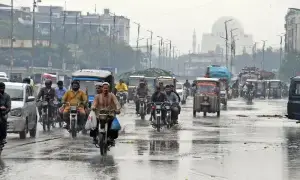
ON Tuesday the Punjab chief minister reiterated his government’s resolve to build a modern light rail transit system in Lahore. The plan has been on the drawing board since 1997. Similar plans for developing a mass transit system in Karachi have been in existence since 1977. The government’s on-again, off-again approach has left the ever-increasing commuters in the country’s two largest cities waiting in vain for reliable urban transport all this time. The smoke-emitting, rickety buses and vans of varying sizes and shapes plying on the roads of Karachi and Lahore continue to be the only means of public transport. Many of the vehicles operating in the two cities and elsewhere in the country are not even roadworthy; they are driven by ill-trained drivers known for running over pedestrians. The government has all but pulled out of the public transport sector, leaving the field open for transport barons to make a killing: fares have kept rising but the quality of service has deteriorated over the years. The system in place is woefully inadequate, but little has been done to replace it with a more efficient system. Even the Karachi Circular Railway, closed down by the railway authorities in 2001, has not been revived in any meaningful manner. Meanwhile, officials and politicians at all levels have restricted themselves to paying lip service to building reliable and efficient urban mass transit systems. If this is the degree of official commitment, then God help us.
The nearest the Karachi and Lahore rail projects ever came to being taken up seriously was in 1997, when international consortiums agreed to build and operate the systems in the two cities. But then came the 1998 nuclear tests, following which the foreign component of the required investment in the projects was withdrawn. Parties still interested in completing the ventures on their own complained of bureaucratic delays and dithering, eventually walking away in utter frustration. It is time a national urban transport strategy was formulated and implemented over a stipulated timeframe to address the worsening transport problems not just in Karachi and Lahore but also in other big cities of the country.
Cadaver donation law
SOUNDING upbeat about an international conference on organ donation scheduled to be held later this month in Karachi, doctors at a recent press conference said they were hopeful that a cadaver transplant bill lying in the Senate since 1992 would be revived and passed. The selection of a Pakistani venue for the meeting is appropriate: the illegal kidney trade is booming in Pakistan, especially in the absence of any legislation to curb it. This is in contrast to India where there is a comprehensive transplant law that was introduced about a decade ago when illegal organ sales started acquiring alarming proportions. Moreover, other Muslim countries, including Saudi Arabia which subscribes to orthodox religious tenets, have held cadaver organ transplant to be legal. Why then is there such reluctance on the part of our lawmakers to enact similar legislation? Is it because they expect a backlash from the religious orthodoxy?
The truth is that the longer the government delays the debate and passage of the bill, the worse the situation will become. The kidney trade involves a large network of unscrupulous doctors and middlemen who pocket substantial sums of money after arranging for poverty-stricken donors to sell their kidney. With organ sales banned in their own country, it is natural for renal patients abroad to turn to those involved in the kidney trade in Pakistan for help. Many are desperate, especially those whose turn for organ transplant is in the middle or the end of a long waiting list. It is, therefore, imperative that parliament enact legislation on cadaver organ transplant without further delay so that all those who are exploiting the absence of legal donation can be dealt with strictly.
Let us not make it any worse
THE aftermath of the apocalypse on October 8 continues to reveal statistics, staggering even to the most fertile imagination. With about one lakh people dead and hundreds of thousands of injured, disabled and displaced, the nation continues to reel under the shock of the devastation. The magnitude of the destruction is such that any discussion on the quake carries far too many aspects. For the sake of brevity, I would like to concentrate on the most immediate concerns first.
It cannot be disputed that earthquakes are not alien to our region. In fact, most parts of Pakistan have suffered earthquakes quite often albeit of lower intensity. During the last century colossal damages of life and property were caused by the earthquakes of high magnitude in Quetta and other parts of Balochistan and northern areas. Hence, it cannot be said that our region was oblivious to the havoc wreaked by nature.
Pakistan does not stand alone as a recipient of such disasters. There are a number of countries that frequently suffer earthquakes of greater velocity touching even nine degrees or more on the Richter scale but with a minimal number of loss of life or property. The tragedy in the case of Pakistan is that irrespective of the government in power, the practice in Pakistan has been to start adopting preventive measures and start preparations for rescue, relief and rehabilitation of the victims only after a disaster has struck.
Consequently, in every such tragic incident, people are made to pay an avoidably heavy toll of life and property. This time too the pattern has been predictably repeated. What is ironic about the current catastrophe is that it is not just the earthquake that caused such a colossal destruction and killed and injured a huge number of people but it was also the collapsibility of the man-made buildings and the absence of any preventive measures as well as of a disaster management system equipped with the earthmoving equipment, air-lifting facilities and the latest technologies that contributed to such a massive scale of destruction and sufferings.
The abysmally poor standard of construction, built largely under the aegis of the administration, is to be blamed for the death of thousands of innocent people. And those who have survived are only marginally better off as they continue to face serious threats to their lives for lack of medical treatment and exposure to extreme climatic conditions, particularly in the mountains. This earthquake has exposed not only the incompetence and ill equipped state of our civil and military bureaucracy but also their ignorance about the highly sensitive and not easily accessible areas in the north. In this age and time when even children sitting at home can log on to the latest technology of “Google Earth” to scan every nook and corner in any part of the world, our government initially did not even have the faintest idea of the gravity of the disaster or the areas struck by the earthquake.
Now, even one month after the catastrophe, the government does not seem to have a hold on things. Relief and rehabilitation efforts fall far below requirements and finances seem scanty in view of the herculean task ahead. Response to the appeals for help to foreign countries and donor agencies is very disappointing as is being witnessed since October 8, particularly from the last donors’ meeting at Geneva, and thereafter. We must understand why it is so.
Instead of criticizing the stingy response of others, the government must review its own conduct, priorities, policies and its incompetence. To persuade and motivate the donors to open their purse strings wider the government must show maximum possible transparency in its conduct, its own accountability, its own ability to generate and save more funds, exercise austerity in the style of governance by radically reducing the non-developmental budget and cancelling the avoidable expenses.
Now the next conference of the donors is being held in Islamabad on November 19. If measures suggested here are adopted by the government, these would probably make a positive and impact and lend credibility to its did appeals.
It is good to learn that the government has cancelled its order for the purchase of a fleet of bullet-proof Mercedes-Benz cars. It will save a few million dollars. Such a positive decision is the need of the hour and warranted by the disastrous earthquake. But this is not enough. Gen Musharraf must do more. He should promote austerity and “Suzuki culture” and discourage the craze for ‘Mercedes-Benz’.
The president should also cancel (i) the order for the purchase of surveillance aircraft from Sweden at the cost of over a billion dollars; (ii) cancel the order for the purchase of frigates and other sophisticated weapons; and (iii) defer shifting of the GHQ from Rawalpindi to Islamabad. By adopting these measures, the government will be able to save more then ten billion dollars in foreign currency as well as billions of rupees in local currency.
The announcement of the government that it has deferred the purchase of 70 F-16 aircraft is very vague. What has been deferred is not clear. Are the aircraft being purchased on suppliers’ credit or through US aid or is Pakistan obliged to pay for the same from its own pocket now or later on in lump sum or in instalments? Has Pakistan deferred payment of price or the date of delivery of the aircraft? The government must tell the whole truth about this deal of F-16 aircraft, which are in any case regarded outdated and its further production is reportedly has been stopped in the US.
Furthermore, the government should also consider generation and saving of more funds. It should reduce its administrative costs and non-developmental expenditure. Instead of levying indirect taxes or raising the cost of fuel and energy, which would inevitably further burden the ordinary people, the government should opt for generation of billions of rupees (a) by imposing tax on the income of all sections of people including the unjustly exempted and privileged agriculturists; and (b) by completing the delayed process of documentation of the economy in all sectors, which was a commitment made to the nation by Gen. Pervez Musharraf in his fist speech of October 17, 1999.
Transparency and accountability are the other crucial issues that the government must address immediately in order to build the confidence of the donors and philanthropists in Pakistan and abroad. In the first place, it should establish a website to give a complete picture, on a daily basis, of the donation, aid and assistance received in cash or kind in the relief accounts of the president/prime minister/chief ministers, etc. This should be done with a break-up showing verbal commitments, actual receipt in cash or kind and detailed particulars of its disbursements to the area, persons and purposes, as was done by the countries struck by the tsunami disaster last year. Pakistan can also establish such a website.
At this juncture, it is also necessary that the builders, architects, engineers, contractors etc., who had built structures such as Margalla Towers in Islamabad, President’s House, Prime Minister’s House, secretariat and all other damaged or collapsed government buildings in the AJK or in the Frontier should be blacklisted forthwith and they should not be allowed to participate in the construction of any building in any part of Pakistan.
It was disappointing that the president very adamantly refused to reduce the defence budget on the plea of national security. We agree national security must not be compromised, but it is absurd to suggest that spending billions of dollars on weapons is an immediate need to strengthen the security of Pakistan. Instead, the need of the hour is to secure the lives and property of the people and provide much needed protection, aid and assistance to lakhs of victims of the earthquake, particularly the widows and orphans, by harnessing all financial resources for these pressing needs. Does not the national security include security of our people? With the race against time to save lives, how can there be any other security concern of greater priority? Is the government expecting any kind of aggression from any country, including our neighbours like Afghanistan, China, Iran or India?
If this is so, the government must disclose the actual or perceived threats to the security of Pakistan in order to make us understand the reality of the situation. In any case, no one individual or institution should have the absolute right to determine the nature or probability of a security threat.
The continued illogical and misplaced emphasis on security at a time when the government is unable to provide adequate food, shelter, medicine and protection to the earthquake victims gives credence to the rumours that these billions of dollars on armaments are meant only to secure the interest of the “merchants of arms” and their patrons in the government, who end up as the only beneficiary of the multi-billion dollar arms deals.
The writer is secretary-general, Human Rights Commission of Pakistan, a former senator and federal law minister.
| © DAWN Group of Newspapers, 2005 |