0
0

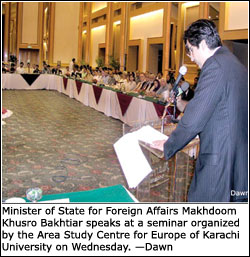 KARACHI, Nov 16: Minister of State for Foreign Affairs Makhdoom Khusro Bakhtiar on Wednesday underscored the importance of the Kashmir dispute and the current peace initiative with India, and said that any number of CBMs would turn out to be futile as long as there was no movement on this front.
“In fact, resolution of the issue of Kashmir itself is the biggest CBM which can usher us into an era of peace, stability and socio-economic progress that the teeming trillions of this subcontinent so direly need,” he said while delivering the keynote address at the inaugural session of an international seminar.
The seminar has been organized by the Area Study Centre for Europe, University of Karachi, in collaboration with Hanns Seidel Foundation.
He was of the view that there was a realization of the centrality of this issue on both sides. “A trouble-free and peaceful South Asia, with huge potential for economic development of our impoverished masses, is not only in our own interest but also in the interest of the region and the world in general.”
He appreciated EU’s initiative for conflict resolution in South Asia and urged ‘mutual friends’ to keep their interest in the issue alive and use their power of persuasion on both sides.
Pakistan, he said, had initiated a number of steps, which had culminated in creating a propitious atmosphere for normalization of relations between Pakistan and India. He described the progress made so far in addressing the core issue as marginal.
Highlighting Pakistan’s role in global war on terrorism, Mr Bakhtiar said that Pakistan had remained committed to combating extremism and rooting out the evil of terrorism in all its forms and manifestations. But the world needed to distinguish between ‘terrorism’ and ‘just struggles for freedom’, he stressed.
“Our zeal to fight terrorist must not force us into discrediting the genuine freedom fighter. If we fall into this trap, it would not only discredit the war on terrorism itself, but would also spell doom fox those fighting the yoke of foreign occupation,” he said.
The fight against terrorism would never be a success if focus remained on a symptomatic treatment alone. Apart from addressing the more obvious causes like poverty, disease and ignorance, latent threats such as the festering wounds of Kashmir and Palestine also needed to be removed.
Referring to Gen Musharraf’s enlightened moderation, he said that Pakistan firmly believed that there was no clash of civilizations now.
Referring to Pakistan’s deep-rooted bonds of friendship with EU countries and its cooperation in war on terrorism, he said the Third Generation Agreement signed between Pakistan and the EU in 2001 would provide for broader cooperation in all areas. An early implementation of this important agreement was needed, he added.
The 9/11 events had cast a lasting shadow on the world and diplomacy had been replaced by reliance on military action, he observed, adding that foreign occupation persisted and power asymmetries were widening as there were attempts to divide the world between ‘us’ and ‘them’.
“The Islamic world seems to be in the eye of the storm. It is facing the heat of ‘coercive diplomacy’ as Islamic nations are perceived as the sponsors of terrorism, and proliferators of WMDs. Muslims are subjected to discrimination and exclusion. The insidious thesis of an inevitable clash of civilizations - Islam and the West - is being openly propounded and a new ‘iron curtain’ seems to be falling along the lines of the major religio-cultural divide of the world,” said Mr Bakhtiar. As a consequence, he said, there was deep anger in the Islamic world which was manifesting itself in diverse forms.
Talking to newsmen after the session, the minister of state expressed optimism about the Nov 19 conference of donors in Islamabad, and said the process would continue.
Earlier, ASCE Director Dr Naveed Ahmad Tahir gave an extensive account of the EU’s role as peacemaker and mediator.
KU Vice-Chancellor Prof Pirzada Qasim Raza Siddiqui presented welcome address.