0
0

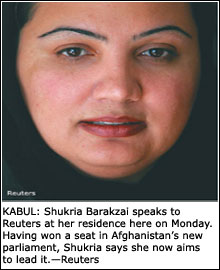 KABUL: Having won a seat in Afghanistan’s new parliament, Shukria Barakzai says she now aims to lead it. The 33-year-old mother of three girls campaigned for the legislative elections in September saying women should try to change the country’s male-dominated Muslim society by stepping out of the shadows to fight for their rights.
Results announced over the weekend confirmed Barakzai, a women’s magazine editor, had secured one of the 68 seats reserved for women in the 249-seat lower house of parliament, the Wolesi Jirga.
“I want to create a cultural revolution in Afghanistan by trying to become the chairperson of the parliament,” Barakzai, who ran a secret school for girls in her Kabul home during the Taliban rule, said in an interview.
The hardline Taliban government, which forced women to live in virtual segregation, was overthrown by US-led forces in 2001 after its leaders refused to hand over Al Qaeda leader, Osama bin Laden, the architect of Sept 11 attacks on US cities.
However admirable her ambition, Barakzai’s chances of chairing the new assembly, when it convenes for the first time next month, appear slim.
She could well be up against former president Burhanuddin Rabbani, Yunus Qanuni, who was runner up to President Hamid Karzai in last year’s presidential election, and Haji Mohammad Mohaqiq, a former commander who has the support of Afghanistan’s ethnic Shia Hazara minority.
Although the elections were fought on a non-party basis, analysts reckon those three heavy-hitters between them control some 100 seats in the assembly.
Several former commanders of military factions, three former Taliban officials and several ex-communists were among those who won seats in the new parliament, besides a clutch of women activists.
If she got the job, Barakzai, whose magazine is called “Women’s Mirror”, says she would forego all privileges.
Her trump card, Barakzai said, was that unlike the men she is untainted by involvement in years of civil war, when tens of thousands of Afghans were killed after the fall of communist regime in the 1990s.
“I have the confidence that I will win for my good reputation, record and good understanding of the society,” she said.
“If a woman becomes the chairperson of the parliament that will show the good aspect of change in Afghanistan.”
Barakzai says she will work for national unity in a country riven by tribal and ethnic divisions, its reconstruction and for the rights of people, particularly women.
Articulate and educated, Barakzai speaks the country’s two main languages, Pashto and Dari. But she also speaks English, French, Russian and Urdu and unlike most Afghans, she is aware of international and local laws.
Another woman ready to take on the men in parliament will be Malalai Joya, a young activist who rose to prominence during a 2003 constitutional conference when she stood up and denounced old faction commanders as war criminals who should be tried.—Reuters