



 0
0

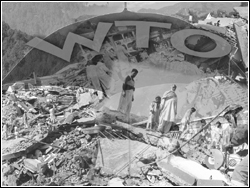 THE nature’s blow of October 8 has posed a number of challenges for the government. The major ones, inter alia, include (i) compensation and rehabilitation of the affected and displaced families, (ii) reconstruction of destroyed infrastructure, (iii) economic development of the affected areas, (iv) increase in the level of unemployment and (v) protection of the economy as a whole from the fallouts of the disaster.
Although the logistic and communication infrastructure viz. air and sea ports, telecommunication and power installations and oil refineries remained unaffected but would certainly require strengthening and protective measures from future unexpected disasters, therefore would involve additional cost. There is already a surge of demand of certain edible goods, like bottled water, food grains, biscuits, edible oil etc., which are being procured by the relief organisations. On the other hand, the demand for tents and bedding is already on the rise.
The demand for construction material will soon gain momentum as soon as the reconstruction phase takes up. At present the demand and supply position of the above mentioned goods is neither being monitored nor being controlled to check the possible imbalances on account of (i) demand and supply, (ii) inflationary impact, (iii) balance of payment, (iv) protection to domestic industry as the government has allowed duty free import of goods required for consumption in the affected areas.
Adequate and timely decisions are required for (i) generation of additional revenue for compensation, rehabilitation and reconstruction, (ii) generation of additional employment for the affected and displaced population in an economy which had very little job opportunities even in the normal course, (iii) setting of adequate tariff protection levels for the domestic industry, as also stated earlier the government has allowed duty free import of blankets which has reduced the tariff protection of the domestic industry to a peril point, (iv) enhancing the pace of economic growth and development so that it can absorb the adverse impacts of the earthquake.
Although the World Trade Organization (WTO) supports trade liberalization and free trade, its rules recognize and provide adequate measures which developing countries, like Pakistan, can take for (i) pursuing economic development, especially in consideration of the natural disaster, and (ii) those required to achieve the objectives of the WTO Agreement. These measures are contained in Article XVIII of GATT, 1994 on “Governmental Assistance to Economic Development”.
The preamble of the Marrakesh agreement establishing the WTO adopted the objectives contained in the preamble to the GATT 1947 now termed as GATT 1994. These objectives have been set to create a liberal and open trading system under which business enterprises from its member countries can trade with one another in a fair and undistorted competitive manner with view to (i) raising standards of living, (ii) ensuring full employment and a large and steadily growing volume of real income and effective demand, and (iii) developing the full use of the resources of the world and expanding the production and exchange of goods.
The WTO expects that these objectives would be achieved by optimally utilizing the resources of the world in accordance with the intention of sustainable development and both to protect and preserve the environment and to enhance the means for doing so in a manner consistent with their respective needs and concerns at different levels of economic development.
The Article XVIII permits the governments of developing countries to take such measures affecting imports, if governmental assistance is required to promote the establishment of a particular industry or industries. Such measures may take the form of additional tariff protection or other measures like tariff rate quota or non-tariff measures. Under the Article such measures are justified in so far as they facilitate the attainment of the objective of the WTO and economic development.
According to the section “C” of Article XVIII, a developing WTO member country (WMC) is free to deviate from the provisions of WTO rules and take adequate measures to protect its industry if it (i) has a weak economy and it can only support low standards of living and (ii) it is in the early stages of development.
The Article XVIII aims at establishment and development of a particular or new industry or industries in accordance with the priorities of the developing countries’ economic development programme. This may require modification or extension of existing industry or industries and achieving fuller and more efficient use of its natural and other resources.
The clause 4(a) of the GATT Article permits a WMC only to deviate from the provisions of the WTO if it has a weak economy and it can only support low standards of living and, moreover, is in the early stages of development. The Article, however, lays no criteria for determining whether an economy can support only a low standard of living or is in the early stages of development. Moreover, the article further states that while determining the weakness of the economy, only the normal position of the economy has to be taken into account.
In terms of Interpretative Notes to Article XVIII of GATT 1994 an abnormal situation resulting from the temporary conditions should not be taken into account. An example of the abnormal situation could be the Far Eastern currency crises in 1997.
The developing countries that have low living standards and usually low wages have peculiar problems specially the ones faced by Pakistan. Their industrial base is not strong and large and is not based on high value added activities. As such these industrial activities cannot generate enough job opportunities which can cater for the population.
The concept of early stages of development does not apply only to members which have just started their economic development but also to WMC the economies of which are undergoing a process of industrialization to correct an excessive dependence on primary production.
As regards the concept of “establishment of particular industries” it does not only apply to the establishment of a new industry, but also to the (i) establishment of a new branch of production in an existing industry, (ii) substantial transformation of an existing industry, (iii) substantial expansion of an existing industry supplying a relatively small proportion of the domestic demand, and (iv) reconstruction of an industry destroyed or substantially damaged as a result of hostilities or natural disasters e.g. earthquakes.
The WTO rules and procedures require that a member country would notify other WTO member countries about the actions it proposes to take under the Article XVIII and the special difficulties which it meets in the achievement of the objectives and the promotion of the establishment of a particular industry with a view to raising the general standard of living of its people. The rules require that the WTO member country shall also indicate the specific remedial measures which it proposes to introduce in order to remedy the difficulties being faced in this regard.
The notification must be made before the measure is introduced. If the tariff on a product is bound against further increases, restrictive measures can be taken only with WTO’s prior approval. Where the duty is not bound the developing country may raise the rate of duty. Rise in the rates of tariffs that are not bound is permissible under GATT rules. The WMC can take such an action without invoking the provisions of GATT Article XVIII. The member, imposing such measures is required to annually review all measures applied pursuant to the provisions of Article XVIII.
The GATT/WTO Rules recognize that the developing WMC in order to achieve the objectives of the WTO Agreement and pursue the policies of economic development may have to protect / provide assistance (a) to new / infant industry, (b) for the further development of existing industries, (c) restricting imports for temporary periods, (d) maintain sufficient flexibility in their tariff structure, (e) apply quantitative restrictions.
The situation demands that the following timely measures should be adopted, which are well with in the scope of GATT / WTO, to maintain and strengthen its economic growth and development and provide shock absorbers. For the generation of additional revenue a levy of five per cent earthquake relief surcharge can be levied on the import of all finished goods, with an additional 5 per cent on the import of all luxury items. This measure will help the government in generating additional resources required for the compensation, rehabilitation and reconstruction of the affected people and area. The CBR and Minstry of Commerce should prepare detailed proposals in this regard.
Tariff rate quota should be imposed on all imports required for the relief, rehabilitation and reconstruction of the affected people and the area. This will enable the government to import the required quantum of goods at duty free rate while adequately protecting the domestic industry. M/o Commerce and National Tariff Commission (NTC) should prepare a policy on this account.
Review of the domestic industry operating at reduced capacity utilization should be undertaken for the grant of additional tariff protection to enable the domestic industry to operate at optimal capacity levels and the establishment of new industrial units. This will enable the government to achieve industrial growth which will in turn generate employment and yield additional federal taxes and duties for economic development. M/o Commerce, NTC and M/o industries should prepare a joint policy package in this behalf.
Adequate measures should be taken to enhance exports under the Generalised System of Preferences, increased market access in the developed economies and the establishment of export-oriented industry. This will broaden the industrial base, boost exports, foster economic development and generate additional job.





























