



 0
0

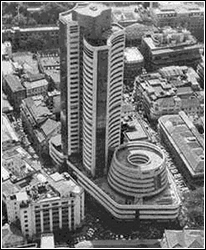 FOR punters playing the Indian stock markets, this has been one of the most profitable years. When the Sensex, the benchmark index on the Bombay Stock Exchange, pierced the 8,000-mark once again last week — during the brief Mahurat session at the start of the traditional Hindu New Year — most market players were proudly reminiscing the year gone by.
Investor wealth in Vikram Samvat 2061 — the markets follow the traditional Hindu year — expanded by an amazing Rs5 trillion (over $110 billion) or about 35 per cent. Total market capitalization on the BSE is around Rs21 trillion. The Sensex ended the year with a gain of nearly 2000 points, the highest in its history. In early October, it reached its lifetime high of almost 8800 points.
Unlike in previous bull runs, there were across-the-board gains on the stock market. A whopping nearly 90 per cent of scrips registered gains during the year, indicating the depth of the bull-run.
Speculators, led by big bulls and manipulators, had been responsible for the bull-run on the Indian stock markets twice in the past 15 years. And on both occasions, there were major meltdowns, following the discovery of scams involving banks and speculators. This time, however, foreign institutional investors (FIIs) and mutual funds have had a significant role in genuinely pushing up prices.
FIIs and mutual funds invested about Rs570 billion (over $12.5 billion) in the stock markets in Samvat 2061, again a record. Foreign investors included many new players from the US, Japan and South Korea.
Investors in about 20 scrips saw their wealth zoom by a thousand per cent, while those who had invested in nearly 900 other companies saw their assets double during the year (had they held on to the scrips). But the luckiest investors were those who had held on to a couple of scrips (Jayabharat Sarees and Anant Raj Industries, for instance), both small-cap stocks, which soared by a whopping 3,000-plus per cent each.
The market capitalization of large companies like Reliance Industries and Bharti Televentures shot up by a hefty Rs300 billion each. Surprisingly, the gains on the stock market happened at a time when global oil prices soared to record levels, and the functioning of the federal government — especially in matters relating to economic reforms — were crippled by stubborn leftist allies, who refused to budge.
The Indian economy is expected to grow by seven per cent this year, though the corporate sector is likely to see double the growth rate. Inflation continues to be under control, below four per cent, while foreign exchange reserves are comfortably placed at over $140 billion.
Though many in the market expect the current bull-run to continue in Samvat 2062, the prospects of the Sensex gaining another 1,000 or 2,000 points appear bleak. The benchmark index is already trading at 14 times its price to earnings ratio, so the upside is likely to be limited.
Political uncertainty will cripple the functioning of the United Progressive Alliance government in Delhi, especially with crucial elections in two states, Kerala and West Bengal due to be held in 2006. The Congress will be battling the leftists in both these states, and there will be very little room for further economic reforms over the coming months.
INDIAN stock exchanges are also undergoing major structural changes. The Bombay Stock Exchange (BSE), one of the country’s oldest, is toying with the idea of acquiring a stake in the Calcutta Stock Exchange (CSE), the country’s oldest. According to Rajnikant Patel, executive director and CEO, BSE, the exchange — which is facing stiff competition from the National Stock Exchange (NSE) — is eager to grow its business volume, and is interested in acquiring a stake in the CSE. The Kolkata-based exchange is planning to divest 51 per cent of its stake — held by brokers — to other entities, including banks.
The Securities and Exchange Board of India, the capital markets regulator, has asked all exchanges to go in for demutualization, by asking brokers to surrender their stocks in exchanges where they trade. SEBI is also expecting a consolidation in the industry, and mergers can be expected.
Volumes on most of the regional exchanges have declined sharply, especially following the expansion by both the NSE and the BSE. Both these exchanges offer terminals to brokers in cities across India.
The BSE, together with the Federation of Indian Stock Exchanges — which represents the interests of 20 regional stock exchanges — promoted a new initiative called IndoNext, which began operations this year, quoting on the BSE as ‘S’ group shares. This enables small and medium enterprises to raise resources from the capital markets, and to create liquidity for scrips listed on the regional exchanges. The BSE is also planning an initial public offering (IPO) as part of its corporatization plan. Under the SEBI’s plans, all exchanges have to go in for a public offering or divest 51 per cent of their shares to a strategic investor. Brokers had resisted the idea of corporatizing stock exchanges, but successive scams on the BSE forced the government to intervene, replacing the governing board of the exchange.
Most Indian stock exchanges have now drawn up plans and a major consolidation is expected over the coming year. Powerful exchanges, including the BSE and the NSE, would try to acquire smaller exchanges, hoping to enhance their volumes.
The NSE, which revolutionized stock trading in India in the 1990s by introducing screen-based trading, has been receiving queries from international bourses seeking permission to start derivatives trading in its S&P CNX Nifty index. According to Ravi Narain, managing director, NSE, trading on Nifty futures has already started on the Singapore Stock Exchange (SGX).
* * * * *
ONE of the major embarrassments for the National Democratic Alliance (NDA) government at the centre was its ‘India Shining’ election campaign in 2004. The Congress and other parties ridiculed the government for its campaign, especially when hundreds of farmers were committing suicide in states like Maharashtra and Andhra Pradesh.
The Democratic Front (DF) government — an alliance of the Congress and the Nationalist Congress Party (NCP) — which was in power in Maharashtra even in 2004 at the height of the farmers’ suicide crisis is now finding it difficult to explain the continuing cases of farmers taking their own lives.
The DF government, which completed a year in office last week, has not been able to tackle the crisis in Vidarbha, a hardscrabble region in the eastern part of the state. Nearly a hundred farmers have committed suicide ever since the sowing season started a few weeks ago.
According to leaders of farmers’ organization in Nagpur — the largest city in the region — every week about 10 farmers take their lives in desperation, unable to pay moneylenders. Most of the farmers raise low-quality cotton, a crop that has few takers. Cotton prices have fallen globally, but the Maharashtra government assures artificially high prices to cotton growers in the state.
Unfortunately, instead of poor farmers — who are in the clutch of moneylenders — it is the large ones and traders who benefit most from this distorted pricing policy. This year has seen record cotton production in the state, thanks to the use of genetically modified bacillus thuringiensis (Bt) seeds by a growing number of farmers in the state.
Maharashtra’s cotton production is expected to jump by 30 per cent, which will worsen the crisis. The state has an unsold inventory of 1.8 million bales (one bale: 170 kg), and accounts for a total production of 4.5 million bales annually (India’s annual production is 7.5 million bales).
Harshvardhan Patil, Maharashtra’s minister for marketing, has urged the federal government to invoke the anti-dumping regulation against imports from the US. He has sought a hike in import duty on US cotton from 10 per cent to 50 per cent, accusing the US government of providing hefty subsidies to cotton farmers. He has also sought additional subsidies for cotton farmers in Maharashtra. The federal government is unlikely to accede to the request.
Maharashtra, which has run up a huge deficit of over Rs1 trillion, is unable to fund its Cotton Monopoly Procurement Scheme, which last year resulted in a loss of Rs16 billion. The government assures a minimum support price (MSP) to farmers, which is about 25 per cent more than the price fixed by the federal government, but is unable to pay them the promised rates.
Farmers borrow funds from moneylenders at usurious rates, and when they are unable to pay, many of them commit suicide. The MSP has proved to be counter-productive, as farmers prefer to raise cotton, irrespective of market conditions. They refuse to diversify to other crops.
The cotton monopoly procurement scheme has run up a total deficit of Rs60 billion. But virtually all the political parties in Maharashtra continue to exploit the cotton producers, promising them higher prices in return for their support. There is already a strong movement for separate statehood for Vidarbha, as the people there feel neglected. Maharashtra politics is dominated by leaders from western Maharashtra, who have been ignoring the needs of Vidarbha and other backward regions.






























