



 0
0

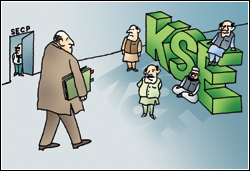 THE next few weeks are likely to see a series of events taking place at the Karachi Stock Exchange which should by now be just routine but which will, in fact, be of significance.
First, a new managing director will be appointed to replace the interim MD and take over the running of the bourse. Then, on December 15, brokers will elect five directors from among their ranks, soon after which the four non-member directors will be nominated to the board as well. Then the board will elect a broker-director as chairman.
These events come at a time when the stock market has been through an extensive period of reform and modernization spawning several years and great upheaval. The aim of the reform was to open up what regulators saw as a closed club of brokers and bring into place a series of measures aimed at ensuring investor protection and best international practices.
Although undoubtedly the reform programme has resulted in some patches of good, by and large it has been characterized by a sequence of misplaced, almost impulsive moves by the Securities & Exchange Commission of Pakistan (SECP) and persistent resistance from the reluctant broker community to change their ways.
Beginning in the nineties, a host of measures were implemented among which were the switch from open outcry to automated trade, the introduction of the T+3 settlement system and the Code of Corporate Governance which included mandatory quarterly financial reports for listed companies.
The size of the board was also reduced from 18 to nine and the concept of non-broker, independent directors was introduced as well along with independent management for the day-to-day running of the bourse.
Several years on though, the effectiveness of the programme is questionable. Indeed it is far from evident that the reform was even designed to result in cohesive, long-term benefits.
Strained relations: Consider, for example, the nature of the three-way relationship between brokers, the exchange and the SECP. Brokers, who lorded over the exchange in the past, now view the managing director or chief executive of the bourse as an employee who must, at any cost, be immediately tamed and brought to submission. In this effort, the brokers (to their credit) use several weapons, among which is the inferior technical knowledge of the MD. Intimidation, of course, is also a commonly employed technique.
The management, in turn, especially all those other than the outside MD, have spent so many years under the old system that they can see no other way than to view themselves as responsible to the brokers.
And from what we’ve seen so far, the outside MD may strut through the corridors brandishing his independence for a while, but is bound to ultimately cower under the pressure of the brokers.
Then, comes the SECP. The brokers view the regulator as the ultimate ogre, striving to gobble their spoils. They see the SECP officials as meddlesome bullies in a playground, who have the raw power to get things done but don’t know how to use it wisely. The SECP sees the broker community mostly as troublemakers who need to be minutely policed. And they see the management of the exchange as their police officers in the ground. The MD typically sees himself as an employee of the SECP, rather than the board of the exchange, and therefore is content to use the name of the SECP as a crutch in implementing directives sent from there.
Granted, there is a natural amount of tension built into the relationships between regulators and those they regulate but this hotchpotch created by all three players in the game in the name of reform does nothing to help achieve the ultimate aim of investor protection and everything to deter and confuse the investing community.
Reform gone bad: So what has gone wrong with reform? The most obvious aspect of course is the severely strained and multi-layered relationships between the stakeholders. This is purely the result of a lack of demarcation of roles and even weaker implementation by each party of the role it and others are meant to play.
So, for example, it is not uncommon for the management to pass off decision-making to the board and for the board in turn to pass it along to the SECP and in the end for the broker community to be up in arms against the SECP’s decision. This can only be corrected if the roles of the brokers, bourse management and SECP are more clearly defined by mutual consent and more importantly implemented in that manner. This can only be achieved, however, when all parties independently develop both the technical abilities and the integrity needed to reach the ultimate aim of investor protection.
Then, reform has been hurt by brokers’ hunger for control over the affairs and regulation of the exchange rather than just over their own businesses. By and large, the broker community remains unwilling to accept change either on account of fears of dilution of power or on account of pure ignorance. The management, in turn, does nothing to alleviate either. The majority of brokers remain unaware of what new measures really mean, and the corps of big, powerful brokers rouse the rest to agitate against change.
This is despite the fact that it is by now fairly evident that the biggest beneficiaries of reform have been the big brokers who have been at the receiving end of bigger flows of brokerage and have been at the centre of growing media attention that has come their way. This problem can only be corrected by a combination of better education of brokers who should be made aware of international best practices and a self-regulated implementation of a code of ethics among brokers.
The re-composition of the board is another failure of reform. Four non-broker directors were brought onto the board to bring independence, integrity and courage to the decision making process. Instead, the nominee directors are usually (but not always) people with scant knowledge of the intricate workings of the share market. They are rarely willing to take tough decisions and typically follow the instructions of the SECP when voting on decisions and are often used by the SECP to push through or reject decisions the board considers.
Indeed to date there is no single decision of the board which can be held out as an example of the astute understanding, courage or integrity of nominee directors. The fact that the SECP often micromanages the bourse, interfering in small decisions is itself testimony to the fact that even they do not consider the nominee directors effective.
Moreover, nominee directors are often heads of major companies and are involved in the mutual favour game by giving their company’s corporate brokerage business to select brokers. As a result, these directors simply sit silent during a duel between the brokers and SECP, failing to play their independent role. This could perhaps be corrected through a more stringent selection of nominee directors who are armed with both the knowledge required to assume the position and the courage to stick by their independent analysis.
The term of the board should also perhaps be extended from one to three years as per global standards, to allow planning and implementation to be carried out. Accountability of the board should also then be made tougher.
Poor management: Reform has also failed to deliver real results because of the poor quality of management. Brokers set their precedent early, harassing the first independent MD of the stock exchange and further subjugating the second one. Neither lasted long. The third and most recent was more experienced. But even he was edged out after one term.
So, the concept of truly independent management is yet to take root in the face of broker pressure and the desire of the SECP to control the MD. This is especially serious since none of the MDs so far made the effort to build capacity at the exchange from where future MDs could grow.
As a result, the management of the exchange below the MD is still a collection of fairly incompetent employees, accustomed to a bureaucratic rather than management style of governance. A drastic overhaul is needed and the KSE will have to begin investing surplus funds (it is, after all, a not-for-profit body) on its human resources by employing several MBAs and chartered accountants every year who should then be put through the system. Currently, for example, the KSE seems unable to find a new MD whom the SECP will endorse.
Finally, the SECP must also share the blame for the flawed and largely failed reform process. Clearly, the SECP is fraught with problems itself. While its annual reports and chairman’s speeches give the impression that no crisis of governance could ever hit the exchange, there have been four major market crises in the last five years.
And more than that, the futures crisis of March 2005 was essentially a failure of governance after which brokers, the management of the KSE, the board and the SECP all fell to poor repute. Similarly, a full year has passed since the report on demutualization came out but no action has yet been taken despite several deadlines announced b the SECP itself.
Part of the problem, of course, is that the SECP chief is usually the choice of the finance minister which means weak top level governance will filter all the way downwards.
So, is another attempt at reform the answer? May be. But more likely is the success a new exchange could bring. As in most businesses, competition is often the language all the stakeholders understand. The time is perhaps right for the authorities to use the March crisis as the moral justification to form a new exchange—not the way a former SECP chief did by awarding one to an old player on the very last day through secret processes—but through fair and open competition.
Maybe then, when brokers, the management and the board are forced to prove themselves better than another, self-improvement rather than abuse of power will become the norm.






























