



 0
0

Courts in absolute chaos
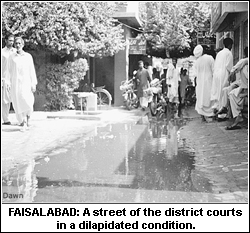 THE premises of the local courts present a highly chaotic picture. They are awfully overcrowded. The official record of some lies in the corridors. A large number of people coming to courts contributes to the traffic chaos on Circular Road, Zila Council Road and the adjoining roads.
A visit to these courts during a working day would land one in utter confusion. The buildings were constructed in the pre-partition days and despite the addition of some blocks after independence, these were not sufficient to accommodate the load of thousands of litigants.
These courts are held by the district and sessions judge, additional district and sessions judges, civil judges and judicial magistrates. They do not have adequate space to ensure proper working. There are courts which are held in the chambers of judges owing to non-availability of adequate space. The problem is so acute that some courts run in shifts.
According to the court staff, as soon as one judge completes his day’s work the same premises come in the use of some other judge by change of nameplate.
Owing to insufficient space, courts lacked decorum which often resulted in contempt of court, said a person familiar with the working of the city courts for the past many years. According to him, a number of people who unknowingly enter the offices or chambers of judges get the feeling of being in the offices of the revenue department.
A number of files are piled up along with other official materials in corridors. The staff attributed this to shortage of space. These files had been lying in the open and there was always the risk that some of them might be stolen any time, said a staffer.
It was a commonplace scene in the morning to find lawyers sitting on footpaths outside the courts, said a senior lawyer, who asked not to be named, adding that sitting on the pavement caused inconvenience to the pedestrians and was, therefore, a violation of rules. But, he hastened to add that one could see that there was no adequate space for judges even who carried out their work in an atmosphere full of pollution of all types.
For occasional visitors, however, it was indeed a bizarre spectacle. Where are the offices of registrar of land transfers? inquired a man from a police constable. He had come in connection with the transfer of his house. Apart from this, for some who have not been to the district courts, a trip can be interesting. At the end of it, you can simply be amazed at the tenacity and courage of the citizens who have to deal with our civil and criminal system at that level. This correspondent went to the family and civil courts, which were housed in an unhygienic building, several floors high, with many rooms and corridors filled with smoke of wagons, rickshaws, buses, motorcycles and cars. The traffic flow is unrelenting and it is quite a feat to cross this stretch of the road.
It was noticed that expectations of people seeking justice keep increasing with each passing day. They come to the courts every day hoping their longstanding cases of property disputes, family feud and enmity would be decided within days. But to the utter dismay of most litigants, that day never comes. Sometimes the hearing take place after months and even years.
In such cases the litigants some time forget the causes of their disputes. It was observed that most of the cases at the civil and family courts seemed to be about guardianship of children arising out of divorce or death of parents. An old couple from a village of Okara had come to know that they would have to get the custody of their three-year-old grandson who was living with his father in Faisalabad. The man said that this was his eighth visit to the court in less than two months and that he was still far from hiring a lawyer.
“Each lawyer I go to tells me something new. One tells me we have no case and another tells me that I should go ahead and sue for custody. But then he is asking for a high fee which I cannot pay.”
Many litigants will narrate terrible stories of how they are suffering at the hands of lawyers, clerks, court staff and others and how they have to pay through the nose to bring the witnesses. But cases do not proceed expeditiously, as the rival party’s lawyers manoeuvre adjournments from the courts on one pretext or the other. One finds a number of litigants in tears while explaining how much mental torture they have to bear for pursuing cases in courts.
They complain that their counsel do not cooperate with them after getting the professional fee and thereafter simply send their clerks to get the case adjourned and force them to pay heavily for each date. The people present in court frequently quote the Punjabi maxim, may God save us from court, the police and illness.
One reason for the delay is the constant increase in cases against the number of cases decided by the courts. The behaviour of the lower staff with the public and litigants is insulting and the corrupt elements do not hesitate to extort money from litigants.
Signs of changing times
WHAT changing times these are in Dubai. It has recently been discovered that the people at the bottom of the economic pile, the labourers who are toiling, often in appalling conditions, to build this so-called City of the Future, actually have some rights. Foremost among them is the right to be paid for their work, which has come as something of a revelation to many companies.
It was not so long ago that going on strike in the UAE was illegal, whatever grievance the workers may have had. During my many years in the country I have witnessed small, peaceful demonstrations being broken up by the police without any questions being asked as to the reasons behind the agitation. Those considered ringleaders in such events have been open to arrest, a trip to the airport and a one-way ticket home. So sensitive has labour unrest been that for many years it was illegal for the press to report strikes. One newspaper for which I once worked was shut down for a few days because it carried a small story about a one-day strike by the drivers of school buses. The report was accurate, but the very fact that it was published was enough to incur the wrath of the authorities.
But, as I said, the times are changing, and changing very quickly, thanks to a combination of factors. Labourers — from many countries, including Pakistan, India, Nepal, Bangladesh, Egypt and Jordan — make up a large portion of the UAE’s population. They always have done, as the country has built up its infrastructure virtually from scratch, but in recent years their numbers have increased tremendously as Dubai has embarked on its ambitious development plans. With the rise in numbers has come an increase in problems. The construction boom has led to fierce competition for contracts from both old-established and new companies. To win contracts they are working on fixed-price contracts with tiny profit margins and when material costs rise — as they have done due to the big demand — the companies can find themselves with cash flow problems. The first people to suffer are inevitably the workers.
Another reason for a shortage of cash in construction companies is that the companies themselves are frequently not paid on time and, on occasions, government departments have been among the worst offenders in this regard. However, many workers who have not been paid work for companies which have no financial shortage; it’s just that the labourers are not considered a high priority and have never before been in a position to complain (by the way, trade unions are illegal). So while non-payment of wages has long been a problem, it has in the past few years reached epidemic proportions.
Coincidentally, it has occurred at the same time as an explosion in the local media scene. As part of the plan to internationalize Dubai, the previous shackles on the press have been removed. New newspaper and magazines have sprung up and they have all been testing the limits of press freedom. Boundaries there still are — and any publication that oversteps the invisible line will undoubtedly find itself in trouble — but reporting labour unrest has become acceptable. And labourers who have grievances have suddenly discovered the art of public relations and they get in touch with newspapers to explain their woes. After all, what’s the point in going on strike if nobody notices? This in turn has meant an unacceptable image for Dubai — the powers that be don’t like to see articles in the western press which talk about this booming rich city being built by the sweat of poor labourers who don’t get paid. And in this glossy metropolis, image is everything.
So, enter Dubai police. And not just any policeman, but the Chief himself, Lieutenant-General Dahi Khalfan. He decreed that it was totally unacceptable for workers not to be paid and said they should complain to the police. The police set up a 24-hour labour grievance hotline and distributed stickers to labour camps with the number printed in Arabic, English and Urdu. “If you encounter problems with your employer which keeps you from obtaining your salary, please call the phone number below and state the name and location of your company,” read the stickers. Little did they know what they were letting themselves in for.
The hotline just about melted with the response and in three days there were 2,200 calls. The police set up a special team to follow up the complaints and suddenly they were claiming great success in resolving cases. Amazing how many companies suddenly found they had money in the kitty to pay their workers when the police came to visit. “Investigations revealed that most of these companies had a lot of money and were big names in the market.
“Unfortunately they were poorly managed,” said the police chief. “We will not tolerate any bad behaviour by companies. We will not delay in implementing the law. This kind of behaviour is not meant to happen in Dubai, a city which respects human rights.”
Yes, these certainly are times of change.
THE new Pakistani consul-general in Dubai is settling in. Abdul Hamid, who was earlier director-general of audit and inspection in the Foreign Office, has already sent a warning signal to social centres and associations that he expects them to work for the benefit of the community and not be platforms for personal gain.
“We have a vibrant community but social centres and associations do not reflect this. It seems they are working in isolation and do not have a good interaction with the community,” Mr Hamid told the Dubai daily Gulf News. He said he wanted to make community centres the hub of welfare activities.
“Everything will be transparent. Only those who are committed to serving the community will be given responsibilities of running the centres,” he said.
At the same time he wants to see major improvements in the schools that are overseen by the consulate. “We need to improve the standards of our community schools to bring them at least on par with other schools,” he said, adding that they would shortly be completely re-organized. There will be many stalwarts of the community anxiously awaiting the consul-general’s next move.
| © DAWN Group of Newspapers, 2005 |


























