



 0
0

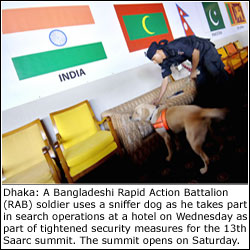 DHAKA: Bangladeshi politicians and civil society leaders say that mistrust among South Asian political establishments remains the main impediment to effective regional cooperation. They have termed the outcome of last two decades’ summit negligible because of lack of a mechanism to resolve bilateral conflicts within the framework.
They say that India, which is the largest and dominant member of the association, needs to play a major role to make the forum effective.
These observations came at a civic dialogue entitled ‘the context, agenda and expected outcome of the 13th summit of the association.’
The summit will be held in Dhaka from Nov 12 to 13.
Organised by Dhaka-based think-tank, Centre for Policy Dialogue, the dialogue was presided over by the Grameen Bank representative Dr Muhammad Yunus. Bangladesh’s Foreign Minister M. Morshed Khan, who spoke as the chief guest of the programmme, said mutual misunderstanding mainly between the two large players has crippled the regional economic cooperation.
“Saarc has become captive to India-Pakistan political relations which are now improving.”
He expressed his optimism on the outcome of the Dhaka summit and urged civil societies of all seven Saarc member states for enhanced support. Tofail Ahmed, senior leader of the opposition Awami League and former commerce minister of Sheikh Hasina’s cabinet, said that one cannot expect regional cooperation without bilateral discussion and to that end, political will from respective parties must be ensured.
Earlier, in his key-note presentation, foreign affairs adviser to Bangladesh government and chief cocoordinator of the present summit, Reaz Rahman, said that key challenges remained the predominance of politics over economy.
“Despite advances, doubts remain whether there is a real commitment, while questions persist whether we can promote economic ties without resolving outstanding political problems.”
Faruque Sobhan, a former foreign affairs secretary of Bangladesh, said without personal initiatives of the country heads, it is not possible to advance the forum’s agenda. He said political will is a must for Saarc and the civil society has to be more active.
Former secretary-general of the Saarc, AQMA Rahim said the forum had failed to appear as regional body for cooperation, and it had remained an inter-governmental organisation.
“Every country has very jealously guarded its sovereignty and the forum’s secretariat had little to do.” Describing weakness of the forum’s secretariat he said the association’s charter did not define functions of the secretariat as it was included in the last minute when India withdrew its reservations.
Rashed Khan Menon, president of the left leaning Worker’s Party of Bangladesh, said political obstacle along with a mindset of 1947 had had hindered the progress of Saarc.
Hasanul Haq Innu of Jatiya Samajtantrik Dal said three bombs — nuclear power, communalism and poverty — are there in the entire region to stop developments of the countries concerned.
Former secretary M Asafuddowlah said as the Saarc charter excluded bilateral issues within Saarc under the pressure from India, the spirit of cooperation has diminished.




























