



 0
0

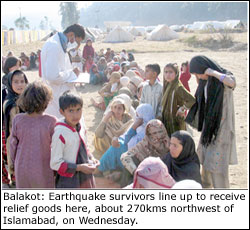 ABBOTTABAD: The first victim arrived at the regional Ayub Medical Complex here soon after the ground stopped shaking from the 7.6-magnitude earthquake. A wall had collapsed on the boy’s chest and he was coughing up blood as doctors frantically tried to insert a breathing tube down his throat. Soon, a 25-year-old woman arrived whose foot was so mangled it no longer resembled part of her body. Even worse off were the victims whose relatives had chopped off their limbs to release themselves from the twisted wreckage of homes and schools. After 24 hours, scores of shocked and exhausted doctors had performed more than 800 procedures on the lawn outside the medical centre that had itself been battered in the quake.
Five days later, before the first foreign medical teams reached this city 25 miles from the quake’s epic centre, the local medical team had performed 6,000 procedures, including 130 amputations. They operated under makeshift tents and sometimes under the open sky — Pakistanis taking care of their own. The physicians slept little, stealing cat naps by lying down in the concrete parking lot. They ran short of antibiotics and anesthesia. Many had tears in their eyes as they performed their surgeries, not knowing whether their own families were alive.
And still the wounded kept coming. Over the days and nights, only rainstorms could drive skittish patients back inside the crippled hospital. Often they would be driven back outside almost immediately by one of the 1,000 aftershocks that struck every few hours. In all, doctors say they lost fewer than 200 patients at the hospital about 40 miles north of Islamabad. But only now, weeks after the tragedy, can they begin to fathom the scale of the rescue operation they conducted in those first adrenaline-filled days. In interviews, half a dozen of the physicians described the ordeal that continues to linger in their dreams, as well as the lessons learned responding to the natural disaster that took at least 60,000 lives in Pakistan and India.
“It was unbelievable, like a war zone,” recalled Mohammad Adeel Riaz, a 26-year-old surgery resident at the teaching hospital. “But wars are planned. Nobody ever dreamed of an earthquake like this.” Several visiting American doctors expressed amazement. “There are limits to human endurance, whether you’re a doctor or anyone else,” said Inam Hussain, a Chicago-area anesthesiologist during a recent needs assessment visit to the hospital. “These people have gone beyond those boundaries.”
On the morning the earthquake hit, Riaz was dozing at the hospital following an overnight shift. The force of the 8:50 a.m. temblor rolled his cot across the room. Before the ground stopped moving 35 seconds later, Riaz ran into a hallway. There he realized that all the emergency doors in the 20-year-old hospital were locked. He scurried down seemingly endless corridors to the front door as the three-floor building shook. Outside, the congregating doctors began to realize the gravity of the disaster. About 60 patients were fleeing the facility, some on crutches; others carried by aides or pushed on wheeled hospital beds.
The physicians quickly forged a plan: If their hospital was damaged, they would build a makeshift facility outside. Student residents volunteered to dash back inside the still-quivering building for supplies. Others began to donate blood for the victims they all knew would arrive soon.
MINI-MASH UNIT: But first there were colleagues to assist. One doctor broke his jaw and both arms after leaping in panic from a third-story hallway. Another suffered severe internal injuries after being buried by a falling wall. Within the first hour, three 25-doctor surgical teams had arranged a mini-MASH unit outside their 1,200-bed hospital. Hours later, they had constructed four operating theatres inside a large circus-like tent normally used for weddings. Nearby, 500 beds and cots were arranged in haphazard rows under the sky.
The preparations could not come fast enough. As some doctors scrambled to lug out heavy operating tables and lights, others attended to the first arriving victims, including students from an adjacent elementary school—two dead, the other three severely injured and crying for their parents. During those first terrible hours, doctors recalled, the boy who needed the oxygen tube died. One in five arriving victims required amputations—from fingers and toes to entire limbs. The cases came so fast that doctors could not follow procedure and consult with family members about the emotional and physical after-effects of the surgery. Relatives often could not be located. So doctors talked over the procedures with bleary patients, stressing the extent of their injuries. Then they began their grim work.
Each day brought 1,000 new victims who came on foot and by mule, carried in blankets or on cots made of sticks and used clothing. Some victims arrived dead, with their families refusing to accept the reality. Soon, doctors say, the backs of their necks began to spasm from the stress of performing so many surgeries. Fasting for Ramazan, they did not drink or eat during the day and often became dizzy. But they pressed on. Zia-ur-Rehman, the hospital’s gray-haired director of surgery, worked side by side with student doctors and hardened medical veterans. He operated on a neighbour whose skin was cut from his skull. And he remembers the woman who awakened from anesthesia “and at first she thought she had died and gone to paradise.” After the first 24 hours, the hospital ran out of medicine and residents volunteered to run to local pharmacies to collect what medications could be found.
Temperatures dropped after dark and patients moaned and called out in the blackness. In succeeding days, the area was hit by severe rainstorms, hail and high winds. Hundreds of terrified patients ran from their open-air beds toward the supposed safety of the hospital.
The big tent that housed the surgeries began to leak. Doctors scrambled for containers to catch the water while others held on to the ends of the canvas so the high winds would not blow the canvas down. In subsequent days, the region would be rocked by five serious aftershocks from 5.7 to 6.2 on the Richter Scale. “People were in shock — they had lost their homes and their children and their parents,” said Imran Taj, a 28-year-old Ayub doctor.
“We needed psychologists. We didn’t have any. All we had were patients.” Slowly, help and reinforcements began to arrive, trucks that brought medial supplies and blankets. A team of Korean aid workers arrived on the sixth day and set up a clinic on the hospital property that continues to operate. One by one, Ayub’s doctors were permitted to leave the hospital to return home to check on the welfare of their own families. Today, many of the most serious patients have been moved to other facilities. The Ayub medical team has moved back inside but doctors still are afraid of their own hospital, pointing out walls that crashed or floors that buckled and sank.
Most physicians perform their normal rounds as though in a daze, caring for the new patients who continue to arrive, but still thinking about those first few hours of the quake. “They will now all be better doctors,” Rehman said. “They worked under stress unlike any they had ever seen, doing in three or four days as many procedures as they would normally do in eight months.” Syed Shahbaz Sultan believes he’s prepared for anything medicine can throw his way. “I’m ready to work anywhere in the world,” said the young medical resident. “The earthquake was terrible. But it taught us all to become survivors.” —Dawn/LAT-WP News Service





























