



 0
0

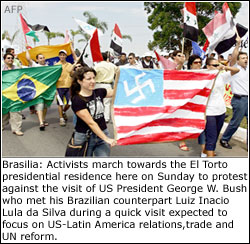 MAR DEL PLATA (Argentina): President Bush left the country before the conclusion of a two-day summit here as key South American leaders rejected the White House’s vision for a free-trade zone that would stretch from the Arctic to the southern tip of South America.
Fierce opposition from the populist presidents of the continent’s three largest economies — Brazil, Argentina and Venezuela — thwarted the resuscitation of the so-called Free Trade Area of the Americas, or FTAA.
“There are two points of view on the continent,” said Argentine Foreign Minister Rafael Bielsa, referring to the five dissenting nations, including the smaller countries of Uruguay and Paraguay. The five nations account for more than half of the continent’s economic activity.
Senior administration officials immediately disputed the notion that the session was a failure for Bush, noting that 29 of the 34 participating nations favoured the trade pact, and that the summit’s final documents calls for further talks next year.
“Isn’t that in itself an important accomplishment?” one administration official said.
But coming amid fading poll numbers for the president back home, some observers called the talks collapse another disappointment for the president.
“I don’t think Bush would have gone down there if he knew he’d run into this kind of opposition,” said Mark Weisbrot, co-director of the Center for Economic and Policy Research, a nonpartisan think tank in Washington. “The FTAA may not be completely dead, but it’s close to dead — and the body’s twitching.”
Bush’s principal South American antagonist, Venezuelan President Hugo Chavez, deemed the outcome an unequivocal victory for critics who say open markets can lead to further poverty by opening the door to plunder by powerful foreign interests.
“The great loser today was George W. Bush. The man went away wounded,” a triumphant Chavez told reporters here, alluding to the president’s quick departure. “You could see defeat on his face.”
Throughout much of the day, mystery surrounded the fate of the proposed free-trade zone, as ministers huddled behind closed doors in an effort to craft a solution. Several news conferences called to discuss the summit’s final document were postponed.
At one point, it was rumoured that Bush, hopeful of a definitive final statement, would stay beyond his scheduled 4pm departure time. That turned out not to be true: Air Force One lifted into the azure sky about the choppy Atlantic just a few minutes behind schedule — and before the document was finalized.
The usual post-summit photo opportunity with beaming heads of state was conspicuously absent: By the time the final declaration was completed, most of the presidents had, like Bush, left the city.
As Bush flew on to the Brazilian capital, Brasilia, a senior administration official aboard Air Force One insisted that some good had come out of the summit.
“It’s disadvantaged by the fact that, of course, most of the leaders have left, and in the end of the day, the whole point of these summits is to be a summit of the leaders,” the official said. “I think our view is the summit declaration in a way is a lot less important. What’s important is the leaders got together, they had this good conversation.”
The final summit document, completed six hours after deadline, included two distinct views: the opinion of Washington and the 28 other countries that backed the creation of the trade accord, and the five dissenters´ view that the imposition of a hemispheric free-market zone would harm certain countries.
“The conditions do not exist to attain a hemispheric free trade accord that is balanced and fair with access to markets [and] free of subsidies and distorted commercial practices,” the dissenters wrote.
A third point, put forward by Colombian President Alvaro Uribe, commits officials to ‘explore both positions’ during a future meeting.
In the end, a summit that was meant to be a symbol of hemispheric unity showcased just how polarized the issue of free trade has become, more than a decade after the pioneering North American Free Trade Agreement brought down commercial barriers between the United States, Mexico and Canada.
The enduring image of the summit may be the limited rioting that took place Friday night and was broadcast worldwide, overshadowing much larger peaceful protests earlier in the day. There were no injuries, and Mar del Plata, along the Atlantic 250 miles south of the Argentine capital, Buenos Aires, was peaceful on Saturday.
The lack of a closing declaration delivered by chief executives — generally a standard feature of global summits — underscored the polarized nature of the free-trade issue.
The fiercest debate of the sessions focused on the hemispheric treaty, an idea that has been on the table for more than a decade but hasn’t advanced much beyond the talking stage.
Carrying the sword here for the Bush administration was a close ally, Mexican President Vicente Fox, who began the day with a news conference that included an impassioned plea for approving the free-trade scheme before time ran out.
“If we keep losing time, if we keep reinventing the wheel, if we keep discussing the same ideas without deciding, the only ones we are sacrificing are our poor,” declared Fox, who maintains that free trade with the United States and Canada has brought jobs and improved living standards to Mexico. “We are creating more poor, we are closing the door to opportunities.”
The Mexican president urged leaders of the 29 participating nations in favour of hemispheric global integration to go ahead with their plans, even without the five dissenting nations.
Representatives of Argentina and Brazil, the continent’s major agricultural producers, insisted that they favoured the concept of economic integration. But they said they fear that their products cannot easily compete with heavily subsidized US foodstuffs.
“Free trade is very important if we respect equality among nations, that we keep in mind the need to help and be generous with poorer countries,” Brazilian President Luiz Inacio Lula da Silva told reporters on Saturday.
Complicating matters throughout the discussions was the summit’s heavily politicized shadow struggle: That confrontation pitted Bush, mired in a second-term slump and extremely unpopular in Latin America, against Venezuelan President Chavez, a fiery populist and acolyte of Fidel Castro.—Dawn/LAT-WP News Service





























