



 0
0

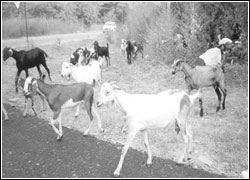 Livestock provides not only the food but also a range of other products which could be sold or consumed by the owner to provide nutrition, income, and fuel.
Major products of livestock include draught power, meat, milk, eggs, manure which is used as fertilizer or fuel, feathers, fibre, hides, and horns. In addition to these, livestock also serves as an asset and may provide a reserve that can be converted into cash in need.
In the past, food security studies concentrated on quantifying the output of cereal crops. The importance of livestock in providing food security is seldom examined. Its role in food security is undervalued. It is not simple to quantify the actual role of livestock to include aspects other than direct food production; an effective method to quantifying its importance has not been developed.
Livestock can be considered as a production system which divides the system into inputs: animal health; animals which are the unit of production; outputs which are the products; and the market which purchases the products and sets the price.
Livestock production and its role in food security: Growing and selling livestock enables the poor rural families (in particular women) to enter the cash economy. This increases the income for the family without disrupting other activities.
The majority of livestock are kept by smallholders, with each producer owning a small number of animals. Specific areas are not set aside for grazing or fodder production but are fed crop residues. They are “opportunistic feeders”.
In most cases, feeding does not cost farmer anything. Their diet is mostly made up of residues from the farmer’s own crops, and the livestock graze and scavenge on common or waste land. Small scale producers do not feed their livestock with food that is otherwise used for human consumption.
In contrast to small scale producer, commercial production is generally intensive and based on imported livestock feeds.
Livestock produced under the prevailing small scale conditions in the region has a low level of productivity. This is partly because the diet is generally at or below maintenance levels, and all of the food is used for maintenance rather than production of livestock products. This is demonstrated in the case of large ruminants where dung is the most valuable output from these animals.
Constraints to small-scale livestock production: Problems in increasing livestock production are almost similar in different countries. The most significant constraints are nutrition, animal health, animal productivity/genetic make-up of the animals, provision of finance to small scale producers, and marketing.
Provision of adequate nutrition to livestock is a major problem. However, considerable information on alternative feed resources is available and there is a need to extend this information to livestock owners. Any information should include production benefits derived from alternative feeds and appropriate feeding regimes.
A slight increase in feed intake through the supplementation leads to increase in production. For example, supplementary feeding of indigenous cattle by smallholders increases milk yield from one litre per day to five. This change takes place without any change in the genetic make up of the animals.
Livestock health is a limiting factor to production. A major problem is the low level of knowledge and understanding of livestock producers of the benefits of disease control. Even those aware of the benefits have limited access to appropriate vaccines and therapeutic drugs.
In some situations cooperatives and the non-government organizations (NGO’s) have provided limited training and assisted in organizing vaccination of stock. As livestock owners become commercially based, they will become more aware of the benefits of disease control but will not be aware of the most appropriate methods for disease control. The government veterinary services are not tailored to meet these aims and there is a need for them to reassess their role in livestock health.
When animals are fed low quality rations and are not protected from disease, genetic traits for survival are more important than those for production. With an increase in nutrition and health, large gains are made in productivity. Improvements in production traits only become important once certain conditions in health and nutrition are met and production levels reached. These conditions vary between species.
The collection, organization and distribution of information are important in successful livestock development. Most farmers are smallholders. As each city has a large number of farmers, it would not be possible for agencies to have regular contact with each farmer.
In this situation, it would not be cost effective to provide small farmers with extension service. Instead it would be more appropriate to base the service at the community level.
An individual family, community or corporation must have the following to be able to buy and raise livestock: (1) money to purchase parent stock; (2) land in which to keep them; (3) food to feed them with; (4) a market for their products; (5) a way to remove and/or recycle their waste; and (6) adequate hygiene and disease control which is especially important in intensive production.
The form of development (intensive to extensive) and selection of stock type will depend on many factors: need for a rapid return on the initial investment; need for a constant cash flow; availability of land; and location of market and infrastructure (such as transport to market).
New approach can be taken in which the productivity of these livestock can be rapidly increased with a small increase in inputs. In addition, more effective use of the outputs from livestock production through processing and marketing can lead to considerable increases in the effects of livestock production on the lifestyle of livestock producers.
Many animals are now kept under poor conditions and are often underfed and poorly cared for. Once the animals become more productive, they become of greater value to the owner and provide an income that can be increased by better feeding and health care.






























