0
0

BIRMINGHAM: Rap music thumps from a car full of black youths as it cruises down a street lined with sari shops, kebab bars and a Bollywood video outlet, a typical scene in multicultural Britain.
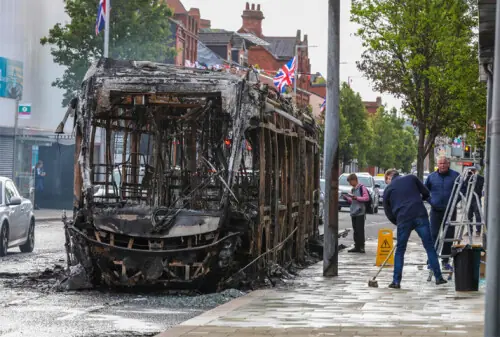
But this road in a run-down suburb of Birmingham, central England, looked more like a war zone last weekend when young Afro-Caribbean and South Asian men clashed in two nights of violence that left two people dead and scores injured.
The unrest hinted at underlying tensions across Britain between immigrant communities from South Asia — such as Pakistan, India and Bangladesh — the Middle East, Africa and increasingly eastern Europe, experts said.
Some white ethnic Britons also resent the growing blend of foreign cultures and languages. They blame the country’s immigrant population for taking jobs and using up public resources.
Such feelings usually stay hidden and communities live together in peace.
But the bloodshed on Birmingham’s Lozells Road — sparked by an unsubstantiated rumour about a gang of South Asians raping a black 14-year-old girl — showed the potential for emotions to boil over.
Khalid Mahmood, the member of parliament (MP) whose constituency covers the Lozells district, blamed opportunistic criminals for the unrest.
He denied any tension between the different ethnic groups, arguing that the clashes would have been much worse if they had been racially motivated.
In contrast, youths on the street, race relations experts and religious leaders feel that political, economic and social frictions are evident and the government must do more to create effective race policies.
The rioting in the Lozells area of Britain’s second largest
city on Saturday night and sporadic bursts of violence 24 hours later sparked media talk of a possible ‘race war’, but Mahmood, an MP in Prime Minister Tony Blair’s governing Labour Party, dismissed such a notion.
“It was purely a criminal issue and the people who were involved are total criminals,” he told AFP.
“If there were underlying (racial) tensions you would not have had a group of just 30 or 40 people. There would have been hundreds more.”
Fierce rioting rocked Lozells and neighbouring Handsworth in September 1985 following the arrest of a black man.
“That was a race riot. This wasn’t,” said Mahmood.
Matthew Burris, 18, who lives locally and whose father comes from Jamaica, was with the crowds on Saturday night and offered a different perspective.
“I was there all the way,” said Burris, who is unemployed.
“It was black verses Asians. Blacks going against Asians, Asians going against blacks after what (allegedly) happened to the 14-year-old girl,” he said, tugging at the black, woolly hat on his head as he ambled down Lozells Road. “I stuck up for my own colour.”
Asked about the mood in the community now, Burris said: “It has calmed down a bit, but you know it is going to kick off again. That is the thing.”
Around the corner, a 35-year-old mechanic from Pakistan, who did not want to give his name, predicted the riot would further divide the ethnic groups.
Asked what he thought was the underlying problem, he accused Afro-Caribbeans of being jealous of South Asians.
“Asians have moved on, they own businesses, they have moved up in the world, they have become MPs, but nothing has changed for the black people,” said the longstanding local resident.
Joy Warmington, chief executive of Birmingham Race Action Partnership, a charitable organization that works to reduce inequality, said poor living conditions, high unemployment and low educational achievement in Birmingham’s inner-city suburbs created a climate for resentment to breed.
“I think tensions have been brewing in Birmingham all over the place not only in relation to Asian and African-Caribbeans but also jointly to newer communities who they perceive to be coming in — Somalians, eastern Europeans — and getting the public resources that they used to have,” she said.—AFP